
Posted on: April 22, 2026 By: VFuture Media Team Category: Artificial Intelligence | Future of Work | Technology
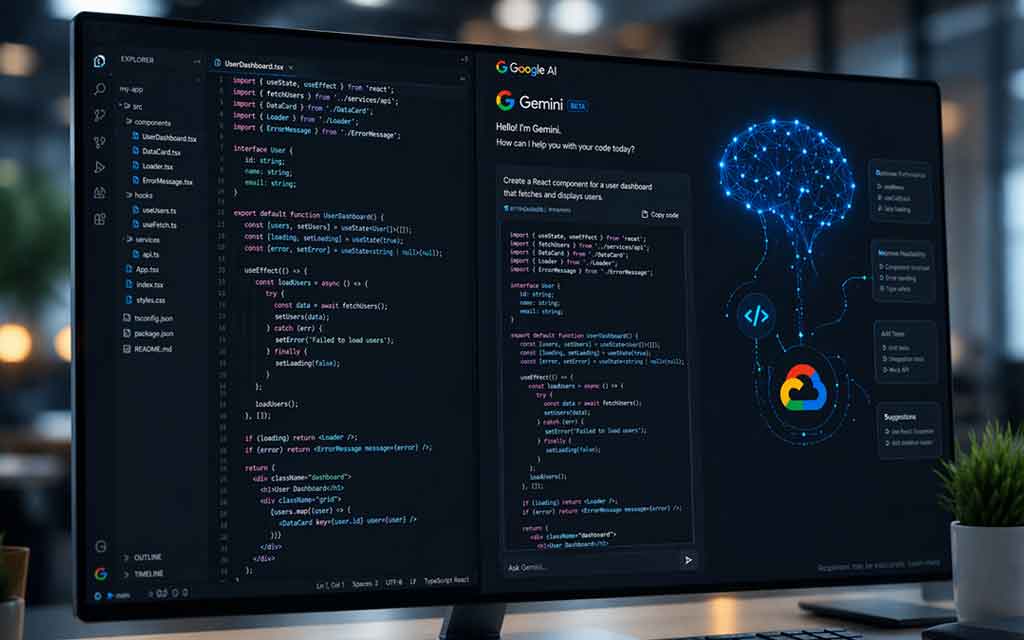
In a stunning update from Google Cloud Next 2026, CEO Sundar Pichai revealed that 75% of all new code written at Google is now AI-generated and then reviewed and approved by human engineers.
This marks a dramatic leap from 50% just last fall and over 25% in late 2024, signaling how quickly generative AI — powered by Google’s own Gemini models — has become central to one of the world’s largest software engineering organizations.
From 25% to 75%: The Rapid Rise of AI Coding at Google
Google’s internal adoption of AI for code generation has accelerated at an impressive pace:
- October 2024: More than 25% of new code was AI-assisted.
- Late 2025: The figure climbed to roughly 50%.
- April 2026: It has now reached 75% of all new code checked into production.
Pichai shared the milestone during the Google Cloud Next 2026 keynote, stating:
“We’ve been using AI to generate code internally at Google for a while. Today, 75% of all new code at Google is now AI-generated and approved by engineers, up from 50% last fall.”
This isn’t about simple autocomplete suggestions. It reflects advanced agentic AI workflows — where AI agents handle complex, multi-step coding tasks, including large-scale code migrations that are reportedly completed up to six times faster than traditional methods.
How Google’s AI Coding Process Actually Works
Google engineers don’t just accept raw AI output. The process follows a clear human-in-the-loop model:
- AI Generation — Gemini models and autonomous coding agents produce the majority of new code.
- Human Review & Approval — Engineers carefully review, refine, and approve every change before it enters the codebase.
- Production Integration — Only code that passes rigorous review contributes to live systems.
This hybrid approach focuses on boosting engineering velocity rather than replacing developers. Pichai has repeatedly emphasized that AI helps teams “do more and move faster with the current footprint,” allowing Google to tackle bigger projects without proportionally increasing headcount.
Key Announcements at Google Cloud Next 2026
The 75% milestone was announced alongside several major developments:
- Launch of the Gemini Agent Platform for building enterprise-grade AI agents.
- Introduction of eighth-generation TPUs to power more efficient AI workloads.
- Strong push toward agentic AI — systems capable of orchestrating complex, long-running tasks autonomously.
Google is positioning itself as “customer zero” for these tools, using them internally before packaging them for Google Cloud customers through offerings like Gemini Code Assist.
What This Means for Developers and Businesses in 2026
For Individual Developers:
- Routine and boilerplate coding will increasingly be handled by AI.
- Focus will shift toward higher-value work: system architecture, problem-solving, code review, and innovation.
- Developers who master prompt engineering, AI agent orchestration, and quality oversight will be in highest demand.
For Companies and CTOs:
- Massive productivity gains are possible, especially in large-scale migrations and maintenance work.
- Organizations can accelerate development cycles while maintaining quality through strong review processes.
- Google Cloud customers will soon access similar agentic coding capabilities, potentially allowing them to approach comparable efficiency levels.
Potential Challenges:
- Ensuring long-term code maintainability and security when AI generates most of the codebase.
- Managing technical debt that could accumulate from rapidly generated code.
- Addressing concerns around over-reliance on AI for critical systems.
The Bigger Picture: AI Is Not Replacing Coders — It’s Redefining the Role
Sundar Pichai and other tech leaders consistently stress that AI augments human capability rather than eliminating it. At Google, engineers remain essential for creativity, strategic decisions, and final accountability.
This 75% milestone serves as a powerful leading indicator for the entire software industry. What Google achieves today with Gemini and agentic workflows will likely become standard practice across enterprises within the next 12–24 months.
Final Thoughts: Welcome to the Agentic Era of Software Development
Google’s announcement that 75% of new code is AI-generated isn’t science fiction — it’s happening right now in 2026. It signals the arrival of the agentic cloud, where AI doesn’t just assist but actively participates as a collaborative teammate in building the digital world.
As AI coding tools mature and become widely available via Google Cloud and competitors, the question for every organization is no longer whether to adopt AI-assisted development, but how quickly and how effectively.
What do you think? Will your team reach 50% or even 75% AI-generated code in the next year? Share your thoughts in the comments below.
Related Articles:
- The Rise of Agentic AI: What Businesses Need to Know in 2026
- How Gemini Is Powering Google’s Internal Transformation
- Future of Work: Will AI Replace Software Engineers?
Tags: AI Coding, Google Cloud Next 2026, Sundar Pichai, Gemini AI, Agentic AI, Software Development, AI Productivity, Future of Coding




Leave a Comment