
By VFuture Media Editorial Team Published: May 1, 2026 | vfuturemedia.com | Future of AI, Space Tech & Orbital Innovation
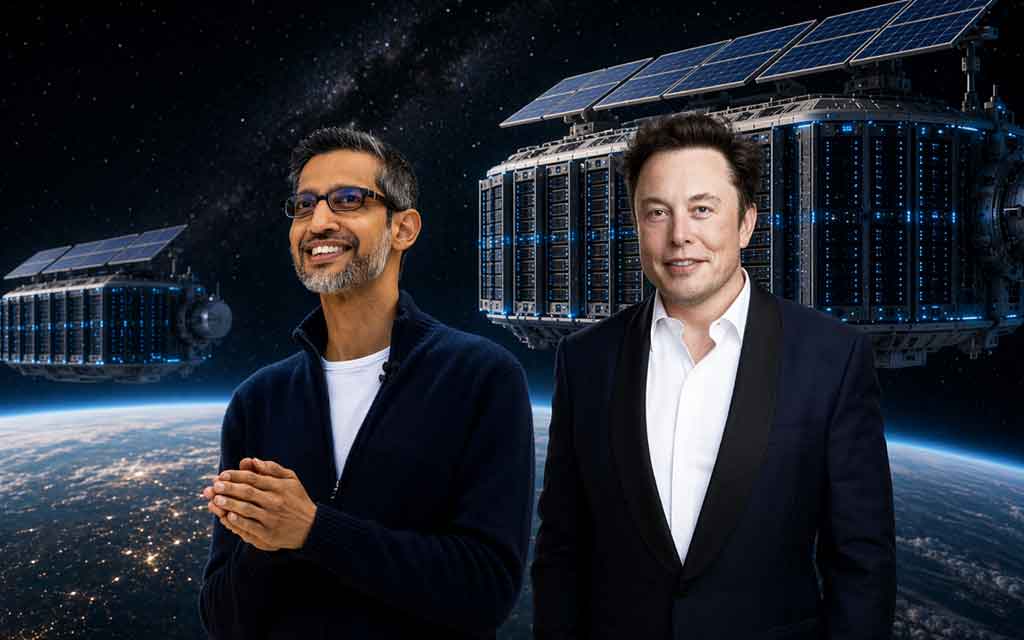
Google CEO Sundar Pichai says data centers in space will become the new normal in a decade as part of Project Suncatcher. Elon Musk, who has championed orbital compute for years via SpaceX, agrees: “True.” Explore the AI energy crisis solution, 2027 test launches, benefits, challenges, and why the orbital compute era is accelerating faster than you think.
Introduction: When Google’s CEO Echoes Elon Musk, the Future Just Got Closer
“Sundar Pichai just said data centers in space will be ‘the new normal’ within a decade. @elonmusk has been saying this for years. When the CEO of Google starts agreeing with Elon, pay attention. The orbital compute era is closer than you think.”
That viral X post by Peter H. Diamandis (executive chairman of XPRIZE) captured the moment perfectly — and Elon Musk replied with one word: “True.”
In a Fox News interview in late 2025, Google CEO Sundar Pichai made headlines by declaring that space-based data centers — powered by constant solar energy in Earth’s orbit — will soon shift from sci-fi to standard practice. Google’s ambitious Project Suncatcher aims to launch the first test satellites as early as early 2027, in partnership with satellite imagery firm Planet. Pichai stated:
“We want to put these data centers in space, closer to the Sun… We will send tiny, tiny racks of machines and have them in satellites, test them out, and then start scaling from there. But there’s no doubt to me that, a decade or so away, we’ll be viewing it as a more normal way to build data centers.”
This isn’t just hype. It’s a direct response to the exploding energy demands of AI. Terrestrial data centers are already straining power grids, consuming vast amounts of electricity and water for cooling. Pichai highlighted the scale: the Sun provides 100 trillion times more energy than we produce on Earth today. Placing compute infrastructure in orbit could unlock that bounty.
Elon Musk has been vocal about this exact idea for years — through SpaceX’s Starlink evolution, Starship reusability, and now direct plans for orbital AI compute. The alignment between the world’s two biggest tech visionaries signals a seismic shift.
At VFuture Media, we track the convergence of AI, space, and sustainable compute. Here’s the complete story: what Pichai and Musk are planning, why it matters for the AI revolution, the massive benefits and real challenges, and what the orbital compute era could look like by the mid-2030s.
Google’s Project Suncatcher: From Moonshot to First Orbital Tests in 2027
Google officially unveiled Project Suncatcher in November 2025 as a long-term research bet under its “moonshots” umbrella (think Waymo-level ambition but for AI infrastructure).
Key details from Pichai and Google’s announcements:
- 2027 timeline: Two prototype satellites launching into low Earth orbit (~400 miles up) with custom AI server chips (TPUs) and tiny racks of compute hardware.
- Solar-powered design: Satellites positioned for near-constant sunlight — no nights, no clouds — to deliver uninterrupted power.
- Partnership: Collaboration with Planet for satellite operations and imagery.
- Goal: Prove hardware can survive radiation, extreme temperatures, and vacuum while delivering reliable AI workloads. Future scaling would use optical inter-satellite links for low-latency data transfer.
Pichai framed it as essential for AI’s next phase: “At Google, we’re always proud of taking moonshots… One of our moonshots is: How do we one day have data centers in space so that we can better harness the energy from the sun.”
This directly addresses the AI power crunch. Hyperscale data centers on Earth already consume gigawatts; training and running frontier models like Gemini or future successors will demand even more.
Elon Musk’s Long-Standing Vision: SpaceX, Starlink, and Orbital AI Compute
Musk hasn’t just talked about this — SpaceX is actively building toward it:
- Starlink evolution: Musk has repeatedly said scaling Starlink V3 satellites with high-speed laser links and radiation-resistant AI chips is the path to orbital data centers. “SpaceX will be doing data centers in space.”
- FCC filing: SpaceX applied for a constellation of up to 1 million satellites dedicated to orbital AI compute, potentially adding massive capacity annually.
- Timeline claims: Musk has predicted space could become the lowest-cost place for AI compute within 2–3 years, thanks to Starship’s reusability slashing launch costs.
- Recent reactions: When Pichai’s comments resurfaced, Musk replied “True” to the viral post. Earlier, he called Google’s idea “Great idea lol” — with Pichai crediting SpaceX’s launch advances.
Musk’s philosophy is clear: “Space is overwhelmingly what matters. If you want something that is 1 million times more energy than Earth could possibly produce, you must go into space.” He sees orbital compute as the next logical step after Earth-based data centers and even lunar factories.
Why Orbital Data Centers? The AI Energy Crisis Demands It
AI training and inference are power-hungry. Global data center electricity demand is projected to surge dramatically by 2030. Earth-side solutions — new nuclear plants, underwater data centers, or efficiency gains — have limits on land, water, and grid capacity.
Core advantages of space-based compute:
- Unlimited solar power: Constant exposure in sun-synchronous or geosynchronous orbits eliminates intermittency.
- Natural cooling: Vacuum allows heat rejection via lightweight radiators into deep space (no air convection needed on Earth).
- Scalability without Earth constraints: No land use, no water for cooling, reduced environmental impact on the ground.
- Low-latency edge for specific workloads: Results beamed back via laser links for sun-synchronous orbits.
Other players are in the race too:
- Startups like Starcloud have already tested NVIDIA H100-class GPUs in orbit.
- Meta is exploring space-based solar beaming to power ground data centers.
- Jeff Bezos and others have echoed similar long-term visions.
Technical Challenges: Not Science Fiction, But Not Easy
Experts and even some insiders acknowledge hurdles (providing E-E-A-T balance):
- Radiation and hardware durability: Cosmic rays can flip bits or degrade chips; radiation-hardened designs add cost and complexity.
- Heat dissipation in vacuum: No air cooling — requires advanced radiators and thermal management.
- Latency and data transfer: Fine for batch AI workloads or edge inference, but not ideal for real-time interactive apps (though laser links help).
- Launch and maintenance costs: Even with Starship, deploying and servicing massive constellations is expensive initially.
- Space debris and regulation: FCC filings and orbital congestion are growing concerns.
- Critics’ view: OpenAI’s Sam Altman has called near-term plans “ridiculous” due to these issues.
Google and SpaceX are tackling these head-on with prototypes. Pichai called it a “research moonshot,” while Musk’s approach leverages existing Starlink infrastructure for organic scaling.
The Broader Implications: A New Era of Orbital Compute
If Pichai’s decade timeline holds, by the mid-2030s we could see:
- Gigawatt-scale AI clusters in orbit.
- Dramatic reduction in Earth’s energy and water footprint for compute.
- New business models: “Compute-as-a-service” beamed from space.
- Acceleration of AI capabilities limited today only by power.
This convergence also strengthens the space economy — more demand for Starship launches, in-orbit assembly, and satellite manufacturing (possibly on the Moon, per Musk’s longer-term ideas).
Environmentally, it could be a net positive: moving power-intensive workloads off-planet frees terrestrial grids for other uses and reduces ground-based emissions.
Conclusion: Pay Attention — The Orbital Compute Era Is Accelerating
When Sundar Pichai and Elon Musk align on data centers in space, it’s not coincidence — it’s convergence. Google’s Project Suncatcher prototypes in 2027 will be the first major test. SpaceX’s constellation plans could make orbital AI compute commercially viable even sooner.
The message is clear: The future of AI won’t be confined to Earth. Unlimited solar power, natural cooling, and Starship-scale reusability are turning what once sounded like science fiction into engineering reality.
At VFuture Media, we’ll continue tracking every launch, prototype, and breakthrough in the orbital compute space. The era of space-based AI infrastructure is no longer “if” — it’s “when.”
What do you think? Will data centers in space become the new normal by 2035? Drop your thoughts in the comments, subscribe for weekly space-tech and AI updates, and follow us on X for real-time insights.



Leave a Comment