
By VFuture Media Team | May 6, 2026
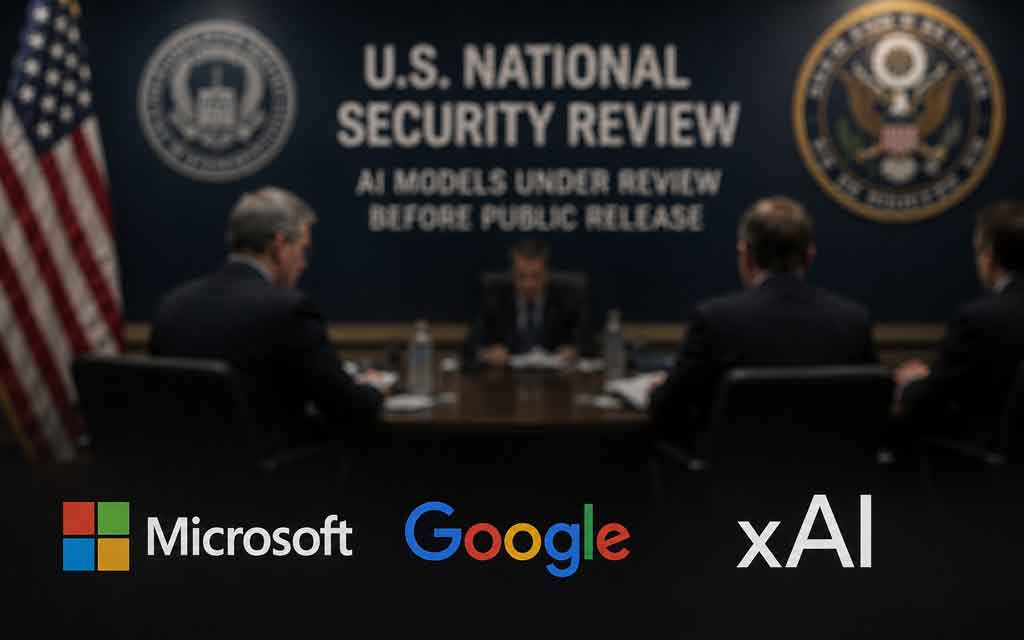
In a landmark move that signals closer collaboration between Big Tech and the U.S. government, Microsoft, Google (DeepMind), and Elon Musk’s xAI have agreed to grant the Trump administration early, pre-release access to their most advanced frontier AI models. The voluntary agreements allow federal experts to test the models for national security risks — including cybersecurity vulnerabilities, biosecurity threats, and chemical weapons-related capabilities — before they reach the public.
The deals were announced on May 5, 2026, by the Department of Commerce’s Center for AI Standards and Innovation (CAISI), part of the National Institute of Standards and Technology (NIST). They expand an existing evaluation program that already includes OpenAI and Anthropic, whose partnerships have been updated to better align with the Trump administration’s AI Action Plan.
What the Agreements Entail
Under the new pacts:
- The companies will share early versions of their unreleased AI models with CAISI scientists.
- Testing will focus on “pre-deployment evaluations and targeted research” to assess frontier AI capabilities and strengthen national security safeguards.
- Reviews include red-teaming scenarios for high-risk behaviors, such as advanced hacking tools or dual-use capabilities in biosecurity and chemical domains.
- Microsoft has committed to building shared datasets and workflows with the government, while Google DeepMind and xAI will provide proprietary models and supporting data.
The program builds on more than 40 prior AI evaluations conducted by CAISI and represents a key pillar of the Trump administration’s strategy to balance rapid AI innovation with responsible oversight.
Why Now? Context and Triggers
The agreements come amid heightened concerns over powerful new AI systems. U.S. officials were particularly alarmed by Anthropic’s recently unveiled Mythos model, which demonstrated exceptional abilities to discover zero-day cybersecurity exploits — capabilities that could be weaponized if released without safeguards.
This voluntary framework fulfills a pledge made in the Trump administration’s July 2025 AI Action Plan, which directed CAISI to lead national security-related AI assessments. While the process remains non-binding and gives the government no legal authority to block releases, it marks the most comprehensive pre-release review system the U.S. has established to date.
Microsoft also announced a parallel agreement with the UK’s AI Security Institute on the same day, underscoring a growing global push for coordinated AI safety testing.
Industry Reactions and Broader Implications
The move has been welcomed by some as a pragmatic step toward protecting critical infrastructure and public safety without heavy-handed regulation. Supporters argue it strengthens America’s competitive edge while mitigating real-world risks.
Critics, however, worry about potential delays in innovation or the risk of government influence over private-sector AI development. Others view it as political insurance for large tech firms seeking continued access to federal contracts and classified systems.
For the AI industry, this represents a new era of structured government-industry partnership:
- Five major frontier labs (OpenAI, Anthropic, Google, Microsoft, xAI) now participate in the program.
- The voluntary nature preserves speed-to-market while creating a standardized safety baseline.
- It could set a precedent for future AI policy under the current administration.
What This Means for the Future of AI in America
By embedding national security reviews into the development cycle of the world’s most powerful AI systems, the Trump administration is signaling that cutting-edge technology must be developed with America’s strategic interests in mind. The agreements position the U.S. as a leader in responsible AI governance while avoiding the more restrictive regulatory approaches seen in the EU.
As frontier models continue to advance at breakneck speed, expect CAISI’s role to grow — potentially shaping everything from enterprise AI adoption to defense applications.
Stay ahead of the AI policy curve. Whether you’re a tech executive, policymaker, or investor, these developments will directly impact how the next generation of AI reaches the market.
Stay ahead of the future with VFuture Media. Follow us for real-time AI policy updates, national security tech analysis, and strategic insights into the intersection of Washington and Silicon Valley.
SEO Keywords Targeted: Microsoft Google xAI Trump AI models early access 2026, Trump administration AI national security reviews, CAISI AI model testing, Google DeepMind Microsoft xAI agreements, AI safety Trump AI Action Plan, frontier AI pre-release evaluation, Mythos model cybersecurity risks.


Leave a Comment