
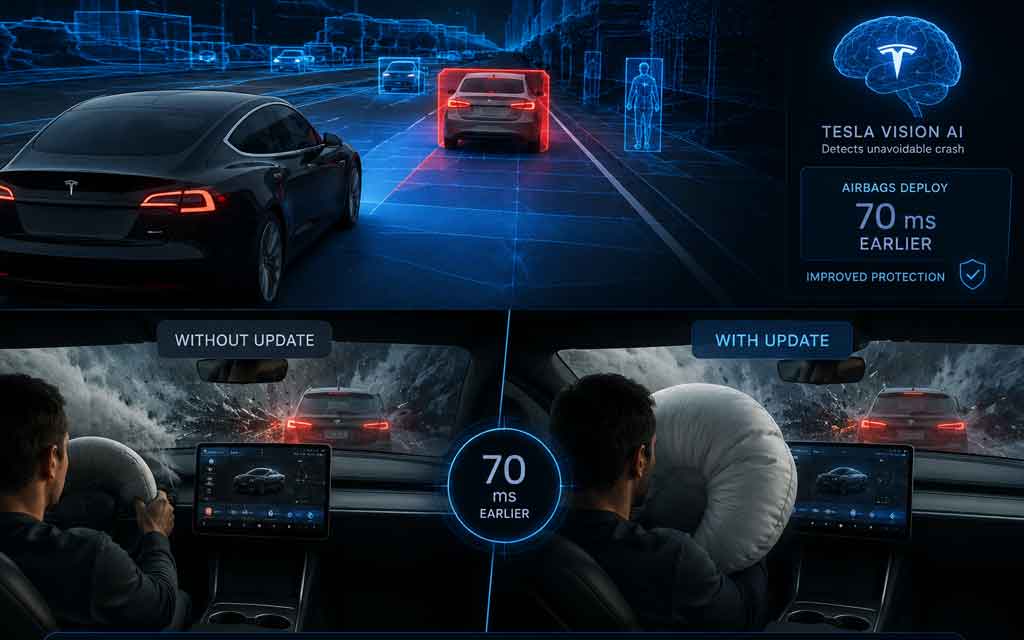
Tesla’s Vision AI now deploys frontal airbags up to 70 milliseconds earlier when detecting unavoidable collisions. Learn how this free OTA update boosts safety for American drivers with top NHTSA ratings and real-world impact.
Tesla has rolled out a major safety enhancement across its U.S. fleet: Tesla Vision can now deploy airbags up to 70 milliseconds earlier when the vehicle detects an unavoidable collision. As Tesla stated, “This can be the difference between serious injury & walking away from a crash.”
This predictive airbag technology is live now via a free over-the-air (OTA) software update for compatible Tesla vehicles in the United States. It represents a significant leap in passive safety for American roads, where traffic fatalities remain a pressing issue.
How Tesla Vision’s Predictive Airbag System Works
Traditional airbag systems activate only after physical impact sensors register a crash. Tesla Vision changes this by using the car’s external cameras and advanced onboard AI to predict a frontal collision fractions of a second before it occurs.
Key details:
- The system analyzes the road ahead in real time.
- When an unavoidable impact is confirmed, it pre-arms and accelerates airbag deployment.
- Airbags can begin inflating up to 70ms earlier than in conventional systems.
- Physical crash sensors still serve as the final trigger, ensuring no false deployments.
This extra time allows airbags to fully inflate and position correctly before the occupant moves forward in the seat — especially critical in high-speed frontal crashes common on U.S. interstates and highways.
Elon Musk highlighted the feature: “Tesla AI Vision deploys airbags before impact, which greatly reduces risk of injury or death. This comes for free on all new cars.”
Why This Matters for American Drivers in 2026
The United States records over 40,000 traffic deaths and millions of injuries each year. Tesla vehicles already demonstrate strong safety performance, with data showing models equipped with advanced driver assistance are significantly safer than the national average.
This new capability is now standard on all 2026 Tesla Model 3, Model Y, Model S, Model X, and Cybertruck vehicles sold in the U.S. Owners of compatible earlier models (primarily 2023 and newer with HW3 or better) receive the update at no cost.
Combined with Tesla’s consistent 5-star NHTSA ratings across all categories, this enhancement strengthens the brand’s leadership in both active and passive safety technologies tailored for U.S. driving conditions.
Real-World Safety Benefits
Even small improvements in airbag timing can deliver meaningful results:
- Reduced head and chest injuries
- Better protection for drivers and passengers of all sizes
- Lower risk of secondary impacts inside the vehicle cabin
Because Tesla builds software-defined vehicles, it can deliver these safety improvements continuously through OTA updates — something traditional automakers struggle to match.
Addressing Safety Questions
Will this cause false airbag deployments? No. Tesla designed the system with multiple layers of redundancy. Vision only pre-charges and speeds up deployment — actual inflation still requires confirmation from physical sensors. The feature fully complies with all U.S. federal safety regulations.
Tesla’s Continued Safety Leadership in the U.S.
This airbag advancement fits into Tesla’s broader commitment to improving vehicle safety over time:
- Industry-leading low injury rates
- Regular free software updates that make cars safer after purchase
- Strong performance in real-world U.S. driving data
As American roads see increasing traffic and evolving mobility needs, technologies like Tesla Vision help bridge the gap between current human-driven vehicles and future autonomous systems.
For Tesla owners in the United States: Check your vehicle’s software update section today. This 70-millisecond advantage could prove lifesaving in an emergency.
Last Updated: May 9, 2026 Author: Ethan Brooks – Covering Tesla, EV safety, autonomous technology, and U.S. automotive innovation for vFutureMedia.




Leave a Comment