
By Ethan Brooks, USA-based tech analyst passionate about American innovation May 18, 2026 – Published on www.vfuturemedia.com
Introduction: American Ingenuity at Its Boldest
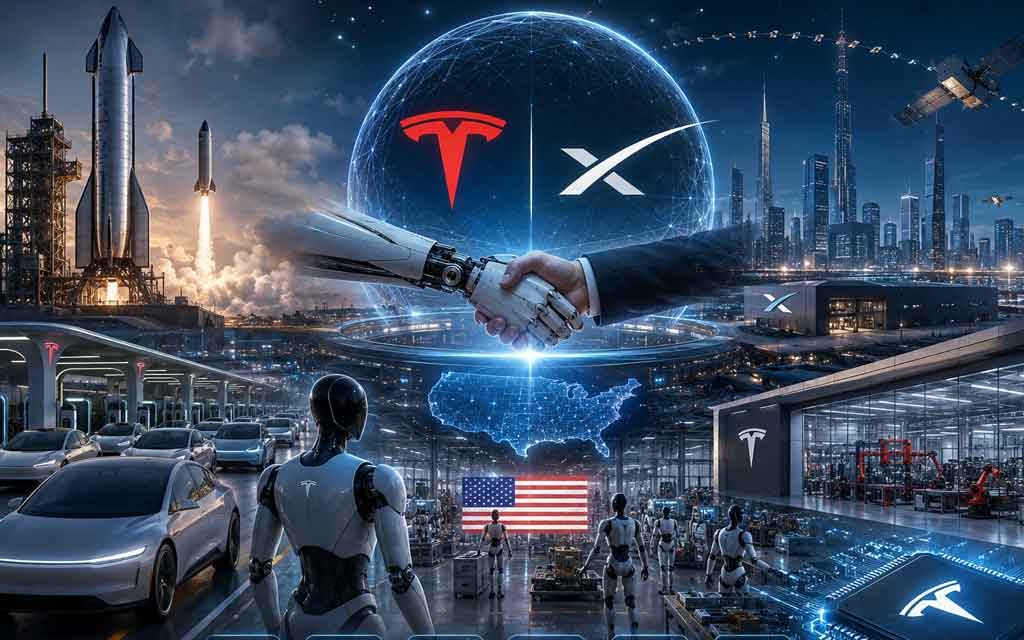
America has always led the world in bold technological leaps—from the Moon landing to the smartphone revolution. Today, two of Elon Musk’s companies, Tesla and SpaceX, stand at the center of the next great leap: merging AI, electric vehicles (EVs), autonomous transport, and space infrastructure into one unstoppable force for American dominance.
As of mid-May 2026, merger rumors between Tesla and SpaceX are heating up. Musk’s biographer Walter Isaacson and analysts like Wedbush’s Dan Ives say a combination is not just possible—it’s likely by 2027, especially after SpaceX’s anticipated IPO. This isn’t just corporate shuffling. It represents a seismic shift that could supercharge U.S. manufacturing jobs, energy independence, AI leadership, and our edge over China.
For everyday Americans in Texas, California, Florida, Michigan, and beyond, this means more high-paying jobs, cheaper clean energy, safer roads, and a future where U.S. innovation keeps us ahead. Let’s break down this week’s developments and what they mean for you.
This Week’s Major Updates: Merger Buzz Intensifies
Merger speculation reached new heights in recent days. Musk’s biographer Walter Isaacson confirmed that combining Tesla and SpaceX aligns with Elon’s long-term vision of building “one big company.” Dan Ives of Wedbush Securities predicts a merger within a year of SpaceX going public, calling it a “70-80% chance.” Betting markets like Kalshi show growing (though still cautious) odds for a deal before mid-2027.
Why now? SpaceX confidentially filed for its IPO in April 2026, targeting a June listing with a potential $1.75–2 trillion valuation—the largest in history. A public SpaceX would give Tesla shareholders clearer access to its rocket, Starlink, and AI synergies. Tesla stock reacted positively to the buzz, climbing on consolidation hopes.
Tesla’s Q1 2026 Earnings: Strong Foundation for Growth
Tesla delivered solid Q1 2026 results that set the stage for bigger things:
- Revenue hit approximately $22.4 billion, up 16% year-over-year.
- Automotive revenue grew similarly, while energy storage showed resilience despite supply constraints.
- Operating income rose sharply, with non-GAAP net income around $1.5 billion.
- Free cash flow remained robust at ~$1.4 billion.
Key highlights for American families and workers:
Robotaxi Progress — Tesla launched unsupervised Robotaxi rides in Dallas and Houston in April, expanding from Austin. Paid Robotaxi miles nearly doubled sequentially. While early rollouts face challenges like wait times, this marks real-world deployment on U.S. roads—creating data that improves safety and efficiency for all drivers.
Energy Storage Wins — Megapack deployments continue, supporting grid stability. With AI data centers demanding massive power, Tesla’s energy business positions America to lead in reliable, clean power without foreign dependence.
Optimus Humanoid Ramp — Preparations for Tesla’s first large-scale Optimus factory begin in Q2 2026 in Fremont (target: 1 million units/year). A second line in Texas aims for 10 million annually. This could revolutionize U.S. manufacturing, handling dangerous or repetitive tasks and freeing American workers for higher-value roles.
Tesla also raised Model Y prices modestly in mid-May—the first increase in two years—signaling strong demand rebound.
The Terafab Project: AI Compute Powerhouse Linking Tesla, SpaceX & xAI
One of the strongest signals of deeper integration is the Terafab initiative. Announced earlier in 2026, this massive AI chip fabrication project in Austin involves Tesla, SpaceX, xAI, and Intel. It aims for over one terawatt of AI compute capacity annually using Intel’s advanced 14A process.
- One factory focuses on chips for Tesla vehicles, Optimus robots, and autonomy.
- Another targets AI data centers, potentially including space-based ones powered by Starlink and Starship.
This $55–119 billion-scale project secures U.S. supply chains for critical AI semiconductors, reducing reliance on Taiwan or China. It creates thousands of high-tech manufacturing jobs in Texas and strengthens America’s position in the global AI race.
SpaceX IPO & Synergies: Rockets Meet Robots & EVs
SpaceX’s upcoming IPO could value it at nearly $2 trillion. Starlink profitability, Starship V3 progress, and xAI integration (acquired earlier) make it a powerhouse. A merger would let Tesla leverage SpaceX’s orbital capabilities for AI compute, global connectivity for Robotaxis, and even future space manufacturing.
Imagine: Optimus robots built with SpaceX-derived materials, Robotaxis coordinated via Starlink, and energy systems supporting both terrestrial and orbital data centers. This vertical integration is pure American muscle—turning separate companies into a unified innovation engine.
Benefits for the American Economy & Everyday Citizens
Job Creation — Tesla and SpaceX already employ tens of thousands of Americans. A combined entity could accelerate hiring in manufacturing (Optimus, Megapack, Cybercab), AI engineering, battery production, and aerospace. Blue-collar and white-collar opportunities across red and blue states.
Energy Independence & Green Tech — Tesla’s energy storage growth helps stabilize the grid for AI and EVs. Reduced oil dependence strengthens national security and lowers costs at the pump for families.
EV & Autonomy Leadership — Wider Robotaxi adoption could slash transportation costs for Americans, improve safety (FSD data shows strong performance), and export U.S. tech globally.
Beating China — Consolidated R&D and manufacturing counter Beijing’s state-backed efforts in EVs, batteries, and AI. This keeps high-value IP and jobs in America.
Investment Opportunity — For retail investors, a merged powerhouse offers exposure to multiple high-growth sectors under one roof.
Challenges & Realistic Outlook
No major move is without hurdles:
- Regulation — Antitrust scrutiny, FAA/NHTSA approvals for autonomy and space.
- Execution Risk — Scaling Robotaxi safely, hitting Optimus timelines, managing massive CapEx (Tesla guided >$25B for 2026).
- Valuation & Shareholder Impact — Tesla holders may demand a premium; integration complexities exist.
- Short-term Volatility — Robotaxi teething issues (wait times, navigation) and energy supply constraints are real but temporary.
Yet history shows Musk’s teams deliver. From reusable rockets to EV mass adoption, skepticism has repeatedly been proven wrong.
Future Outlook to 2027 and Beyond
By late 2026–2027, expect:
- Broader unsupervised Robotaxi fleets in major U.S. cities.
- Optimus in factories and homes.
- Terafab online, powering next-gen AI.
- SpaceX public + potential merger creating a $3+ trillion American titan.
- Starship enabling lunar/Mars infrastructure with Earth-side benefits.
This positions the U.S. as the undisputed leader in the AI-physical world convergence.
Conclusion: Bet on American Innovation
The Tesla-SpaceX merger buzz isn’t hype—it’s the logical next chapter in America’s story of bold exploration and technological supremacy. For families, workers, and investors who believe in U.S. ingenuity, energy freedom, and a thriving future, this is an exciting time.
Stay informed, consider opportunities in American tech leaders, and support policies that prioritize innovation over regulation. The future isn’t coming—it’s being built right here in the USA.
What do you think? Will the merger happen in 2027? Drop your thoughts in the comments and subscribe to vfuturemedia.com for weekly tech roundups.
Author Bio: Ethan Brooks is a USA-based tech analyst with over 15 years covering EVs, AI, and space. Passionate about how innovation creates opportunity for American workers and families. Follow on X @EthanBrooksTech.

Leave a Comment