
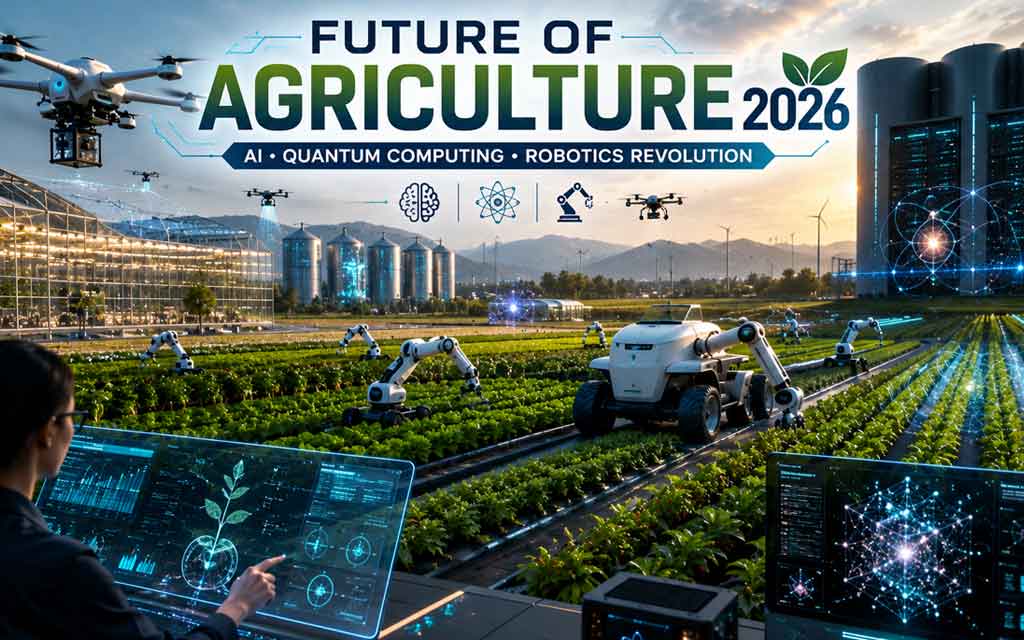
Introduction: The Dawn of Agriculture 4.0
The future of agriculture is being rewritten by the powerful convergence of Artificial Intelligence (AI), quantum computing, and robotics. As the global population heads toward 9.8 billion by 2050, traditional farming methods can no longer meet demand while preserving resources and combating climate change.
For www.vfuturemedia.com readers at the forefront of innovation, this transformation represents one of the most exciting intersections of emerging technologies — turning farms into intelligent, data-driven, autonomous ecosystems. By 2026 and beyond, precision agriculture powered by these tools promises higher yields, lower environmental impact, and resilient food systems.
AI: The Brain Powering Precision Farming
AI has moved from experimental to field-ready in 2026. It now acts as a true decision partner for farmers.
Key Applications in 2026:
- Predictive Analytics & Yield Optimization: AI models analyze satellite imagery, drone data, soil sensors, and weather patterns to forecast yields with remarkable accuracy.
- Crop Health Monitoring: Computer vision and generative AI detect diseases, pests, and nutrient deficiencies days or weeks before visible symptoms appear.
- Smart Irrigation & Resource Management: AI-driven systems optimize water, fertilizer, and pesticide use, potentially reducing inputs by 20–40%.
- Agentic AI: Autonomous AI agents handle complex workflows — from recommending planting schedules to coordinating drone fleets.
The AI in agriculture market is projected to reach approximately $47 billion by 2034, with strong growth already visible in 2026 through conversational tools that explain recommendations in plain language.
Robotics: From Labor Shortage Solution to Autonomous Workforce
Robotics is addressing one of farming’s biggest challenges: labor shortages. In 2026, “Physical AI” — robots with advanced perception and decision-making — is becoming practical and affordable.
Breakthroughs Include:
- Autonomous tractors and harvesters that operate 24/7 with minimal human oversight.
- Robotic weeders and precision sprayers that target individual plants, drastically cutting chemical usage.
- Fruit-picking robots using soft grippers and AI vision for delicate crops like berries and tomatoes.
- Human-in-the-loop automation, where robots handle repetitive tasks while farmers focus on strategy.
These systems thrive in both open fields and controlled environments like vertical farms.
Quantum Computing: The Game-Changing Optimizer
While still emerging, quantum computing is poised to solve agriculture’s most complex optimization problems that classical computers struggle with.
Transformative Quantum Applications:
- Molecular-Level Crop Breeding: Quantum simulations accelerate development of climate-resilient, high-yield, and nutrient-rich crops.
- Optimization of Supply Chains & Resource Allocation: Quantum algorithms find optimal routes, schedules, and resource distributions across vast farm networks.
- Quantum Sensors: Ultra-precise sensors monitor soil conditions, plant stress, and environmental factors at a level impossible with traditional tools.
- Quantum-Enhanced AI: Hybrid quantum-AI systems deliver superior pattern recognition for massive agricultural datasets.
Early pilots in 2026 focus on quantum machine learning for precision farming and sustainable practices. Full-scale impact is expected in the early 2030s, but forward-thinking agribusinesses are already preparing.
The Synergy: AI + Quantum + Robotics in Action
The real magic happens at the intersection:
- AI provides intelligence.
- Robotics delivers physical action.
- Quantum computing handles ultra-complex calculations.
Imagine a smart farm where:
- Drones and ground robots collect real-time data.
- AI analyzes it instantly.
- Quantum systems optimize decisions across thousands of variables (weather, soil variability, market prices).
- Autonomous robots execute planting, tending, and harvesting with pinpoint accuracy.
This convergence supports sustainable agriculture goals — reducing water usage, minimizing chemicals, lowering emissions, and increasing biodiversity.
Challenges and Implementation Roadmap for 2026–2030
Key Hurdles:
- High initial costs (mitigated by financing and ROI-driven models).
- Connectivity issues in rural areas.
- Data privacy and cybersecurity concerns.
- Need for farmer training and change management.
Actionable Steps for Farmers & Agribusinesses:
- Start with accessible AI tools (drones, sensors, basic analytics platforms).
- Pilot robotic solutions for high-labor tasks.
- Partner with research institutions exploring quantum applications.
- Invest in upskilling — courses on AI for agriculture are expanding rapidly.
Investment & Business Opportunities
For innovators and investors following vfuturemedia.com:
- Precision agtech startups.
- Quantum-agriculture solutions.
- Robotics-as-a-Service models.
- Carbon credit platforms powered by verifiable AI/quantum data.
The sector offers strong growth potential amid global food security demands and sustainability mandates.
Conclusion: Feeding the Future Sustainably
The future of agriculture with AI, quantum computing, and robotics is not science fiction — it’s unfolding now in 2026. This technological revolution promises to make farming smarter, more productive, and environmentally responsible than ever before.
At www.vfuturemedia.com, we believe the farms of tomorrow will be intelligent ecosystems where technology works in harmony with nature. Those who embrace these advancements early will lead the next Green Revolution.
The question isn’t whether these technologies will transform agriculture — but who will seize the opportunity first.


Leave a Comment