
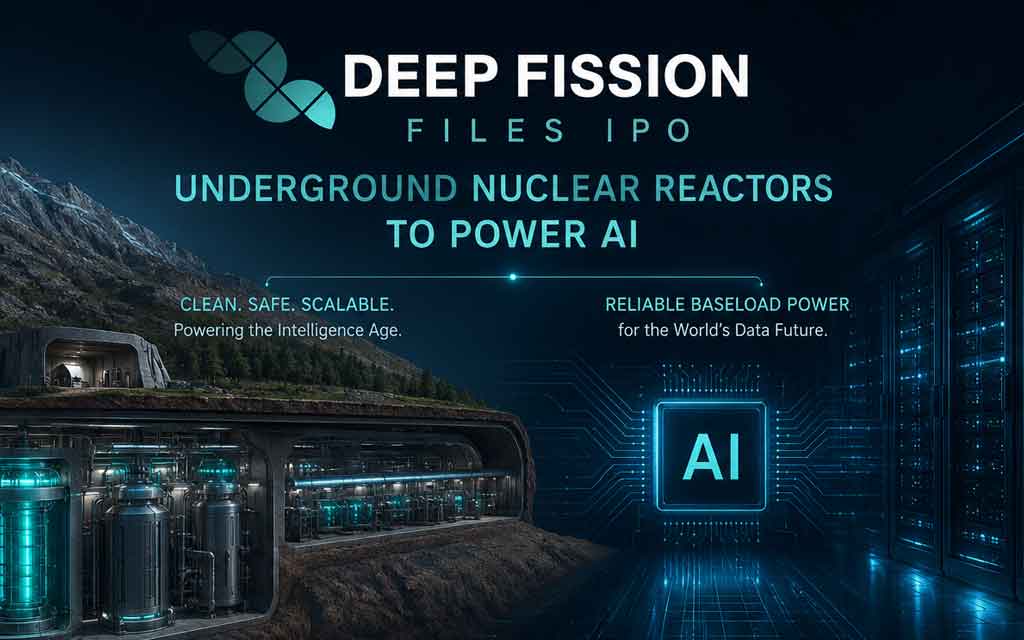
Introduction: Nuclear Innovation Goes Deep for the AI Energy Boom
May 22, 2026 — Deep Fission, a Berkeley, California-based nuclear startup, has filed for an initial public offering (IPO) as it races to deploy small modular reactors one mile underground to meet the surging electricity demand from artificial intelligence data centers.
The company is seeking to raise up to $156 million by offering 6 million shares priced between $24 and $26 each, targeting a valuation of approximately $1.66 billion. This move highlights the intense investor interest in advanced nuclear solutions amid the AI-driven energy crisis.
For www.vfuturemedia.com readers focused on the convergence of AI, energy innovation, and emerging technologies, Deep Fission represents a bold bet on reimagining nuclear power for the 21st century.
Deep Fission’s Revolutionary Approach: The Gravity Reactor
Deep Fission’s flagship technology, the Gravity Nuclear Reactor™, places compact pressurized water reactors (PWRs) deep underground in boreholes approximately one mile (1.6 km) below the surface.
Key Design Advantages:
- 15 MWe per reactor: Each unit can power roughly 10,000 homes or support data center needs.
- Natural Containment: The massive overburden of rock provides passive shielding, pressure (via water column creating ~160 atmospheres), and cooling support.
- Drilling-Based Deployment: Uses proven oil & gas and geothermal drilling techniques, enabling faster, lower-cost construction compared to traditional nuclear plants.
- Safety Focus: Radioactivity stays deep underground. The design leverages off-the-shelf components and low-enriched uranium (LEU) fuel.
- Scalability: Multiple reactors can be stacked or placed in clusters, with minimal surface footprint — ideal for locating near data centers.
This approach could reduce costs by up to 80% compared to conventional nuclear by minimizing expensive surface infrastructure.
Company Background and Progress
Founded in 2023 by father-daughter team Elizabeth (Liz) Muller (CEO) and Richard Muller, Deep Fission builds on nuclear and drilling expertise. Liz previously co-founded Deep Isolation, focused on deep borehole waste storage.
Milestones:
- Selected for the U.S. Department of Energy’s Reactor Pilot Program.
- Broke ground on a pilot site in Parsons, Kansas (Great Plains Industrial Park) in late 2025.
- Began drilling data acquisition wells in early 2026.
- Non-binding letters of intent for up to 15 GWe in its commercial pipeline.
The company aims for first commercial operations in 2027–2028.
Why Now? The AI Energy Demand Driver
Data centers powering AI training and inference are projected to consume enormous amounts of electricity. Traditional power sources struggle to keep pace while meeting carbon reduction goals. Nuclear offers reliable, high-density, low-carbon baseload power — and Deep Fission’s underground model addresses key concerns around safety, waste, proliferation, and public acceptance.
Deep Fission joins a wave of nuclear startups going public to capitalize on this demand, including others targeting small modular reactors (SMRs) for tech giants.
Risks and Challenges
As with any early-stage nuclear venture, Deep Fission faces significant hurdles:
- Regulatory approvals from the NRC.
- Technical execution of deep borehole reactors at scale.
- Public and community acceptance.
- Competition from other SMR developers and alternative energy sources.
The IPO filing includes standard risk disclosures typical for pre-revenue advanced nuclear companies.
Investment and Market Context
Wall Street’s appetite for nuclear remains strong. Deep Fission’s IPO comes as multiple advanced nuclear firms seek public capital to accelerate deployment. Underwriters include William Blair, Stifel, and Canaccord Genuity. The stock is expected to list on Nasdaq under the ticker FISN.
Conclusion: Powering the Future from a Mile Below
Deep Fission’s IPO filing marks a pivotal moment in the quest to solve the AI energy crunch with innovative, underground nuclear technology. By combining proven reactor designs with revolutionary deployment methods, the company aims to deliver safer, cheaper, and faster clean power.
At www.vfuturemedia.com, we see this as a prime example of how bold engineering at the intersection of nuclear, drilling tech, and AI demand could reshape the global energy landscape. If successful, Deep Fission’s Gravity Reactors could become a cornerstone of sustainable data center power and broader decarbonization efforts.
The underground nuclear revolution is just beginning — and it’s going deep


Leave a Comment