
Introduction: A Historic Papal Response to the AI Revolution
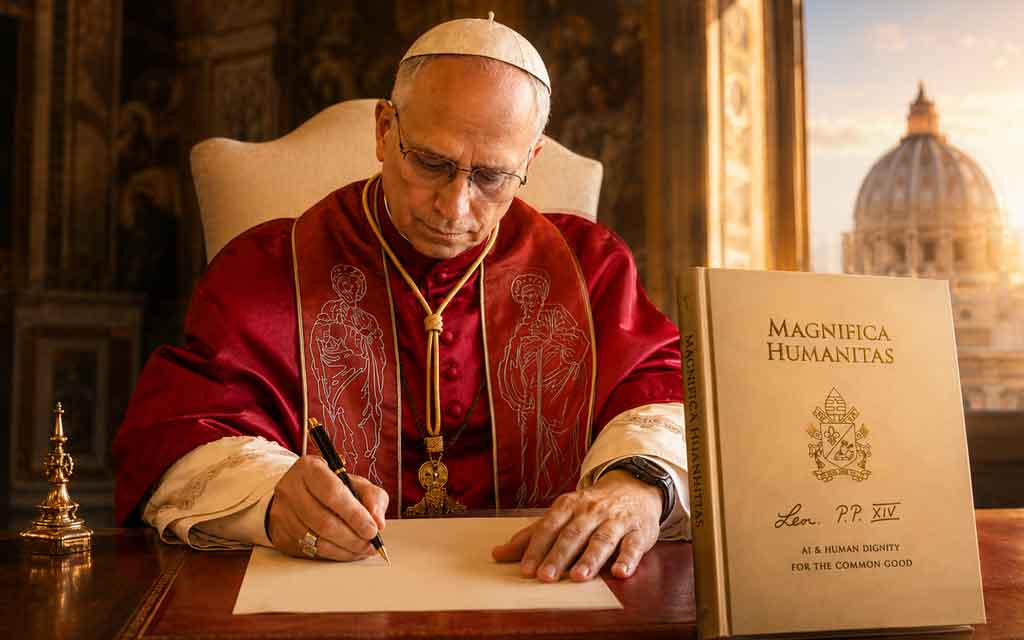
May 22, 2026 — Pope Leo XIV has announced he will publish his first encyclical, titled Magnifica Humanitas (“Magnificent Humanity”), on May 25, 2026. The document focuses on the protection of human dignity in the age of artificial intelligence.
This landmark teaching document comes as AI rapidly transforms society, raising profound ethical, spiritual, and social questions. For www.vfuturemedia.com readers exploring the intersection of emerging technologies, faith, and humanity, this encyclical represents a major moment where the world’s oldest moral institution engages directly with the defining technology of our era.
Background: Why an Encyclical on AI?
Pope Leo XIV, the first American pope (born Robert Francis Prevost in Chicago), signed the encyclical on May 15, 2026 — exactly 135 years after Pope Leo XIII issued Rerum Novarum, the groundbreaking social encyclical addressing the Industrial Revolution.
By choosing this symbolic date, Pope Leo XIV draws a clear parallel: just as the Church responded to the upheavals of industrialization in the 19th century, it now confronts the “anthropological crisis” posed by AI in the 21st century.
The encyclical is expected to address:
- Protection of human dignity
- Ethical use of AI
- Impact on work, relationships, and creativity
- Risks of dehumanization and loss of human agency
Key Details of the Announcement
The Vatican revealed that Pope Leo XIV will personally present Magnifica Humanitas on May 25 in the Synod Hall. The event will include participation from cardinals, theologians, and notably Christopher Olah, co-founder of Anthropic, highlighting an unusual bridge between the Church and the AI industry.
This collaborative presentation underscores the Pope’s desire for dialogue rather than confrontation with tech leaders.
What to Expect in Magnifica Humanitas
While the full text will be released on May 25, early indications suggest the encyclical will:
- Warn against AI systems that diminish human intellect, creativity, and interpersonal relationships.
- Affirm the unique dignity of every person created in the image of God.
- Call for ethical guidelines rooted in Catholic social teaching — emphasizing justice, the common good, and care for the vulnerable.
- Address challenges like job displacement, algorithmic bias, data privacy, and the potential for AI to exacerbate inequality.
- Explore positive possibilities: AI as a tool for human flourishing when guided by moral principles.
The title Magnifica Humanitas celebrates the wonder of humanity even as it urges protection of what makes us uniquely human.
Significance for Technology and Society
This is not the Catholic Church’s first engagement with AI, but it marks the highest-level, most comprehensive response yet from the papacy. Pope Leo XIV has previously spoken about AI as part of a new “industrial revolution” that demands careful stewardship.
Why This Matters for vfuturemedia.com Readers:
- Ethical AI Development: The encyclical could influence global policy discussions, corporate practices, and public opinion on responsible innovation.
- Faith-Tech Intersection: It bridges spirituality and cutting-edge technology, relevant for leaders in AI, robotics, quantum computing, and beyond.
- Global Impact: With over 1.4 billion Catholics worldwide, this document will shape conversations in education, healthcare, governance, and daily life.
The involvement of Anthropic’s co-founder signals openness to collaboration with innovators committed to safe and beneficial AI.
Historical Context and Broader Implications
Encyclicals are among the most authoritative teachings in the Catholic Church. Previous social encyclicals have influenced labor laws, human rights, and environmental policy. Magnifica Humanitas is positioned to do the same for the AI age.
In a world racing toward artificial general intelligence, quantum-enhanced systems, and autonomous technologies, the Church’s voice adds a crucial moral dimension focused on human dignity over pure efficiency or profit.
Conclusion: A Call for Human-Centered Innovation
Pope Leo XIV’s upcoming encyclical arrives at a critical juncture. As AI reshapes economies, cultures, and even our understanding of what it means to be human, Magnifica Humanitas promises thoughtful guidance grounded in centuries of wisdom.
At www.vfuturemedia.com, we see this as a vital contribution to the conversation on technology’s future. True progress must enhance, not erode, our shared humanity.
Stay tuned for full coverage and analysis after the May 25 release



Leave a Comment