
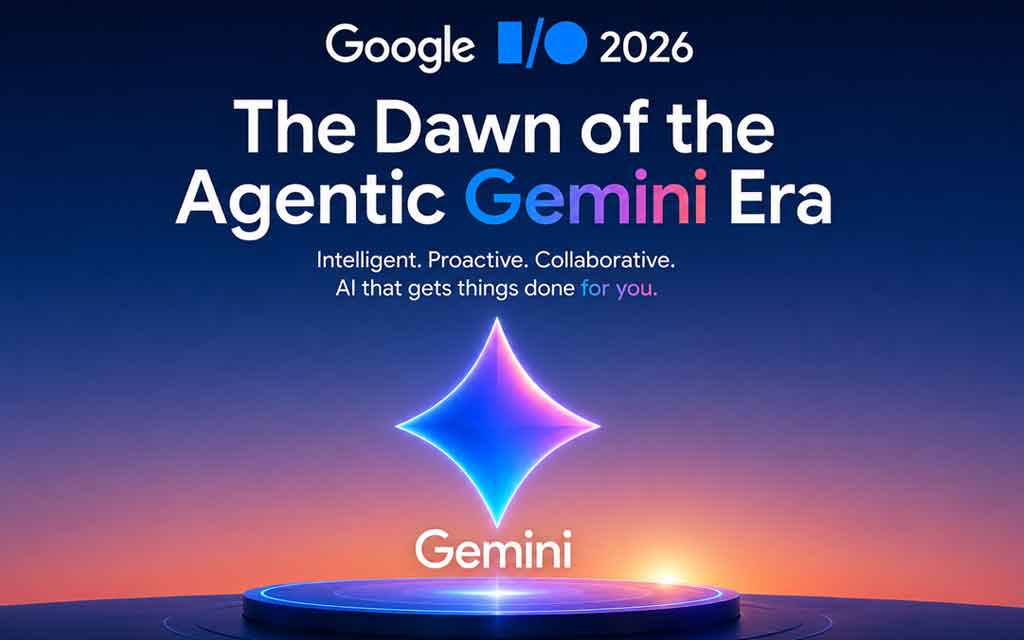
This week, Google I/O 2026 emerged as the defining tech event of the year, officially launching what many are calling the Agentic Gemini Era. The conference wasn’t just another product showcase — it represented a fundamental shift from conversational AI to autonomous, goal-oriented agentic AI systems that can plan, reason, act across tools, and deliver real-world results with minimal human supervision.
For readers searching for “Google I/O 2026 recap,” “Gemini 3.5 agentic AI,” or “latest AI news May 2026,” this comprehensive analysis covers every major announcement, technical details, business implications, developer opportunities, consumer benefits, and future outlook.
The Big Picture: Why Agentic AI Matters in 2026
Traditional generative AI (like early ChatGPT or Gemini versions) excelled at creating content and answering questions. Agentic AI goes further — these systems pursue complex, multi-step goals autonomously. They break down tasks, use tools, handle long-horizon planning, adapt to new information, and execute actions like booking reservations, coding features, or managing workflows.
Google CEO Sundar Pichai opened the keynote by declaring: “We are entering the agentic Gemini era.” This builds on 2025’s foundation (Gemini 2.5 series, Project Mariner, Jules coding agent) but scales dramatically with new models, orchestration tools, and deep product integrations.
The timing is perfect. As AI energy demands surge and businesses seek ROI beyond chat interfaces, agentic systems promise 40-70% productivity gains in coding, operations, research, and personal productivity. Google positioned itself as the leader in making agents practical, safe, and accessible to everyone — from individual users to enterprises.
Core Model Announcements: Gemini 3.5 Series
Gemini 3.5 Flash stole the show as the first release in the new family. Engineered for agentic workflows, it delivers frontier-level intelligence at Flash-series speed and cost efficiency.
Key capabilities include:
- Superior Reasoning & Coding: Tops benchmarks in Terminal-Bench (76.2%), GDPval-AA, and MCP Atlas. It handles complex, long-horizon tasks better than previous Pro models.
- Multimodal Mastery: Processes text, images, audio, and video with a 1-million-token context window.
- Speed & Efficiency: Up to 4x faster output than rival frontier models at roughly half the cost — ideal for real-time agents.
- Deep Think Mode: Enhanced reasoning that considers multiple hypotheses before responding, especially powerful for math, coding, and strategic planning.
Gemini 3.5 Pro is in testing and expected next month, promising even higher performance for enterprise use cases.
Gemini Omni extends the family into advanced multimodal creation and editing. Early demos showed impressive video generation and editing via natural language prompts — turning everyday clips into stylized masterpieces with realistic physics.
Gemini Spark introduces personal AI agents that work proactively across Google apps (Gmail, Calendar, Photos, Drive). It delivers daily briefs summarizing your inbox, tasks, and schedule while suggesting actions.
These models form the intelligence layer for the entire agentic ecosystem.
Antigravity 2.0: The Orchestration Engine
One of the most developer-focused announcements was Antigravity 2.0 — Google’s framework for building and orchestrating AI agents. It simplifies creating multi-agent systems where specialized agents collaborate (e.g., one researches, another analyzes data, a third executes purchases).
Features:
- Managed execution environments in the cloud.
- Support for Model Context Protocol (MCP) for seamless tool integration.
- Agent-to-Agent (A2A) communication protocols.
- Built-in safety, monitoring, and auditing tools.
This lowers the barrier for businesses to deploy custom agents without massive engineering overhead.
Agentic Search: Search That Acts
Google Search is transforming into an intelligent agent. AI Mode now supports complex, multi-step tasks:
- Plan trips with real-time monitoring.
- Compare products and create custom dashboards.
- Execute agentic shopping (track prices, buy when criteria met using Google Pay).
- Generate dynamic UIs and visualizations on the fly.
Project Mariner’s web-interaction capabilities are being rolled out progressively into Search, Chrome, and the Gemini app. Users can delegate tasks like apartment hunting or event booking, with the agent navigating sites autonomously.
Developer & Enterprise Tools
- Jules Evolution: The asynchronous coding agent is more powerful, handling larger repositories and complex refactors.
- Gemini in Android Studio: New agentic Journeys for end-to-end testing and version upgrades.
- Vertex AI Enhancements: Deeper agent support with thought summaries for transparency and security improvements.
Google Cloud is pushing hard into agent platforms, making it easier for enterprises to build secure, scalable agents.
Consumer Experience: Proactive & Personal
In the Gemini app, agents become everyday companions:
- Daily Brief with personalized insights.
- Proactive suggestions (e.g., “Based on your calendar, book a ride now?”).
- Seamless integration across devices, including upcoming Android XR glasses.
Privacy controls remain central, with on-device processing options and clear user consent for agent actions.
Technical Deep Dive: How Agentic Systems Work
Agentic AI typically involves:
- Planning: Breaking goals into steps using chain-of-thought and tree-of-thought reasoning.
- Tool Use: Calling APIs, browsing web, controlling interfaces via computer use features.
- Memory & State: Long-term context retention across sessions.
- Reflection & Adaptation: Self-correction when plans fail.
- Multi-Agent Collaboration: Specialized agents handing off subtasks.
Google’s stack (Gemini 3.5 + Antigravity + MCP) excels here, combining strong reasoning with reliable execution. Benchmarks show it leading in real-world agentic scenarios like software engineering and data analysis.
Business & Economic Implications
Analysts predict the agentic AI market will explode from single-digit billions today to over $50 billion by 2030. Early adopters in software development, customer service, e-commerce, and operations will see massive efficiency gains.
Challenges:
- Reliability & Hallucinations: Agents acting autonomously need robust guardrails.
- Energy Consumption: Training and running frontier agents is power-intensive.
- Regulation & Ethics: Data privacy, accountability for agent actions, and job displacement concerns.
- Security: Preventing prompt injection or malicious agent behaviors.
Google addresses many of these with built-in safety layers, thought transparency, and enterprise controls.
Competitive Landscape
While Google leads in distribution (Search, Android, Workspace), competitors are strong:
- OpenAI continues advancing GPT-5.5 agent capabilities.
- Anthropic focuses on safe, constitutional agents with Claude models.
- Microsoft integrates deeply into enterprise workflows.
Google’s advantage lies in its vast data, product ecosystem, and developer tools — making agents feel native rather than bolted-on.
Future Roadmap: What’s Next After I/O 2026?
Expect rapid iteration:
- Wider rollout of agentic features this summer.
- More multimodal agents (video, AR integration).
- On-device agents for privacy-sensitive tasks.
- Industry-specific solutions (healthcare, finance, education).
By 2027, many knowledge workers may have multiple AI agents handling routine and complex tasks, freeing humans for creative and strategic work.
How to Get Started Today
For Individuals:
- Try Gemini app with Agent Mode.
- Experiment with new Search AI features.
- Subscribe to Google AI Pro/Ultra for early access.
For Developers:
- Explore Gemini API and Antigravity.
- Build with Jules for coding projects.
- Join Google AI Studio for rapid prototyping.
For Businesses:
- Assess use cases in operations and customer support.
- Pilot agents on Vertex AI.
- Train teams on prompt engineering for agents.
Conclusion: A Transformative Week for AI
Google I/O 2026 wasn’t just an event — it marked the transition to practical, widespread agentic AI. With Gemini 3.5, Antigravity, enhanced Search, and proactive personal agents, Google delivered a compelling vision backed by immediate availability and developer tools.
The agentic future is no longer science fiction. It’s here, and it’s powered by Gemini.
This shift will redefine how we work, create, and live. At vFutureMedia.com, we’ll continue tracking these developments closely.
What excites (or concerns) you most about agentic AI? Share in the comments below. Subscribe for weekly AI roundups and in-depth analyses.




Leave a Comment