
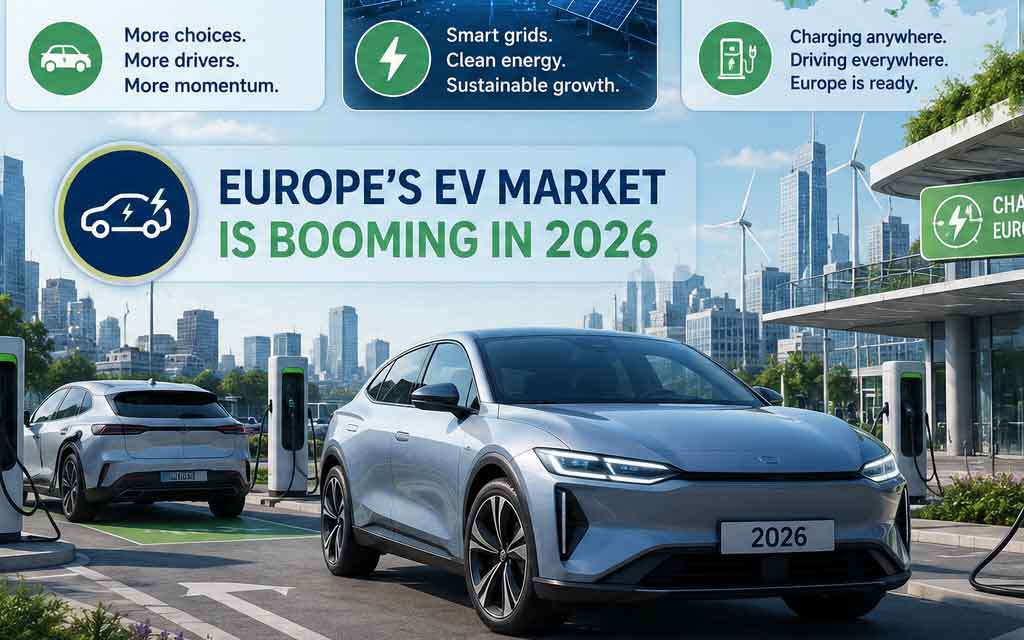
This week, the electric vehicle (EV) sector demonstrated robust momentum worldwide, with Europe emerging as a key region of steady growth despite policy shifts and trade tensions. As AI data centers drive unprecedented energy demand, investments in battery technology and renewable integration are accelerating the EV transition. For readers searching for “EV market Europe 2026,” “affordable EV batteries 2026,” “European EV adoption by country,” or “green tech news May 2026,” here is a comprehensive 2600+ word analysis with expanded focus on Europe.
The Global EV Landscape in May 2026
Global EV sales are projected to exceed 18-22 million units in 2026, accounting for around 25% of total vehicle sales. The surge is fueled by cheaper batteries, Chinese manufacturing scale, and the need for energy storage solutions linked to AI infrastructure growth. While China leads in volume, Europe stands out for policy-driven adoption and innovation in sustainable mobility.
Europe’s EV Market: Strong Rebound and Country-Level Variations
Europe has seen a significant rebound in Q1 2026, with EV sales up approximately 26% year-on-year. Every fifth new car sold across the continent is now electric. While Nordic countries dominate in market share, larger economies like Germany, France, and the UK lead in absolute volumes.
Germany — Europe’s largest EV market: In 2025, electric car sales reached a record 850,000 units (around 30% market share). In Q1 2026, Germany registered 159,630 BEVs, up 41% year-on-year. Recovery is driven by company car tax incentives, more affordable models, and a growing network of over 100,000 public chargers. Cities like Berlin and Munich lead deployment.
France: Battery electric sales rose nearly 15% in 2025 and continued strong into 2026 (112,083 BEVs in Q1, +50%). Market share hovers around 25-28%. Government incentives, though adjusted, combined with urban low-emission zones, support growth. France focuses on domestic manufacturing and battery production.
United Kingdom: EV sales increased over 25% in 2025, with more than 1 in 3 new cars electric in early 2026. Q1 2026 saw 137,614 EVs sold. The ZEV mandate and expanding charging infrastructure (over 119,000 points) drive progress. Tesla Model Y remains a top seller.
Norway — World leader in EV penetration: Nearly 97-98% of new car sales in 2025-2026 are electric. Strong tax exemptions, free tolls, and bus lane access make EVs the default choice. Norway’s success serves as a blueprint for full electrification.
Netherlands: Consistent performer with 31-54% combined EV/PHEV shares. High urban density, excellent cycling + charging infrastructure, and progressive policies support adoption. Amsterdam and Rotterdam lead in fleet electrification.
Nordic Leaders (Sweden, Denmark, Finland): Denmark reached 66-81% shares, Sweden around 36-60%, and Finland 41-50%. These countries combine high incentives, renewable energy grids, and cold-climate battery innovations.
Southern & Eastern Europe:
- Italy: Strong growth (+65% in 2025) thanks to new incentive programs offering up to €20,000.
- Spain: +80% growth with extended MOVES III subsidies (€400 million boost).
- Poland: Explosive +125% increase via major zero-emission funding.
- Belgium: Over 34% BEV share, benefiting from corporate incentives.
This diversity shows Europe’s EV market is not monolithic — Northern and Western countries focus on high penetration, while Southern and Eastern nations emphasize rapid catch-up through subsidies.
Affordable Battery Technology Driving European Growth
Battery advancements are central to Europe’s strategy for affordable, practical EVs:
- LFP Batteries: Now dominant (over 60% of production) due to lower costs ($65-85/kWh), safety, and longevity. European manufacturers partner with CATL and others.
- Sodium-Ion & Next-Gen Chemistries: Promising for budget models under €25,000.
- Fast Charging: Prototypes achieving 10-80% in 6-10 minutes.
- Local Production: Europe is boosting domestic gigafactories to reduce reliance on Asia amid tariffs.
Used EV prices dropped 15-25% across major markets, boosting accessibility in Germany, France, and the UK.
China’s Role & Trade Dynamics in Europe
Chinese EV exports continue growing into Europe despite tariffs (7.8-35.3% depending on manufacturer). Brands adapt via local assembly (e.g., in Spain) and competitive pricing. This pressure accelerates European innovation while offering affordable options to consumers.
AI + Green Tech + EV Synergy in Europe
AI data centers’ energy demands are prompting massive renewable + battery storage investments. Vehicle-to-Grid (V2G) technology is advancing in Germany, Netherlands, and Nordic countries, turning EVs into grid assets. AI optimizes charging networks and predicts battery health.
Battery Technology Comparison (2026)
LFP (Lithium Iron Phosphate)
- Cost/kWh: $65–85
- Energy Density: Medium
- Lifespan: 3000+ cycles
- Key European Use: Mass-market EVs in countries like Germany and France
NMC (Nickel Manganese Cobalt)
- Cost/kWh: $95–120
- Energy Density: High
- Lifespan: 1500–2500 cycles
- Key European Use: Premium electric vehicles in Sweden and Norway
Sodium-Ion
- Cost/kWh: $45–65
- Energy Density: Lower
- Lifespan: 4000+ cycles
- Key European Use: Budget EVs and stationary energy storage systems across Europe
Investment & Economic Implications for Europe
Europe’s EV market offers opportunities in:
- Battery recycling and materials recovery.
- Charging infrastructure (targeting millions of points).
- Domestic manufacturing revival.
- Green tech funds targeting AI-energy-EV convergence.
Challenges include grid upgrades, raw material sourcing, and balancing tariffs with consumer affordability.
Consumer Perspective Across Europe
Total cost of ownership favors EVs in high-incentive countries like Norway and Denmark. In Germany and France, falling prices and better models make switching attractive. Test drives and home solar + EV packages yield maximum savings.
Environmental Impact
Europe’s greener grids (especially Nordics) amplify EVs’ carbon reduction. Battery second-life applications and high recycling rates strengthen circular economy goals.
Future Outlook: 2026-2030 in Europe
- Price parity expected by 2027-2028.
- Solid-state batteries in premium segments.
- Widespread V2G and smart charging.
- Full electrification targets in multiple countries.
Conclusion
In May 2026, Europe’s EV market is accelerating with strong performances in Germany, France, UK, Norway, Netherlands, and fast-growing Southern/Eastern nations. Affordable batteries, policy support, and AI-driven energy needs create a powerful tailwind for sustainable mobility. The continent’s varied adoption patterns highlight both challenges and opportunities.
At vFutureMedia.com, we track these trends to help you navigate the future of transport and green tech.
What’s your view on Europe’s EV progress? Which country’s approach impresses you most? Share below!

Leave a Comment