
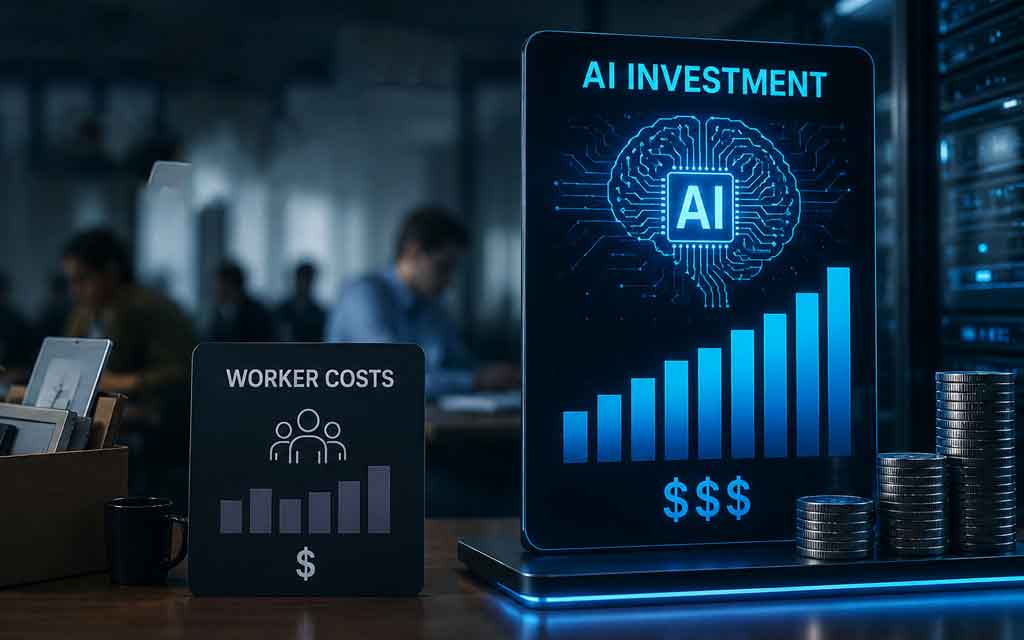
A new Forbes analysis shows that many companies are now spending more on AI systems than on the human workers those systems have replaced. Here’s what the data reveals and what it means for businesses and employees.
A recent Forbes analysis has highlighted a striking trend: companies are investing more money in artificial intelligence than the cost of the workers those AI systems are displacing. This shift marks a significant change in how businesses approach automation and productivity.
Key Findings from the Forbes Analysis
According to the report, many organizations are allocating larger budgets to AI tools, infrastructure, and implementation than the total compensation previously paid to the roles now being automated or augmented by AI.
Notable points include:
- In several sectors, AI-related spending (including software, hardware, training, and integration) now exceeds the annual salaries of the positions being reduced.
- Companies are treating AI as a capital investment rather than just a cost-cutting measure.
- The trend is especially visible in customer service, software development, data analysis, and administrative functions.
This suggests that businesses are no longer viewing AI primarily as a way to reduce headcount costs, but rather as a strategic investment expected to deliver long-term returns.
Why Companies Are Spending More on AI
Several factors are driving this shift:
- Higher Upfront Costs Implementing AI often requires significant investment in technology, data infrastructure, model training, and employee upskilling — costs that can exceed the salaries of replaced workers in the short term.
- Long-Term Productivity Gains Companies expect AI to deliver compounding benefits, such as 24/7 operation, faster processing, and scalability that human workers cannot match.
- New Capabilities AI is not just replacing tasks — it’s enabling entirely new functions (such as advanced data analysis, personalized customer experiences, and automated decision-making) that were previously impossible or too expensive.
- Competitive Pressure Businesses feel they must invest heavily in AI to stay relevant, even if the immediate ROI on labor savings is lower than expected.
Impact on Workers and the Job Market
While AI is displacing certain roles, the Forbes analysis also points to a more nuanced reality:
AI’s Impact on Workers
Job Displacement
- Impact: Moderate to high in specific roles
- Details: Routine, repetitive, and rule-based tasks are most vulnerable to AI-driven automation.
New Job Creation
- Impact: Growing opportunities in AI-related fields
- Details: Rising demand for roles in AI oversight, prompt engineering, data labeling, AI operations, and system maintenance.
Wage Pressure
- Impact: Mixed across industries
- Details: Some occupations may experience wage stagnation, while high-skill AI professionals continue to command premium salaries.
Reskilling Demand
- Impact: High
- Details: Continuous upskilling and reskilling are becoming essential for workers to remain competitive in an AI-driven job market.
The analysis suggests that while some jobs are disappearing, the overall cost of AI implementation means companies are not necessarily seeing massive short-term savings from layoffs alone.
What This Means for Businesses
The trend has several important implications:
- AI as a Capital Expense: Companies are increasingly budgeting for AI the same way they budget for machinery or infrastructure — with expectations of multi-year returns.
- Slower ROI: Because AI spending often exceeds immediate labor savings, many organizations are taking a longer-term view of their investments.
- Focus on Augmentation: Rather than pure replacement, many companies are using AI to make existing employees more productive.
- Talent Strategy Shift: There is growing demand for workers who can work alongside AI systems rather than compete with them.
The Bigger Picture
This Forbes finding challenges the common narrative that AI is primarily being adopted to cut labor costs. Instead, it shows that AI is becoming a major line item in corporate budgets — sometimes more expensive than the human labor it partially replaces.
For employees, this means job security increasingly depends on adaptability and the ability to leverage AI tools rather than perform tasks that can be easily automated.
For businesses, the message is clear: successful AI adoption requires viewing it as a strategic investment, not just a cost-reduction tactic. Companies that treat AI purely as a headcount replacement tool may struggle to see meaningful returns.
Final Thoughts
The Forbes analysis reveals that the economics of AI are more complex than simple labor replacement. While AI is undoubtedly changing the nature of work, many companies are discovering that implementing it effectively requires substantial investment — often more than the cost of the workers it displaces.
As AI capabilities continue to advance, this trend is likely to intensify, forcing both businesses and workers to rethink traditional approaches to productivity and employment.




Leave a Comment