
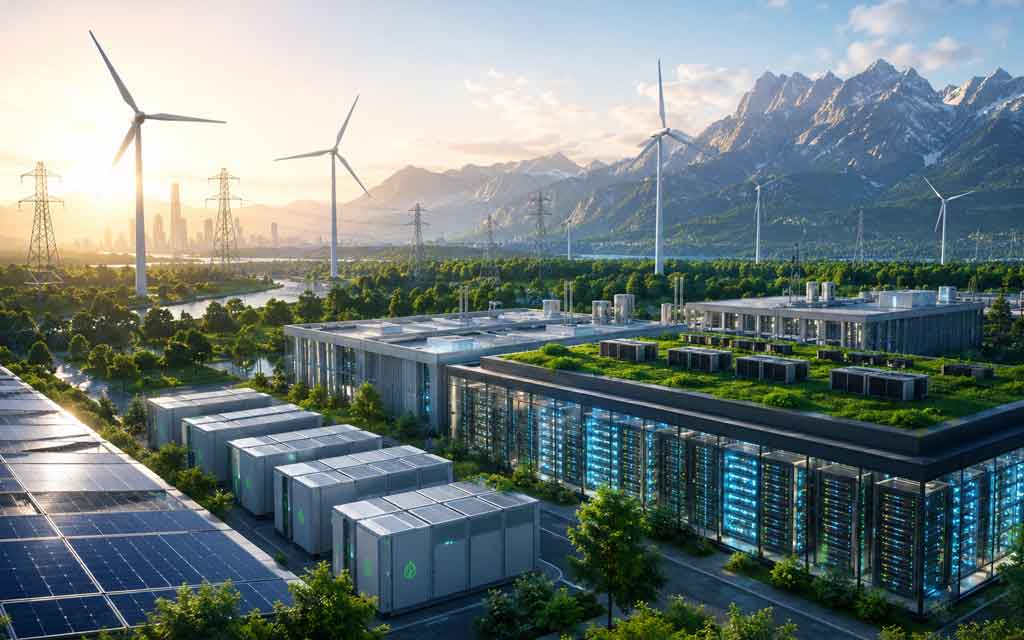
This week, the massive energy appetite of AI data centers has once again taken center stage, accelerating investments in green technology, renewable energy, and advanced battery storage. As AI models like Gemini 3.5 and GPT-5.5 become more powerful and agentic, their infrastructure needs are reshaping the global energy landscape. For readers searching for “AI data centers energy demand 2026,” “green tech news May 2026,” “AI renewable energy investment,” or “data center sustainability Europe,” here is a comprehensive 2600+ word analysis covering the current situation, technological solutions, European developments, investment opportunities, challenges, and future outlook.
The Explosive Energy Demand of AI in 2026
AI training and inference are power-hungry. A single large language model training run can consume electricity equivalent to hundreds of households for years. With the rapid rollout of agentic AI systems — which run continuously, use tools, and maintain long contexts — energy consumption has skyrocketed.
Key facts from this week:
- Global data center electricity demand is projected to double between 2025 and 2027, with AI responsible for over 60% of the growth.
- A single hyperscale AI data center can consume as much power as a mid-sized city.
- By 2026, AI could account for 4-8% of total global electricity consumption, according to recent industry estimates.
This surge is creating unprecedented demand for clean, reliable, and scalable energy solutions — directly fueling the green tech boom.
Why AI Data Centers Need Green Tech
Traditional fossil-fuel-based power is no longer viable due to environmental regulations, corporate sustainability pledges, and rising costs. Tech giants (Google, Microsoft, Amazon, Meta, OpenAI) have committed to 24/7 carbon-free energy. This has triggered massive investments in:
- Solar and wind farms
- Advanced battery storage
- Next-generation nuclear (Small Modular Reactors)
- Geothermal and hydro enhancements
- AI-optimized smart grids
Green Tech Solutions Powering AI Infrastructure
1. Renewable Energy + Battery Storage Large-scale solar and wind projects paired with gigawatt-hour battery systems are the most deployed solution. Lithium Iron Phosphate (LFP) and emerging sodium-ion batteries provide affordable, long-duration storage to handle the intermittent nature of renewables.
2. AI for Energy Optimization Ironically, AI itself is being used to improve energy efficiency:
- Predictive cooling systems that reduce data center cooling costs by 30-40%.
- Smart load balancing that shifts computation to times/regions with abundant clean energy.
- Real-time grid management algorithms.
3. Next-Generation Nuclear Several companies are advancing Small Modular Reactors (SMRs). Microsoft and Google have signed deals for nuclear-powered data centers, offering reliable baseload carbon-free power.
4. Innovative Cooling Technologies Immersion cooling, direct liquid cooling, and waste heat recovery systems are cutting energy use for cooling (which traditionally accounts for 40% of data center power).
Europe’s Leadership in AI + Green Tech Integration
Europe stands out for its ambitious climate targets and strong policy framework, making it a hotspot for sustainable AI infrastructure development.
Germany: Europe’s data center capital. Frankfurt is one of the world’s largest data center hubs. The country is combining AI growth with its Energiewende (energy transition). New regulations require data centers to use at least 30% renewable energy by 2026, rising to 100% by 2030. Major projects pair AI facilities with onshore wind and solar-plus-storage.
France: Leveraging its nuclear-heavy grid (already ~70% carbon-free). Paris and surrounding regions are attracting hyperscalers. France aims to become Europe’s AI powerhouse while maintaining its low-carbon advantage. New battery storage projects support both data centers and the EV market.
United Kingdom: London and surrounding areas host significant AI infrastructure. The UK government is pushing “Green Data Centers” initiatives with tax incentives for renewable integration. Offshore wind development is key — several data center operators have signed PPAs (Power Purchase Agreements) with massive wind farms.
Nordic Countries (Sweden, Norway, Denmark, Finland): Massive growth due to abundant renewable and hydro power plus cold climates that reduce cooling needs. Sweden and Norway are particularly attractive — Microsoft and Google have announced large AI data center investments here. Iceland is also emerging due to geothermal energy.
Netherlands: Constrained by grid capacity but leading in innovation. Amsterdam is focusing on high-efficiency, water-cooled facilities and circular economy approaches (reusing waste heat for district heating).
Southern & Eastern Europe:
- Spain: Rapid growth in solar-powered data centers thanks to excellent sunshine.
- Italy: Increasing investments in Mediterranean renewable projects.
- Poland: Transitioning from coal to green AI infrastructure with EU funding support.
This week’s news highlighted new renewable energy deals across Europe specifically tied to AI expansion, with over €12 billion in fresh commitments announced.
Investment Landscape: Where Capital is Flowing in 2026
The AI-green tech nexus is one of the hottest investment themes:
- Climate Tech Funds: Record capital flowing into battery storage, long-duration energy storage, and grid modernization.
- Renewable Developers: Companies with large pipelines of solar/wind projects are seeing strong demand from tech hyperscalers.
- Nuclear Revival: SMR technology companies attracting major funding.
- Battery Innovators: Firms working on sodium-ion, solid-state, and flow batteries.
European investors are particularly active due to strict ESG requirements and EU Green Deal funding.
Technology Comparison: Energy Solutions for AI Data Centers (2026)
| Technology | Reliability | Cost | Carbon Free | Scalability | European Advantage |
|---|---|---|---|---|---|
| Solar + Battery Storage | Medium | Low | Yes | High | Strong in Spain, Germany |
| Onshore/Offshore Wind | Medium | Medium | Yes | High | Excellent in UK, Nordics |
| Nuclear (SMR) | Very High | High | Yes | Medium | France, UK, Sweden |
| Geothermal | Very High | Medium | Yes | Regional | Iceland, parts of Germany |
| Hydro + Pumped Storage | High | Medium | Yes | Limited | Norway, Sweden |
Challenges Facing the Industry
Despite strong momentum, several hurdles remain:
- Grid Congestion: Many European countries face delays connecting new renewable projects to the grid.
- Energy Price Volatility: Short-term fluctuations affect operational costs.
- Water Usage: Data centers require significant water for cooling in some regions.
- Regulatory Complexity: Balancing rapid AI growth with strict environmental and data sovereignty rules.
- Talent Shortage: Need for engineers skilled in both AI and energy systems.
Future Outlook: 2026-2030
By 2027-2028, experts predict:
- Widespread deployment of AI-managed 24/7 carbon-free energy systems.
- Data centers becoming net energy contributors through V2G, waste heat recovery, and on-site generation.
- Integration of agentic AI to dynamically optimize entire energy ecosystems.
- Europe achieving 80-90% renewable-powered data centers in leading countries.
The convergence of AI, green tech, and EVs will create smart energy networks where data centers, electric vehicles, and renewable sources work in harmony.
How This Affects Businesses and Individuals
For Businesses: Companies adopting AI must factor in energy costs and sustainability. Early movers who secure clean power contracts gain competitive advantages and better ESG ratings.
For Investors: The AI energy theme offers multi-year growth potential across renewables, storage, nuclear, and efficiency technologies.
For Consumers: Indirect benefits include cheaper renewable energy, more EV charging infrastructure, and accelerated climate action.
Conclusion
This week clearly demonstrated that the rise of agentic AI is not just a technology story — it is fundamentally an energy story. AI data centers are driving massive demand for green tech solutions, creating one of the most important industrial transformations of our time.
Europe is particularly well-positioned with its policy framework, renewable resources, and innovation ecosystem. From Germany’s wind-solar hybrids to Nordic hydro-powered facilities and French nuclear-backed AI hubs, the continent is turning energy challenges into opportunities.
At vFutureMedia.com, we will continue monitoring the critical intersection of AI, energy, and sustainability.
What are your thoughts on the AI energy challenge? Do you see nuclear or renewables as the main solution for data centers? Share your opinions in the comments below.
Subscribe for weekly insights on AI, green tech, EVs, and gadgets.
Primary SEO Keywords: AI data centers energy demand 2026, green tech investment Europe, AI renewable energy, data center sustainability 2026, Europe green AI infrastructure, solar battery storage for AI.


Leave a Comment