
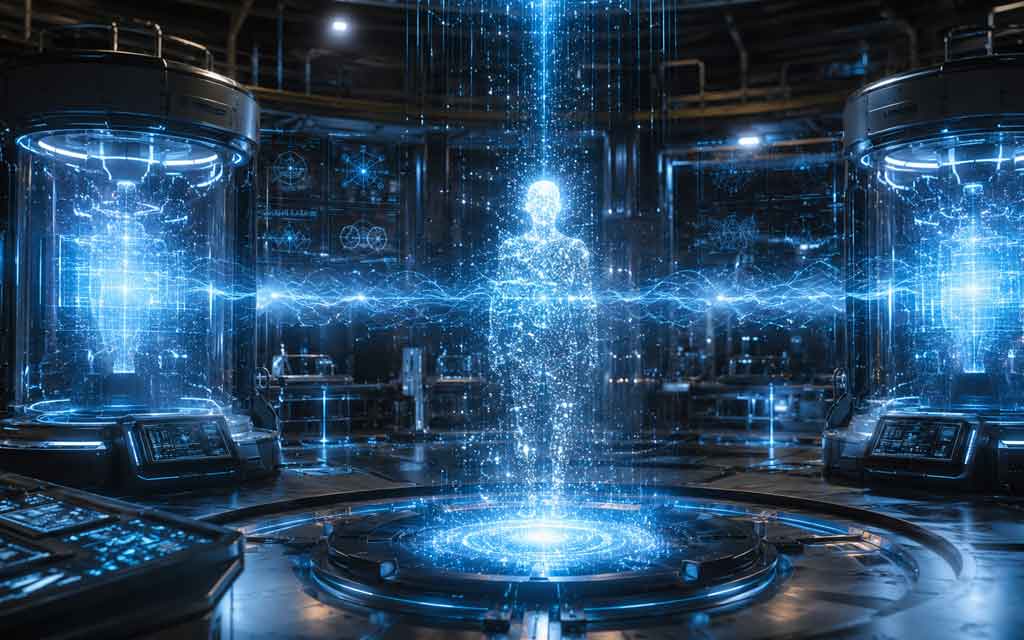
Quantum teleportation breakthroughs in 2026 bring human teleportation closer. From photon teleportation over real networks to scalable quantum systems—explore the science, challenges, and future implications. (148 characters)
Introduction
The idea of teleporting a human being has long been the stuff of Star Trek and science fiction. But in 2026, rapid advances in quantum technologies are turning theoretical discussions into serious scientific exploration. Recent breakthroughs in quantum teleportation — transferring quantum states across distances — are fueling speculation that one day, we might beam people from one place to another instantaneously.
While true human teleportation remains decades (or centuries) away, new experiments with photons, entanglement, and networked quantum processors are laying the groundwork. This article dives into the latest developments, the science behind it, massive challenges, and what it could mean for humanity if it ever becomes real.
Understanding Quantum Teleportation: Not What You Think
Quantum teleportation does not move physical matter like in movies. Instead, it transfers the quantum state (information) of a particle from one location to another using quantum entanglement — the mysterious link where two particles remain connected regardless of distance.
The original particle’s state is destroyed in the process, and an identical state is recreated elsewhere. This aligns with the no-cloning theorem in quantum mechanics, which prevents perfect copying without destroying the original.
Key recent milestones (2024–2026):
- Northwestern University demonstrated quantum teleportation of photons over busy fiber optic cables carrying regular internet traffic.
- University of Paderborn and others achieved photon state teleportation across 270 meters in open air using quantum dots.
- Oxford researchers linked independent quantum processors via photonic networks, teleporting logical quantum gates.
- Japanese teams advanced multi-photon “W state” entanglement for more robust information transfer.
These steps represent huge progress toward a quantum internet — ultra-secure, instantaneous communication networks.
The Path to Human Teleportation: What Scientists Are Exploring
Some researchers and futurists now openly discuss scaling these techniques toward biological systems and, eventually, humans. The process would theoretically involve:
- Scanning every atom/quantum state in the body (≈10^27 atoms in a human).
- Transmitting that immense dataset via entangled particles.
- Reassembling an exact replica at the destination using the received quantum information.
A Popular Mechanics piece highlights that breakthroughs in quantum computing and entanglement could eventually make this feasible, though it comes with a profound catch: the original body must be destroyed during the scan.
Current efforts focus on:
- Better entanglement stability and error correction.
- Hybrid quantum-classical systems.
- Photonic and atomic-scale teleportation as stepping stones.
No lab is actively “planning” to teleport a full human today — headlines often sensationalize incremental physics advances — but the foundational science is accelerating faster than expected.
Major Challenges: Why Human Teleportation Is Still Extremely Hard
- Scale and Complexity: A human contains ~7 octillion (10^27) atoms. Mapping and transmitting their precise quantum states would require computational power and bandwidth far beyond today’s quantum computers.
- Decoherence: Quantum states collapse easily due to environmental interference. Maintaining coherence for something as large and warm as a human body is currently impossible.
- Biological Integrity: Consciousness, memories, and life processes depend on exact molecular arrangements. Even tiny errors could result in a non-viable or altered “copy.”
- Energy and Ethics: The energy requirements would be astronomical. Philosophical questions about identity (is the replica “you”?) and the destruction of the original raise deep ethical dilemmas.
- Heisenberg Uncertainty: Precise measurement of all particles simultaneously violates fundamental limits.
Experts like those at Oxford and Northwestern emphasize these advances are primarily for computing and communication, not Star Trek transporters — yet.
Potential Revolutionary Impacts If Achieved
- Space Travel: Instantaneous travel to Mars or beyond, solving radiation and time issues.
- Medicine: “Teleporting” organs or patients for emergency care.
- Global Connectivity: Eliminate physical travel, transforming economies and climate impact.
- Backup Humanity: Digital/quantum immortality through perfect state copies.
It would also revolutionize quantum computing, AI, and secure communications.
Timeline and Realistic Outlook for 2026 and Beyond
- Short-term (2026–2030): Robust quantum networks, teleportation of complex molecules or small biological samples.
- Mid-term (2030–2050): Advanced quantum internet and atomic-scale teleportation.
- Long-term: Human-scale applications, if ever.
UN-designated 2025 as the International Year of Quantum Technology has accelerated global investment. Optimists point to exponential progress similar to classical computing; skeptics warn of insurmountable physical barriers.
Ethical and Philosophical Questions
If teleportation creates a perfect copy while destroying the original, does the person “survive”? This touches on consciousness, the soul, and personal identity — topics intersecting science, philosophy, and even spirituality.
Regulatory frameworks would be essential before any human trials.
Conclusion
The 2026 quantum breakthroughs in teleportation of information and entangled states mark exciting progress toward technologies once confined to fiction. While scientists aren’t beaming up volunteers yet, the foundational pieces for human teleportation are slowly falling into place.
This field sits at the bleeding edge of physics, computing, and human ambition. Whether it leads to practical human teleportation or primarily powers a quantum internet, the implications are profound for our future.
Stay tuned to vfuturemedia.com for more on quantum computing, emerging tech, AI, and future innovations. What do you think — would you step into a teleporter? Share your thoughts in the comments below.


Leave a Comment