
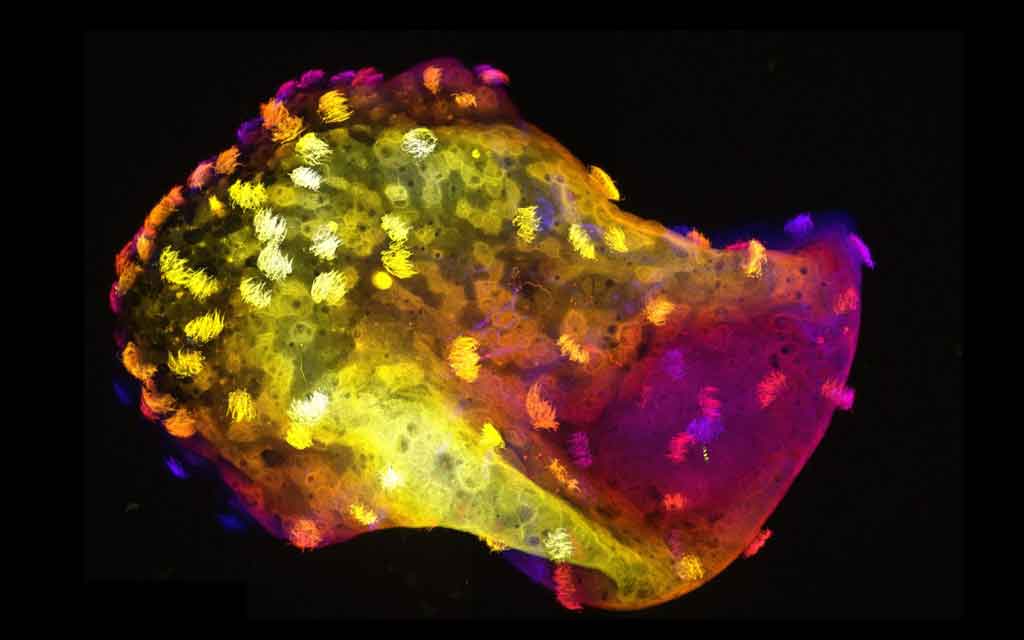
Breakthrough alert: Researchers at Tufts and Wyss Institute have engineered neurobots — tiny living robots from frog cells that self-organize functional nervous systems, enabling complex movement and behaviors. Explore the science, implications, and future of programmable biology in 2026.
Introduction
In a groundbreaking advance at the intersection of biology, robotics, and synthetic biology, scientists have created “neurobots” — tiny living robots made from frog cells that can self-organize their own primitive nervous systems. These biological machines represent a major leap beyond earlier xenobots, demonstrating emergent neural circuits that coordinate complex behaviors.
Developed by teams at Tufts University and the Wyss Institute at Harvard, this innovation blurs the lines between living organisms and machines. Published in Advanced Science, the research opens exciting possibilities for regenerative medicine, environmental cleanup, and programmable biological systems while raising profound ethical questions.
For tech enthusiasts and futurists tracking living robots 2026, xenobots neurobots, and synthetic biology, this development signals a new era where biology itself becomes a programmable medium.
From Xenobots to Neurobots: The Evolution
- 2020 Xenobots: The original living robots, designed with AI assistance and built from frog (Xenopus laevis) embryonic skin cells. They could move, heal themselves, and even self-replicate by gathering loose cells.
- Neurobots (2026): The next generation incorporates neural precursor cells implanted during early development. These cells mature into neurons that self-wire into functional circuits, extending axons and dendrites throughout the structure.
The neurobots are microscopic (hundreds of micrometers) and form spherical or other shapes. Neurons integrate with non-neuronal cells, creating simple neural networks that influence movement patterns via cilia (hair-like structures) and coordinated signaling.
How the Neurobots Work
Researchers used a microsurgical technique to insert clusters of neural precursor cells into forming biobots during a critical healing window. Over about a week:
- Neurons self-organize and form synapses.
- Neural projections connect internally and reach the surface.
- This results in more complex, directed locomotion compared to earlier aneural versions.
- Distinct gene expression profiles emerge, showing the nervous system actively shapes the organism’s behavior.
These living robots operate without traditional hardware, relying entirely on biological processes. They are biodegradable, ethically sourced (no genetic modification in basic forms), and demonstrate remarkable plasticity.
Key Achievements and Capabilities
- Self-Organizing Nervous System: First demonstration of functional neural circuits forming in a novel biological body plan.
- Complex Behaviors: Improved coordination, response to stimuli, and varied movement patterns.
- Self-Healing and Resilience: Consistent with prior xenobots.
- Potential for Sensing: Early signs of sensory-like capabilities through neural integration.
This work builds on Michael Levin’s pioneering research in bioelectricity and cellular intelligence, showing cells can follow “rules” to assemble novel structures beyond their natural evolutionary context.
Revolutionary Applications
- Regenerative Medicine: Neurobots or similar constructs could repair nerve damage, deliver drugs, or regenerate tissues using a patient’s own cells (building toward human-cell versions like anthrobots).
- Environmental Remediation: Programmable bots for cleaning pollutants or microplastics.
- Drug Testing and Research: Living testbeds for studying neural development and diseases.
- Future Robotics: Hybrid bio-machines combining living and synthetic components for extreme environments (space, deep sea).
Ethical, Philosophical, and Safety Considerations
The creation of living robots with nervous systems intensifies debates:
- Moral Status: Do entities with neural activity deserve ethical protections?
- Biosafety: Risk of unintended replication or ecological impact (though current designs are controlled and short-lived).
- Dual-Use Concerns: Potential military or manipulative applications.
- Definition of Life: Challenges traditional boundaries between machine, organism, and synthetic life.
Researchers emphasize responsible development with strict oversight.
Comparison: Xenobots vs. Neurobots
Cellular Base
- Xenobots (2020+): Frog skin cells
- Neurobots (2026): Frog cells + integrated neurons
Nervous System
- Xenobots (2020+): None (aneural)
- Neurobots (2026): Self-organizing primitive neural circuits
Movement
- Xenobots (2020+): Basic cilia-driven movement
- Neurobots (2026): More complex and coordinated movement
Behavior
- Xenobots (2020+): Simple, emergent behavior
- Neurobots (2026): Influenced by neural signaling
Applications
- Xenobots (2020+): Basic tasks and replication studies
- Neurobots (2026): Advanced sensing, tissue repair, and medical applications
Conclusion
The development of neurobots capable of forming their own nervous systems marks a historic milestone in synthetic biology. By harnessing the inherent intelligence of cells, scientists are redefining what’s possible in programmable life forms — moving us closer to a future where biology and technology merge seamlessly.
While challenges remain, this research promises transformative benefits in medicine and beyond, provided we navigate the ethical landscape thoughtfully.
Stay tuned to vfuturemedia.com for more on synthetic biology, living robots, AI-bio convergence, emerging tech, and future innovations. What do you think about creating living machines with nervous systems? Share your thoughts in the comments below.



Leave a Comment