
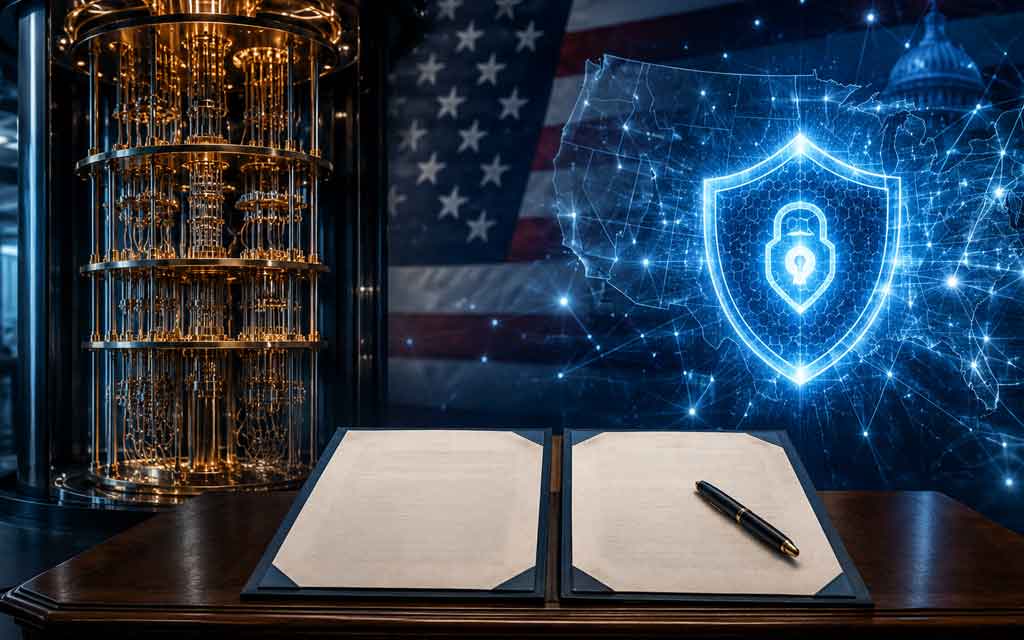
President Trump signed two executive orders on June 22, 2026, directing a powerful U.S. quantum computer by 2028 and faster federal migration to post-quantum cryptography by 2030–2031. Here’s what it means for national security, tech leadership, and the race with China.
On June 22, 2026, President Donald Trump signed two executive orders aimed at accelerating American leadership in quantum technologies while hardening the nation’s digital defenses against future quantum-enabled threats.
The first order establishes a national effort to develop a scientifically powerful and commercially relevant quantum computer by 2028. The second directs federal agencies to speed up migration to post-quantum cryptography (PQC), moving key systems to quantum-resistant encryption well ahead of the previous 2035 timeline.
These moves come as the U.S. competes with China in a high-stakes race for quantum supremacy — a field expected to revolutionize computing, materials science, drug discovery, artificial intelligence, sensing, and secure communications.
What the Quantum Computing Executive Order Requires
The order creates the Quantum Computer for Application Development and Discovery Science (QC-ADDS) initiative. It tasks the Department of Energy (DOE), in coordination with the White House Office of Science and Technology Policy, with delivering at least one large-scale quantum computer suitable for transformative scientific applications to a DOE facility, with access for the broader scientific community where feasible.
Key deadlines and directives include:
- 90 days: DOE must publicly release technical specifications for a system capable of economically significant applications beyond classical supercomputers.
- 180 days: Explore public-private partnership models to accelerate delivery.
- Deployment of quantum sensors and networks within five years (targeting ~2031).
- Expanded workforce programs through the Department of Labor and National Science Foundation (quantum apprenticeships and training).
- Strengthened domestic supply chains via the Department of Commerce.
- Enhanced protection of quantum research and intellectual property through the FBI.
White House officials, including OSTP Director Michael Kratsios, framed the goal as initiating “a new era of quantum-enabled scientific discovery” and commercial capabilities in the United States.
The Post-Quantum Cryptography and Cyber Defense Order
The second order focuses on defending U.S. government systems and critical infrastructure against “harvest now, decrypt later” attacks — where adversaries collect encrypted data today to break it with future quantum computers.
Major provisions:
- Accelerates the federal shift to post-quantum cryptography (standards developed by NIST to resist quantum attacks like Shor’s algorithm).
- Sets aggressive new timelines: High-value assets and certain systems must transition by 2030–2031, significantly earlier than the prior 2035 target.
- Directs the Office of Management and Budget (OMB) and National Cyber Director to lead a coordinated, nationwide PQC migration.
- Requires agencies to designate dedicated PQC migration leads.
- Calls for practical guidance from Commerce, NSA, and DHS.
The order explicitly aims to protect sensitive government data, critical infrastructure, and the broader digital economy from quantum threats.
Why This Matters: The Quantum Race and National Security
Quantum computers use qubits and phenomena like superposition and entanglement to solve certain problems exponentially faster than classical machines. While today’s systems are still noisy and limited in scale, experts believe fault-tolerant, large-scale quantum computers could emerge in the coming decade — with profound implications.
Potential breakthroughs:
- Drug discovery and materials science (simulating molecular interactions at unprecedented scale)
- Optimization problems in logistics, finance, and energy
- Machine learning acceleration
- Breaking current public-key cryptography (RSA, ECC)
This last point is why the post-quantum cryptography push is urgent. Adversaries (especially nation-states) are already believed to be harvesting encrypted data in anticipation of future quantum decryption capabilities.
The dual focus of the executive orders — build capability while hardening defenses — reflects a comprehensive national strategy. It also signals continued U.S. intent to lead (or at least not fall behind) China, which has made massive state-backed investments in quantum research.
Industry and Economic Implications
These orders are expected to benefit U.S. quantum companies through increased federal R&D funding, clearer technical roadmaps, public-private partnerships, and supply chain support. Companies working on superconducting qubits, trapped ions, neutral atoms, photonic systems, and quantum networking stand to gain from clearer government demand signals.
The workforce provisions could help address the acute shortage of quantum engineers, physicists, and technicians — a bottleneck for scaling the industry.
For cybersecurity firms and enterprises, the accelerated PQC timelines mean organizations handling federal data or critical infrastructure will need to prioritize crypto-agility and begin inventorying and migrating cryptographic systems sooner than previously planned.
Challenges Ahead
Delivering a scientifically useful quantum computer by 2028 is an ambitious target. Current systems remain limited by qubit count, coherence times, error rates, and scalability. Achieving the scale and reliability needed for meaningful scientific advantage will require continued breakthroughs in hardware, error correction, software, and algorithms.
On the cybersecurity side, migrating large, complex federal systems to new post-quantum standards involves significant engineering, testing, and interoperability work. Many legacy systems were not designed with crypto-agility in mind.
What Comes Next
Expect the Department of Energy to release detailed technical specifications within 90 days, followed by partnership models and funding mechanisms. Agencies will begin standing up PQC migration offices and roadmaps. Industry players and research institutions will likely see new opportunities to collaborate on both the offensive (quantum computing/sensing) and defensive (PQC) fronts.
These executive orders represent a clear policy signal: Quantum technology is now treated as a core national priority on par with artificial intelligence and advanced semiconductors.
For American technological competitiveness, scientific leadership, and long-term cybersecurity resilience, the coming years will be decisive.
What do you think? Is the 2028 timeline realistic for a scientifically useful U.S. quantum computer, or overly ambitious? How should organizations outside government begin preparing for post-quantum cryptography?
Sources include the White House Executive Orders and Fact Sheets (June 22, 2026), Reuters, and related official statements. Timelines and requirements are based on the signed orders and accompanying briefings.




Leave a Comment