
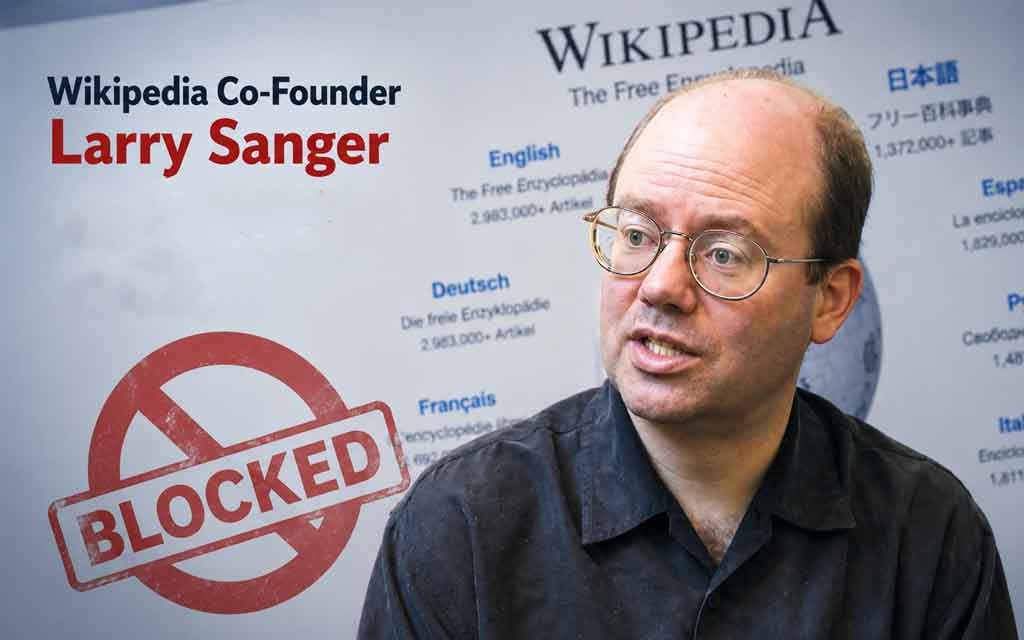
Larry Sanger, who co-founded Wikipedia and coined its name, has been indefinitely blocked from editing the English site. Here’s what happened, why it matters, and what it reveals about Wikipedia’s governance.
In a striking turn of events, Larry Sanger — the philosopher who co-founded Wikipedia alongside Jimmy Wales in 2001 and coined the name “Wikipedia” — has been indefinitely blocked from editing the English-language version of the site he helped create.
The block, enacted around June 22, 2026, followed a lengthy discussion on Wikipedia’s Administrators’ Noticeboard/Incidents (ANI). Editors cited violations related to off-wiki canvassing and disruptive behavior. Sanger has publicly described the decision as the work of a “faceless mob” with no due process.
The irony is hard to miss: one of the platform’s most prominent early architects is now barred from contributing to it.
Who Is Larry Sanger?
Larry Sanger played a foundational role in Wikipedia’s early days. He served as its first editor-in-chief (alongside Nupedia), helped draft core policies like the neutral point of view (NPOV) guideline, and was instrumental in shaping the collaborative model that made the project explode in popularity.
He stepped away in 2002 after the dot-com crash affected funding. Since then, Sanger has become one of Wikipedia’s most consistent and high-profile critics. He has argued for years that the site has drifted from its original mission of neutral, reliable knowledge summarization toward ideological capture — particularly what he calls a “GASP” worldview (Globalist, Academic, Secular, Progressive).
In 2025, he published a widely discussed piece outlining reforms, including ending indefinite blocks, making leadership more transparent, and allowing public ratings of articles. He also launched efforts like WikiProject Intellectual Diversity to encourage broader participation and counter perceived bias.
What Happened? The Block Explained
According to Wikipedia discussions and reports, Sanger was blocked for promoting his WikiProject Intellectual Diversity outside the platform in ways that violated canvassing rules.
Specifically:
- He announced and promoted the project on X (formerly Twitter), where he has a large following.
- In a podcast appearance, he encouraged outsiders — including groups he believed were underrepresented, such as Hindus and Indians — to join Wikipedia and participate in the project to “learn how to play the game” and help restore intellectual balance.
- Critics on Wikipedia argued this constituted off-wiki canvassing (WP:CANVASS) and attempts to recruit “meatpuppets” to influence ongoing discussions and consensus-building (WP:MEAT).
The ANI thread reportedly reached “clear consensus” for an indefinite community ban. Some participants acknowledged sympathy for Sanger’s broader goals around diversity of viewpoints but concluded his methods crossed lines into disruption. Others framed it as long-term behavior inconsistent with “building the encyclopedia.”
Jimmy Wales reportedly commented during the discussion, but the block was upheld by community consensus.
Sanger responded on X, stating he had been blocked “indefinitely” for unstated reasons by a “mob,” with no meaningful due process. He maintains his actions were aimed at improving Wikipedia, not disrupting it.
Sanger’s Long-Standing Critique of Wikipedia
This ban didn’t come out of nowhere. Sanger has spent over two decades arguing that Wikipedia has systemic issues:
- Bias in contentious topics: He and others have pointed to articles on politics, gender, science controversies, and geopolitics as reflecting the ideological leanings of its active editor base (often described as disproportionately young, Western, secular, and left-leaning).
- Anonymous power structures: A small number of highly active, often pseudonymous administrators and editors wield significant influence. Sanger has highlighted how few key accounts control major decisions.
- Indefinite blocking culture: He has long criticized Wikipedia’s heavy use of permanent bans, arguing it drives away good-faith contributors and entrenches groupthink.
- Reliability erosion: While he still sees value in the project for non-controversial topics, he believes politically charged articles often fail basic neutrality standards.
His launch of WikiProject Intellectual Diversity was an explicit attempt to address what he sees as an imbalance — by encouraging more diverse voices to participate constructively.
Why This Matters
1. Symbolism and Credibility Blocking a co-founder sends a powerful message about who “owns” Wikipedia today. It reinforces critics’ claims that the platform has been captured by a specific ideological and editorial class that is intolerant of challenges to its consensus.
2. Governance and Due Process Sanger’s complaint about lack of due process echoes long-standing concerns about Wikipedia’s dispute resolution. Decisions made via large, often heated noticeboard discussions can feel opaque or driven by the loudest voices rather than clear policy.
3. The Bias Debate Whether one agrees with Sanger’s specific diagnoses or not, this event will fuel ongoing conversations about Wikipedia’s reliability on politically sensitive topics. Studies and analyses from various think tanks have repeatedly documented measurable slant in certain article categories.
4. Free Speech vs. Community Standards Wikipedia is a private platform with its own rules. However, as one of the most influential sources of information in the world, its internal governance has outsized public impact. The tension between maintaining editorial standards and allowing dissenting or reformist voices is now on full display.
What’s Next?
Sanger has indicated he will continue advocating for Wikipedia reform from outside. His previous projects (like Citizendium) and ongoing commentary suggest he may double down on alternative knowledge platforms or transparency efforts.
For everyday users, the episode is a reminder to treat Wikipedia as a useful starting point rather than an infallible authority — especially on contentious subjects. Cross-referencing with primary sources and diverse outlets remains essential.
Wikipedia itself will likely continue operating as before. The blocking of a high-profile critic rarely changes the underlying dynamics that led to the conflict in the first place.
The Irony of the Founder’s Exile
Larry Sanger helped build a platform meant to democratize knowledge and empower anyone to contribute. Two decades later, that same platform has used its community processes to indefinitely bar him from editing.
Whether this represents the successful defense of standards against disruption — or the entrenchment of an insular culture resistant to reform — depends on your perspective. Either way, it’s a notable moment in the ongoing story of how the internet’s most ambitious knowledge project has evolved.
Do you think Wikipedia’s block of Larry Sanger was justified, or does it highlight deeper problems with the platform’s governance? Share your thoughts in the comments.
Sources include Wikipedia’s Administrators’ Noticeboard discussion, Larry Sanger’s public statements on X, contemporary reporting, and historical context from Sanger’s own writings and Wikipedia’s records. This is an evolving story.



Leave a Comment