
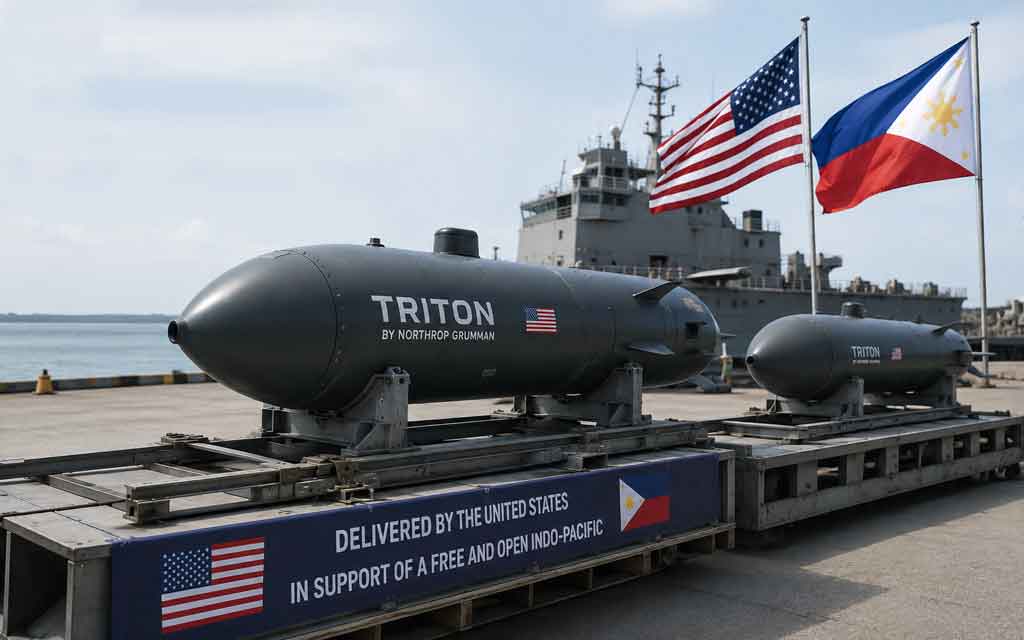
The United States has transferred four solar-powered Ocean Aero Triton autonomous underwater and surface vehicles worth $13 million to the Philippine military. The move strengthens Manila’s maritime surveillance capabilities amid ongoing tensions with China in the South China Sea.
The United States has transferred four Ocean Aero Triton autonomous underwater and surface vehicles (AUSVs) to the Philippine military in a deal valued at approximately $13 million. The handover took place on June 22, 2026, at the Philippine Navy’s Naval Operating Base Subic in Zambales.
These solar-powered drones can operate for up to 30 days without human crews, collecting data both above and below the ocean surface. The transfer comes as Manila faces repeated Chinese pressure in the South China Sea, including recent incidents near Scarborough Shoal.
What Are the Triton AUSVs?
The Ocean Aero Triton is a hybrid autonomous system capable of operating as both an underwater vehicle and a surface drone. Key features include:
- Long endurance: Solar power allows extended missions of up to 30 days.
- Dual-domain operations: Functions on the surface and submerged, enabling versatile surveillance.
- Data collection: Equipped with sensors for maritime domain awareness, including anti-submarine warfare support, mine detection, and monitoring of illegal fishing or gray-zone activities.
- Unmanned design: Reduces risk to personnel while providing persistent presence in contested waters.
The Philippine Navy will use these systems to improve its ability to monitor its exclusive economic zone (EEZ) and respond to maritime challenges. U.S. officials described the transfer as a demonstration of Washington’s commitment to its longtime ally under the Mutual Defense Treaty.
Strategic Context: South China Sea Tensions
The delivery occurs against a backdrop of heightened friction between the Philippines and China. Beijing has ramped up gray-zone tactics — including the installation of floating structures, use of maritime militia, and economic pressure — in disputed areas such as Scarborough Shoal and the Second Thomas Shoal.
Manila has responded by strengthening security ties with the United States, Japan, Australia, and other partners. Recent joint exercises (including Salaknib 2026) and increased U.S. rotational presence under the Enhanced Defense Cooperation Agreement (EDCA) reflect this shift.
These Triton AUSVs give the Philippines a low-cost, high-endurance capability to monitor vast ocean areas without deploying expensive manned vessels or risking personnel. In asymmetric warfare scenarios common in the South China Sea, unmanned systems like these can serve as force multipliers.
Tech Angle: The Rise of Autonomous Maritime Systems
This transfer highlights the growing importance of unmanned and autonomous systems in modern naval operations. Key technological aspects include:
- Solar-powered endurance: Extends mission duration far beyond battery-only systems.
- Hybrid surface-subsurface capability: Allows seamless transitions between domains for persistent surveillance.
- Sensor fusion and data collection: Supports real-time intelligence, surveillance, and reconnaissance (ISR).
- Reduced logistical footprint: Minimal crew requirements make them ideal for archipelagic nations with limited naval resources.
The United States has been investing heavily in similar technologies (e.g., Orca extra-large unmanned undersea vehicles and various USVs). By sharing these capabilities with allies like the Philippines, Washington is building a networked deterrence architecture across the Indo-Pacific.
For vfuturemedia readers interested in future tech, this represents a practical application of autonomous systems in geopolitics — moving beyond theoretical discussions into real-world deployment.
Implications for Regional Security and U.S. Strategy
For the Philippines:
- Enhanced maritime domain awareness in a region where traditional naval assets are limited.
- Asymmetric tools to counter China’s numerical and technological advantages in certain areas.
- Strengthened interoperability with U.S. forces.
For the United States:
- A tangible demonstration of commitment to allies without direct combat involvement.
- Export of advanced unmanned technology that aligns with broader goals of distributed maritime operations.
- Counter to China’s own rapid development of unmanned systems.
Broader Indo-Pacific Dynamics:
- Unmanned systems are becoming central to gray-zone competition. Both the U.S. and China are racing to field persistent, autonomous platforms.
- Allies and partners are increasingly adopting these technologies to avoid being outmatched in contested waters.
- This transfer could pave the way for further U.S. unmanned system support to Southeast Asian nations.
Challenges and Limitations
While valuable, four vehicles represent a modest initial capability. Integration into Philippine Navy operations, training, maintenance, and data processing will be critical for effectiveness. Additionally, any new technology faces the risk of countermeasures as adversaries adapt.
The Philippines will likely seek more such systems, along with training and sustainment support, in the coming years.
The Future of Autonomous Naval Warfare
The U.S.-Philippines Triton transfer is part of a larger trend: the militarization of autonomous systems at sea. Expect continued development in:
- Longer-endurance platforms
- AI-driven autonomy for decision-making
- Swarming tactics
- Integration with satellite and aerial systems for full-domain awareness
For nations like the Philippines facing superior conventional forces, these technologies offer a pathway to credible deterrence at relatively lower cost and risk.
What do you think? Will unmanned systems like the Triton AUSV change the balance of power in the South China Sea, or are they mainly symbolic? How should the U.S. balance technology sharing with allies against proliferation risks?




Leave a Comment