
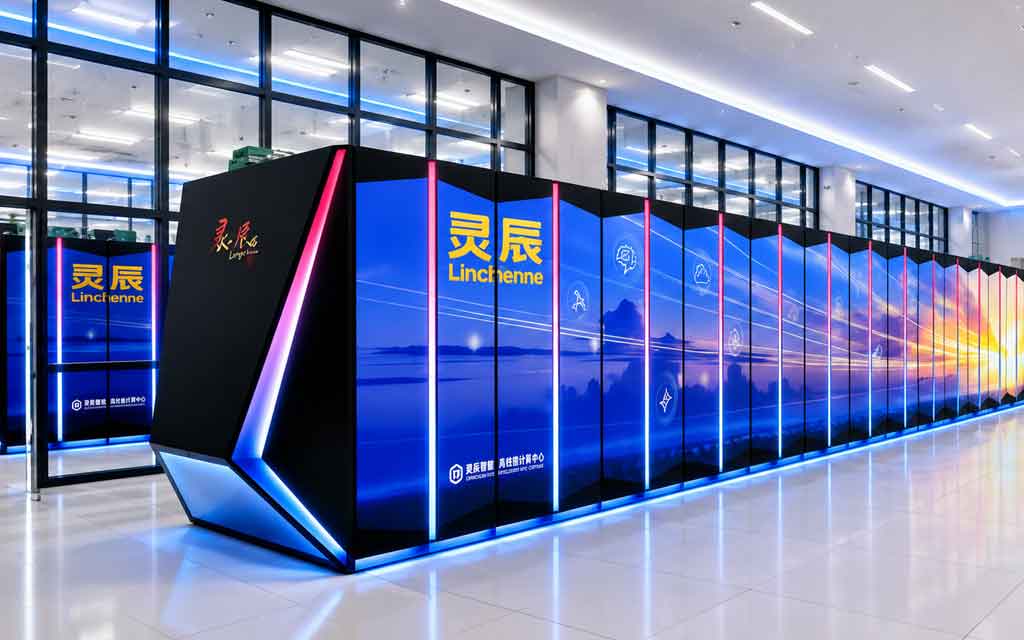
China’s LineShine supercomputer has taken the #1 spot on the TOP500 list with 2.198 exaflops, beating America’s El Capitan. It marks Beijing’s return to the top for the first time since 2017 — using only domestic chips.
China has reclaimed the crown as home to the world’s fastest supercomputer.
On June 23, 2026, the LineShine system at China’s National Supercomputing Centre in Shenzhen topped the latest TOP500 ranking, surpassing the previous champion — the U.S. Department of Energy’s El Capitan at Lawrence Livermore National Laboratory.
This is the first time a Chinese machine has held the top position since Sunway TaihuLight in 2017, signaling a significant milestone in Beijing’s long-running push for technological self-reliance amid U.S. export restrictions on advanced chips.
The Numbers Behind the Record
- LineShine achieved 2.198 exaflops on the High Performance Linpack (HPL) benchmark.
- It edged out El Capitan, which clocked in at approximately 1.809 exaflops.
- The system uses 13.79 million cores based on China’s domestically designed LingKun processors — with no GPUs or foreign accelerators.
The machine made its debut on the TOP500 list and immediately claimed the top spot, a striking achievement given the constraints of U.S. sanctions that have limited China’s access to the most advanced semiconductor technology.
Not Just About Raw Speed
While the headline is impressive, experts are quick to add important context:
LineShine is not primarily optimized for AI workloads. It ranks lower on benchmarks that better reflect real-world scientific and AI-like computing (such as the HPCG test). The U.S. still holds strong positions across the broader list, with four of the top five systems overall.
This victory appears more symbolic of China’s determination to build high-performance computing systems independently than a direct leap in AI training capability. Many analysts view it as a demonstration of engineering resilience under pressure rather than a decisive shift in the global AI compute race.
The Geopolitical Backdrop
The timing is significant. For years, the U.S. has imposed strict export controls on advanced chips and manufacturing equipment to slow China’s progress in AI and high-performance computing. Beijing has responded by accelerating domestic chip development and supercomputing programs.
LineShine’s success using only Chinese-designed processors is being celebrated in China as proof that self-sufficiency is possible — even if the system’s architecture differs from the GPU-heavy designs favored by leading AI labs in the U.S.
It also highlights the diverging paths in supercomputing strategy:
- The U.S. has focused heavily on GPU-accelerated systems optimized for AI and scientific simulation.
- China is showing strength in massive CPU-based systems that excel at traditional high-performance computing benchmarks.
What This Means Going Forward
For the U.S.: The loss of the top spot is a symbolic blow, but American leadership in AI-relevant computing and ecosystem strength remains intact. El Capitan and other U.S. systems continue to lead in many practical workloads.
For China: This is a major propaganda and technical win. It boosts national confidence and demonstrates that domestic innovation can compete at the highest levels despite sanctions.
For the Global Tech Landscape: The supercomputing race is increasingly becoming a proxy for broader technological competition. Expect continued investment on both sides, with China doubling down on indigenous processors and the U.S. maintaining its edge in software ecosystems, AI frameworks, and GPU technology.
LineShine’s achievement also raises questions about how we measure “fastest.” Raw Linpack performance is one metric — but real-world usefulness for AI training, scientific discovery, and national security applications matters more.
The Bottom Line
China’s LineShine has officially become the world’s fastest supercomputer on the TOP500 list, marking Beijing’s return to the pinnacle of high-performance computing after nearly a decade. While impressive, the win comes with caveats about its relevance to the AI-driven future of computing.
The race for exascale and beyond is far from over — it’s simply entering a new, more fragmented chapter defined by geopolitics as much as raw performance.
What do you think? Does this Chinese supercomputer milestone represent a real shift in global tech leadership, or is it mostly symbolic? How should the U.S. respond to maintain its edge in AI and scientific computing?
Sources: TOP500.org (June 2026 list), Reuters, The New York Times, and industry analysis.




Leave a Comment