
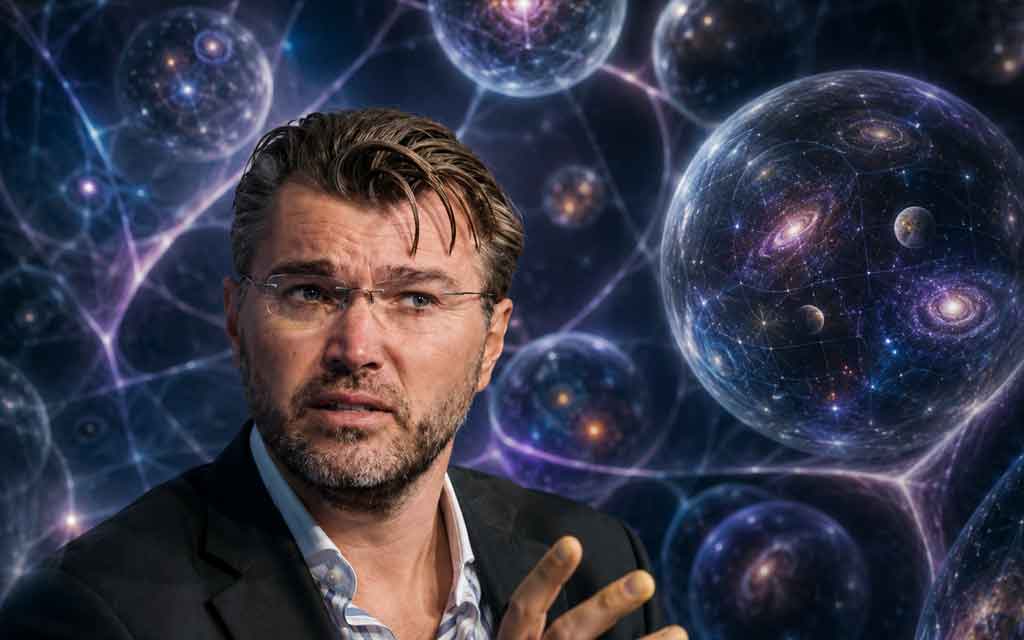
Meta Description: Oxford physicist Vlatko Vedral proposes that versions of “you” in parallel universes could be influencing your reality through quantum effects — flipping our understanding of free will and destiny.
What if the choices you make today are being quietly nudged by countless alternate versions of yourself living out different lives in parallel realities?
That’s the mind-bending idea at the heart of a recent quantum theory gaining attention. According to University of Oxford physicist Vlatko Vedral, the traditional view of how we shape reality may be backwards. Instead of us observing and collapsing possibilities into one outcome, other versions of “you” across the multiverse may be subtly steering your path.
This isn’t pure science fiction — it builds on the well-established Many-Worlds Interpretation of quantum mechanics, with a provocative twist on how those worlds might interact.
The Many-Worlds Foundation
In standard quantum mechanics, particles exist in multiple states at once until measured. The Many-Worlds Interpretation (MWI), first proposed by Hugh Everett in 1957, takes this literally: every possible outcome of a quantum event actually happens, and the universe branches into parallel realities to accommodate all of them.
When you make a decision — or when a quantum event occurs inside your body or environment — reality splits. One version of you turns left. Another turns right. Both are equally real, just in different branches of the multiverse.
Most physicists who accept MWI treat these branches as completely non-interacting. Once they split, they never influence each other again.
Vedral’s recent argument challenges that isolation.
The “Influence” Twist
In pieces published in outlets like Popular Mechanics, Vedral suggests that the observer effect has been misunderstood. Rather than you collapsing reality through observation, countless other versions of you in parallel branches may be exerting a subtle pull on your current reality.
Think of it like this: every tiny quantum interaction constantly forks the universe. With so many branches, rare cross-influences or interference effects could occur — not dramatic “meeting your alternate self” moments, but tiny statistical nudges that shape probabilities in your branch.
According to this view, your “fate” isn’t determined solely by your local choices and classical physics. It’s also being gently tugged by the collective weight of all your parallel selves living out every possible variation of your life.
Some popular summaries have framed it dramatically: other versions of you might be “actively steering” your everyday decisions, almost like cosmic voodoo dolls.
What the Science Actually Says
It’s important to separate the solid physics from the speculative extension:
- Many-Worlds itself is a serious, mainstream interpretation of quantum mechanics embraced by many leading physicists. It elegantly solves the measurement problem without needing wavefunction collapse.
- Cross-branch influence is far more controversial. Standard MWI predicts that once branches decohere (separate), they no longer interact in any meaningful way. Vedral’s idea explores whether subtle, rare interferences might still occur — an area of active theoretical discussion but not established fact.
- No experiment has demonstrated parallel versions of you affecting your decisions. This remains a theoretical proposal.
Vedral’s framing is more nuanced than some headlines suggest: he argues that our intuition about “we create reality through observation” may be inverted in a multiverse picture.
Implications for Free Will and Fate
If parallel versions of you are influencing your path, what does that mean for personal responsibility?
- Free will becomes even more complicated. Your choices might not be as independent as they feel.
- Fate shifts from something predetermined by classical cause-and-effect to something shaped by an enormous ensemble of realities.
- Consciousness might not be the special ingredient that collapses possibilities — it could be just another quantum process playing out across branches.
Some find this liberating (“your bad decisions might be someone else’s good ones”), while others find it unsettling (“am I even in control?”).
Why This Matters Now
Interest in these ideas has surged alongside rapid progress in quantum computing and our growing ability to manipulate quantum systems at larger scales. As we build more powerful quantum technologies, questions about the nature of reality, measurement, and branching become more than philosophical — they become engineering constraints.
Whether or not parallel versions of you are actively shaping your life, the Many-Worlds framework forces us to confront a humbling possibility: the universe may be far stranger and more vast than our single experienced timeline suggests.
The Bottom Line
A new wave of discussion around quantum theory — led by thinkers like Vlatko Vedral — is challenging the comforting idea that we are the sole authors of our reality. In this view, countless alternate versions of yourself may be quietly contributing to the probabilities that define your path.
It’s a provocative idea that sits at the edge of established physics and bold speculation. While it doesn’t (yet) have experimental confirmation, it highlights how quantum mechanics continues to upend our deepest assumptions about time, choice, and what it means to be “you.”
The multiverse might not just contain other versions of your life — it might be helping write the one you’re living right now.




Leave a Comment