
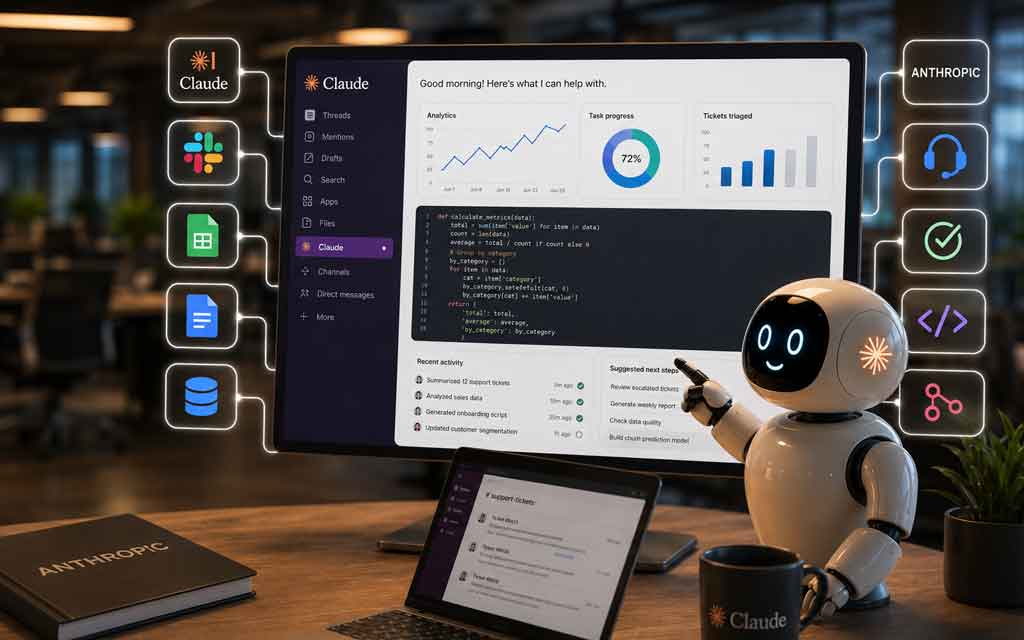
Anthropic launched Claude Tag, a persistent AI agent inside Slack that can take on real work using your tools and data. With 65% of its own product code now generated by the internal version, is this the beginning of the end for standalone SaaS tools?
On June 23, 2026, Anthropic quietly dropped something that could reshape how entire companies operate.
It’s called Claude Tag — a persistent AI agent that lives inside Slack. Instead of the old “Claude in Slack” experience where you chatted back and forth, Claude Tag is always on. Teams simply @Claude in any channel, hand it a task, and it gets to work in the background using approved tools, company data, and even codebases. When it’s done, it posts the results back into the thread.
This isn’t another chatbot. It’s an always-available teammate that can actually do things.
And Anthropic is already using an internal version of it aggressively: 65% of the company’s product team code is now generated through Claude Tag. Employees are also using it to analyze metrics, process support tickets, debug production issues, and more.
The message to the SaaS industry is loud and clear: the era of dozens of disconnected tools may be ending.
How Claude Tag Actually Works
Unlike traditional Slack bots or the previous Claude integration, Claude Tag is designed as a persistent agent:
- You tag it in a channel (@Claude)
- Give it a clear task and context
- It can access approved tools and data sources
- It works autonomously (even across multiple steps)
- It returns results, code changes, analysis, or answers directly in the thread
This turns Slack from a simple messaging app into a command center for real work. Instead of switching between Jira, GitHub, Notion, analytics dashboards, support tools, and your code editor, teams can stay inside one interface and let the AI handle the heavy lifting.
Anthropic’s own usage shows the power:
- Code generation at massive scale (65% of product team output)
- Automated metric analysis
- Support ticket triaging and resolution
- Debugging and issue investigation
This Is Different From Previous AI Tools
Most AI features in SaaS products have been bolt-ons — helpful copilots inside existing tools. Claude Tag flips the model:
- The AI becomes the primary interface.
- It reaches into your existing tools and data rather than living inside one app.
- It can chain actions across multiple systems.
- It operates persistently without constant human supervision.
This is the difference between “AI-assisted work” and “AI-driven workflows.”
For many teams, especially in engineering, product, support, and operations, this could dramatically reduce the need for multiple specialized SaaS subscriptions. Why maintain separate tools for code review, ticket management, data analysis, and documentation when one agent in Slack can handle large parts of those workflows?
The Threat to Traditional SaaS
Anthropic’s move lands like a warning shot to the entire SaaS industry:
Traditional SaaS vs Claude Tag
Traditional SaaS Approach
- Separate tools for each business function
- Employees switch between multiple applications
- Data and permissions stay siloed
- Subscription pricing per user or tool
Claude Tag Approach
- One AI agent works across connected tools
- Tasks happen directly inside Slack conversations
- Uses approved company data across systems
- Usage-based AI agent pricing
Potential Impact
- Increased pressure on standalone SaaS products
- Reduced context switching and improved productivity
- Better integration with higher security considerations
- Potential disruption of traditional SaaS pricing models
Companies that sell standalone tools for coding assistance, customer support automation, analytics, project management, or documentation now face a new competitor: a general-purpose agent that can do many of those jobs from inside the most widely used workplace chat platform.
The 65% internal code generation stat is particularly telling. If Anthropic — a company at the frontier of AI — is already replacing the majority of its own engineering output with this system, what does that mean for companies still relying on traditional development tools and processes?
Risks and Realities
Of course, this isn’t without challenges:
- Security & Permissions: Giving an AI agent broad access to codebases, data, and tools requires very careful governance. One misconfigured permission could be disastrous.
- Reliability: Agents still hallucinate or make mistakes. Critical workflows will need strong human oversight and review processes.
- Data Privacy: Companies will need clear policies on what data the agent can access and how that data is handled.
- Adoption Curve: Not every team is ready to hand real work to an AI agent.
Anthropic appears to be addressing some of these concerns by emphasizing “approved tools and data,” but enterprise adoption will depend on how robust the controls and auditability prove to be.
What This Means for the Future of Work
Claude Tag represents a bigger shift toward agentic AI in the workplace. Instead of humans using multiple tools, AI agents will increasingly act as intermediaries — taking instructions in natural language and executing work across systems.
We’re moving from:
- “I use tools to do my job” to
- “I tell my AI teammate what needs to be done”
For companies that embrace this shift, the productivity gains could be enormous. For traditional SaaS vendors, it creates both threat and opportunity — many will need to evolve from standalone applications into platforms that powerful agents can easily plug into.
Anthropic has essentially shown what a post-SaaS world could look like: one persistent, capable AI agent that lives where teams already work and gets real things done.
The question now is how fast other companies will follow — and how many existing tools will still be necessary when an agent like Claude Tag can handle large parts of the workflow from inside Slack.
The SaaS industry just got a very clear signal that the rules are changing.
What do you think? Is Claude Tag the beginning of the end for many standalone SaaS tools, or will most companies still need specialized applications? Would you trust an AI agent to handle significant parts of your team’s work inside Slack?
Sources: Anthropic announcements and internal usage data shared around the June 23, 2026 launch of Claude Tag.


Leave a Comment