
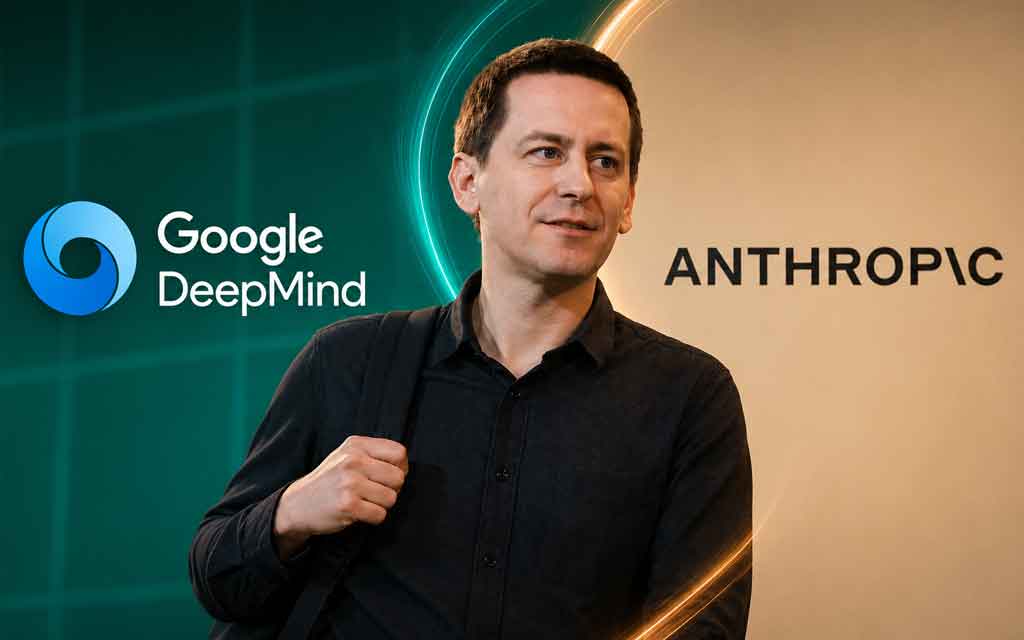
Meta Description: Nobel Prize-winning AI researcher John Jumper is leaving Google DeepMind after nearly nine years to join Anthropic. Discover the full story behind the move, AlphaFold’s revolutionary impact, reactions from Demis Hassabis, and what it means for the AI talent wars and scientific AI progress.
John Jumper, the Nobel Prize-winning computer scientist behind AlphaFold, announced on June 19, 2026, that he is leaving Google DeepMind after nearly nine years to join Anthropic. The move comes after a short recharge period and follows other high-profile exits from DeepMind, intensifying questions about talent retention at one of the world’s leading AI labs.
This is a major development in the AI industry. Jumper co-created AlphaFold, the system that solved the 50-year-old protein folding problem and earned him (along with Demis Hassabis and David Baker) the 2024 Nobel Prize in Chemistry. His departure to Anthropic — the AI safety-focused lab behind the Claude family of models — signals both personal career evolution and broader shifts in how top scientific AI talent is moving between frontier labs.
Who Is John Jumper?
John Jumper is a US scientist and VP/Engineering Fellow at Google DeepMind. He played a central role in developing AlphaFold, the deep learning system that predicts the three-dimensional structure of proteins from their amino acid sequences with remarkable accuracy.
Before AlphaFold, predicting protein structures was one of biology’s greatest challenges. It often took years or decades of expensive lab work. AlphaFold changed that overnight. The system has predicted structures for more than 200 million proteins — nearly all known proteins — and made the data freely available to researchers worldwide.
Jumper’s work didn’t just win a Nobel Prize. It accelerated drug discovery, disease research, and our fundamental understanding of life at the molecular level. Pharmaceutical companies and academic labs now routinely use AlphaFold outputs to design new therapies faster and more cheaply.
AlphaFold: The Breakthrough That Changed Biology
AlphaFold represents one of the clearest examples of AI delivering transformative real-world scientific impact. The protein folding problem had stumped scientists since the 1970s. Traditional methods were slow, costly, and often incomplete.
AlphaFold used deep learning trained on known protein structures from the Protein Data Bank. It achieved accuracy levels that matched or exceeded experimental methods in many cases. The 2024 Nobel Prize recognized this achievement as a landmark in both chemistry and artificial intelligence.
The downstream effects are still unfolding:
- Faster identification of drug targets
- Better understanding of genetic diseases
- New approaches to enzyme design and synthetic biology
- Accelerated research into antibiotics, cancer therapies, and neurodegenerative diseases
Jumper often emphasized that AlphaFold was built by a collaborative team at DeepMind. He credited Demis Hassabis for giving him the opportunity to lead the project just six months after completing his PhD.
The Announcement: “GDM Is a Special Place”
In a post on X (formerly Twitter), Jumper wrote:
“A bit of news: After nearly 9 years, I have decided to leave Google DeepMind and join Anthropic (after taking some time to recharge). I am incredibly grateful for my time at GDM. @demishassabis took a real chance letting me lead the AlphaFold team just six months after finishing my PhD. The entire GDM team taught me so much about how to do great science. GDM is a special place, and I’ll still be excited to hear about what amazing things they discover next.”
The tone was gracious and reflective rather than dramatic. Jumper expressed continued interest in DeepMind’s future work while signaling a new chapter at Anthropic.
Warm Response from Demis Hassabis
Demis Hassabis, CEO of Google DeepMind and Jumper’s longtime collaborator, replied publicly with gratitude:
“Thanks John for an extraordinary partnership and wonderful collaboration over the past 9 years! What we achieved with AlphaFold changed the world, and showed the field what was possible with AI for science and medicine, lighting the way for how AI can benefit humanity.”
Google Chief Scientist Jeff Dean also reportedly sent warm wishes. The public tone from DeepMind leadership has been respectful and appreciative, highlighting the strength of the relationship even as Jumper moves on.
Why Anthropic? Context and Implications
Anthropic has positioned itself as a safety-conscious alternative in the frontier AI race. The company, known for its Claude models, has received major investment from Amazon and Google (though it operates independently). Jumper’s expertise in applying AI to complex scientific problems could strengthen Anthropic’s efforts in areas like biological AI, scientific reasoning, or long-context understanding of complex systems.
The timing is notable. Jumper’s move follows the recent departure of Noam Shazeer (co-author of the seminal “Attention Is All You Need” paper and a Gemini co-lead) to OpenAI. Multiple high-profile exits in a short period have sparked discussion about whether DeepMind is facing retention challenges amid intense competition for top AI talent.
Anthropic is also preparing for a science-focused event on June 30, 2026, which may provide an early glimpse of how the company plans to leverage Jumper’s expertise.
The AI Talent Wars Heat Up
The AI industry is in the midst of an unprecedented talent competition. Top researchers move between labs (OpenAI, Anthropic, Google DeepMind, xAI, Meta, and others) as companies race to build more capable systems.
Key dynamics include:
- Compensation and equity packages at well-funded startups often outpace traditional Big Tech roles.
- Mission alignment — some researchers prefer safety-focused cultures (Anthropic) or maximum capability focus (other labs).
- Scientific vs. general intelligence priorities — Jumper’s background makes him particularly valuable for labs wanting to push AI deeper into biology, chemistry, and materials science.
Jumper’s move is less about “Google losing” and more about the maturation of the AI ecosystem. Top talent now has multiple high-caliber options, and researchers are increasingly choosing environments that align with their specific interests in applying AI to the hardest scientific problems.
What This Means for Google DeepMind and the Future of Scientific AI
DeepMind remains one of the strongest AI research organizations in the world, with deep expertise across reinforcement learning, multimodal models, and scientific applications. Losing a Nobel laureate is significant, but the lab has a track record of attracting and developing exceptional talent.
For the broader field, Jumper’s move reinforces that AI for science is becoming a major strategic priority. Labs that can successfully combine frontier model capabilities with deep domain expertise in biology and chemistry will likely lead the next wave of breakthroughs — from new medicines to sustainable materials and beyond.
Jumper’s track record suggests he will continue focusing on high-impact scientific applications wherever he lands. His presence at Anthropic could accelerate work on AI systems that reason about complex biological and chemical systems.
Looking Ahead
John Jumper’s transition from Google DeepMind to Anthropic marks another chapter in the fast-evolving story of AI transforming science. AlphaFold already proved that AI can solve problems that stumped generations of scientists. The next phase will likely involve even more powerful models tackling increasingly complex challenges in biology, medicine, and beyond.
Whether at Anthropic or elsewhere, Jumper’s expertise will remain highly influential. The AI talent wars show no signs of slowing, and the competition is ultimately driving faster progress across the entire field.
For now, the AI community is watching closely to see how this move shapes both Anthropic’s trajectory and the ongoing race to build beneficial, capable artificial intelligence.




Leave a Comment