
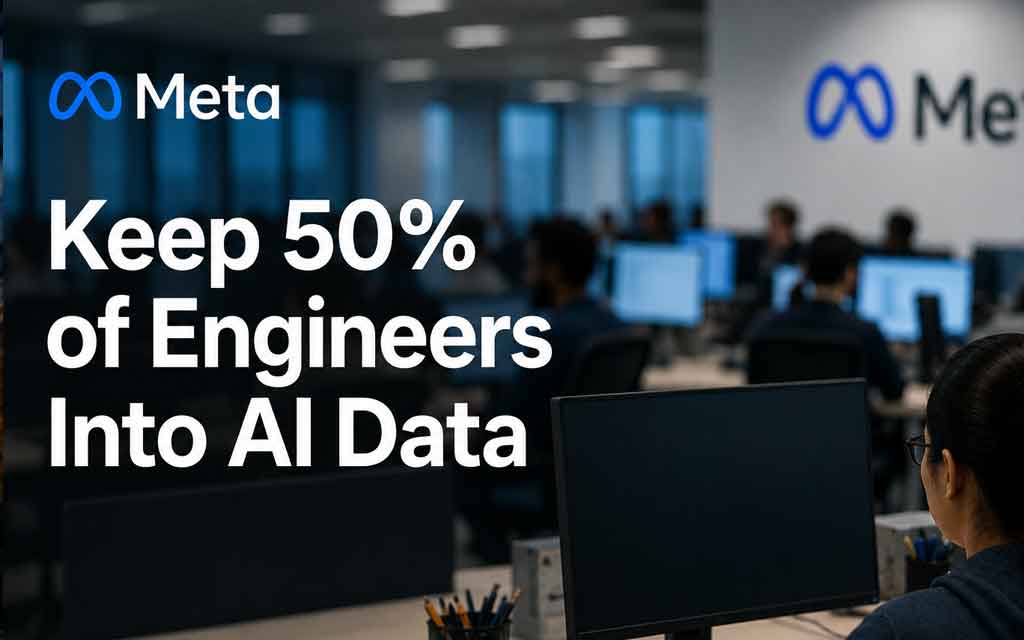
Meta is reportedly shifting a significant portion of its engineering talent away from traditional product development and into data-labeling and AI training work.
According to multiple reports and internal discussions, the company has moved 30% to 50% of engineers on some core teams into roles focused on creating high-quality training data for its AI models. This includes generating coding challenges, puzzles, and demonstrations of how humans complete technical tasks — all to help train more capable AI agents.
The move is part of Meta’s aggressive push to close the gap with leaders like OpenAI and Google in frontier AI capabilities, particularly for coding and agentic workflows.
What’s Actually Happening at Meta
Over the past few months, Meta has been rapidly reorganizing parts of its engineering organization around AI. Key developments include:
- Creation of a new Applied AI (AAI) or Agent Data Optimisation (ADO) organization with roughly 6,500 engineers and product managers.
- Forced reassignments (often described internally as “drafts”) where engineers are told to join these teams or leave.
- A focus on generating high-quality, human-generated training data rather than relying solely on synthetic data or public internet scraping.
- In some cases, implementation of tools to capture mouse movements, keystrokes, and screen activity to create realistic training examples of how engineers work.
Employees in these roles are reportedly tasked with:
- Creating coding problems and puzzles for model training
- Demonstrating step-by-step workflows on computers
- Labeling and grading AI-generated outputs
- Providing high-quality demonstrations for reinforcement learning from human feedback (RLHF)-style training
This is a notable departure from typical software engineering work and has led to significant internal pushback.
Why Meta Is Doing This
Frontier AI models still struggle with complex, real-world reasoning and coding tasks. While models like Meta’s Llama series have made impressive progress, they often fall short when it comes to understanding nuanced human workflows or producing reliable agent behavior.
To improve performance, companies need massive amounts of high-quality, human-annotated data. This includes:
- Examples of how skilled engineers actually solve problems
- Step-by-step reasoning traces
- Corrections and preferences on model outputs
Synthetic data has helped, but many labs believe human-generated or human-verified data remains essential for pushing model capabilities further — especially for agentic AI that can use computers autonomously.
Meta appears to be betting that repurposing some of its own engineering talent is one of the fastest ways to generate this high-quality data at scale.
Employee Reactions and Internal Morale
The reassignments have reportedly caused significant frustration among affected engineers. Many describe the work as repetitive, low-status, and far removed from the creative problem-solving that attracted them to software engineering in the first place.
Internal sentiment (shared on platforms like Blind and through anonymous reporting) includes:
- Descriptions of the new teams as a “gulag” or “data extraction factory”
- Complaints about being forced into roles with little choice (“join or quit”)
- Concerns that this work could accelerate the automation of their own jobs
- Protests, including flyers, petitions against keystroke tracking, and even internal livestream disruptions
Some engineers have expressed worry that Meta is devaluing core engineering skills in favor of using humans as temporary training data generators for AI systems that may eventually replace them.
Leadership has reportedly responded with internal events, hackathons, and messaging emphasizing the strategic importance of the work for Meta’s AI future. Mark Zuckerberg has publicly stressed the need to use internal talent aggressively in the AI race.
Broader Implications
This situation at Meta highlights several important trends in the AI industry in 2026:
1. Data Quality Remains a Major Bottleneck Even the largest tech companies are struggling to generate enough high-quality training data for next-generation models. Human involvement is still considered essential for certain types of complex reasoning and agent training.
2. AI Is Reshaping Job Roles Internally Companies aren’t just using AI to automate customer-facing or lower-skill work. They’re also fundamentally changing what their own highly paid engineers do on a daily basis.
3. The Human-in-the-Loop Reality Despite rapid progress in AI, the most advanced labs still rely heavily on human labor for data creation and curation. This creates an interesting tension: using expensive engineering talent for labeling work while simultaneously trying to build AI that can eventually reduce the need for that labor.
4. Morale and Retention Risks Forced reassignments and role changes can damage employee morale and retention, especially among top talent who have many options in the current market.
What This Means for the Future of Software Engineering
Meta’s approach raises bigger questions about the evolution of software engineering roles:
- Will more companies start using their own engineers as training data sources?
- How will this affect career paths and skill development for engineers?
- Will specialized “AI trainer” or “data curator” roles become more formalized and better compensated?
- Or will this phase be temporary until synthetic data and model capabilities improve enough to reduce the need for human-generated examples?
For now, it appears that even at one of the world’s largest tech companies, building better AI still requires significant human effort — including from the very engineers whose work AI may one day transform or replace.
FAQs
Is Meta really moving 30-50% of its engineers to data labeling? Reports and internal discussions suggest that on certain core teams, 30-50% of engineers have been reassigned to new AI-focused organizations involving data labeling and training data creation. It does not appear to apply uniformly across all 25,000+ engineers at the company.
What kind of work are these engineers doing? Tasks reportedly include creating coding challenges, generating step-by-step demonstrations of technical work, labeling AI outputs, and providing high-quality training examples for AI agents.
Why is Meta doing this? To improve its AI models’ performance on complex reasoning and coding tasks by generating high-quality human data at scale.
How are employees reacting? Many describe the work as repetitive and demoralizing, leading to internal protests, petitions, and concerns about job security and the future of engineering roles.
Is this unique to Meta? While Meta’s scale is notable, other AI labs also rely heavily on human data annotation and RLHF-style training. Meta appears to be using more of its internal engineering talent for this work than most competitors.



Leave a Comment