
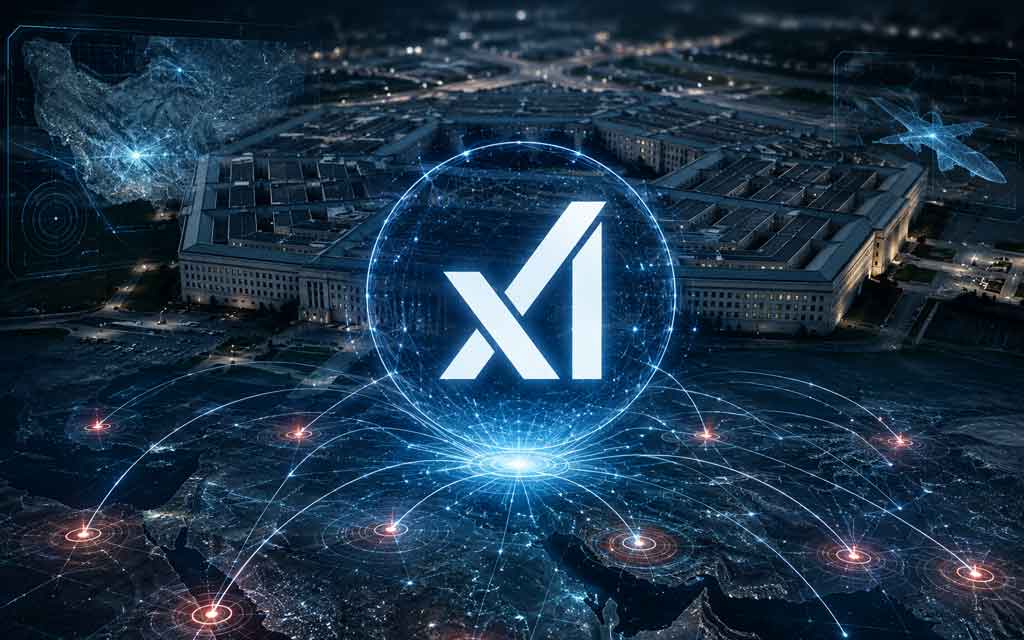
In a significant disclosure about the role of commercial AI in modern warfare, the Pentagon’s Chief Digital and Artificial Intelligence Officer has confirmed that a specialized version of xAI’s Grok played a key role in U.S. military operations against Iran.
According to a sworn statement filed in federal court, the “Grok Gov Model” — a derivative of xAI’s Grok integrated into the military’s Maven Smart System — enabled U.S. forces to deploy over 2,000 munitions against 2,000 distinct targets in just 96 hours during Operation Epic Fury.
The revelation, first reported by multiple outlets including The Hill and Middle East Eye, came not in a defense briefing but in legal filings defending xAI’s Colossus 2 data center in Memphis, Tennessee, against a lawsuit by the NAACP over alleged pollution.
The Court Filing and Pentagon Statement
Cameron Stanley, the Pentagon’s Chief Digital and AI Officer since January 2026, submitted a declaration stating that the U.S. military “relies on derivatives of” xAI’s commercial offerings, specifically the Grok Gov Model.
He wrote that the system “enabled U.S. forces to deploy over 2,000 munitions to 2,000 distinct targets within 96 hours during Operation Epic Fury, a testament to the greatly increased operational efficiency made possible by the Grok Gov Model.”
Operation Epic Fury refers to the Trump administration’s military campaign against Iran that began in late February 2026. The operation reportedly focused on dismantling Iran’s missile arsenal and defense infrastructure in coordination with Israel.
This marks one of the most explicit public acknowledgments yet of a commercial large language model being directly integrated into lethal targeting workflows at scale.
Context: Project Maven and AI in Targeting
The Grok Gov Model is being used within Project Maven, the Pentagon’s long-running AI-assisted targeting and intelligence analysis program. Maven was originally powered by other commercial models (including earlier work with Anthropic’s Claude) before expanding to include xAI technology.
The Maven Smart System (MSS) helps process vast amounts of intelligence data, identify potential targets, and support rapid decision-making in high-tempo operations. The ability to strike 2,000 targets in just four days represents an extraordinary pace that would be extremely difficult without advanced AI assistance for data fusion, target validation, and coordination.
Pentagon officials have framed the use of Grok derivatives as a national security asset, arguing that xAI’s infrastructure (including the Memphis data center) is critical to maintaining U.S. technological superiority in AI-enabled warfare.
What This Means for Military AI
This disclosure highlights several important trends:
1. Commercial AI Now Powers Real Combat Operations Frontier models developed by companies like xAI, OpenAI, Anthropic, and Google are no longer limited to research or non-lethal support roles. They are being adapted for direct integration into targeting systems.
2. Speed and Scale Advantages The claimed ability to process intelligence and enable strikes on 2,000 targets in 96 hours underscores how AI can dramatically compress the “kill chain” — the time from detection to engagement.
3. Growing Dependence on Private Sector AI The U.S. military is increasingly relying on commercial frontier labs rather than building everything in-house. This creates both capability advantages and new dependencies (and potential vulnerabilities).
4. Data Center Geopolitics The court filing’s defense of xAI’s Memphis facility as vital to national security shows how AI infrastructure itself is now treated as a strategic asset in legal and regulatory battles.
Important Clarifications
While the Pentagon statement attributes significant operational impact to the Grok Gov Model, several nuances are worth noting:
- Grok itself is xAI’s model, not SpaceX’s (though Elon Musk founded both companies).
- The military is using a specialized government-adapted derivative (Grok Gov Model), not the consumer version of Grok.
- The exact degree of autonomy versus human oversight in the targeting loop has not been publicly detailed.
- Previous versions of Project Maven used other commercial models before incorporating xAI technology.
Broader Implications
The integration of advanced AI into high-intensity conflict raises important questions:
- Ethics and Accountability: How are decisions about lethal force being made when AI systems process targeting data at this scale?
- Escalation Risks: Faster targeting cycles could compress decision timelines in future conflicts.
- Proliferation: As commercial AI improves, similar capabilities may become available to other nations.
- Industry Impact: xAI’s demonstrated value in a national security context strengthens its position among frontier AI labs and could accelerate government adoption of its models.
For xAI, the revelation represents a major validation of its technology in one of the most demanding environments possible. For the broader AI industry, it underscores that military applications are already a significant (if sometimes under-discussed) driver of frontier model development and deployment.
The Bottom Line
The Pentagon’s court filing confirms that a version of xAI’s Grok has moved beyond theoretical discussion into active support of large-scale combat operations. The ability to enable strikes on 2,000 targets in just four days illustrates both the power and the reality of AI in 21st-century warfare.
As commercial AI models become increasingly embedded in national security systems, the lines between Silicon Valley innovation and military capability continue to blur — with profound implications for technology, geopolitics, and the future of conflict.
FAQs
Did Grok directly launch missiles? No. The statement indicates that the Grok Gov Model helped process intelligence and support targeting decisions within the Maven Smart System, enabling faster and more efficient munitions deployment. Human operators remain in the decision loop.
Is this the consumer version of Grok? No. The military is using a specialized government-adapted version called the Grok Gov Model.
When did Operation Epic Fury take place? The operation occurred in late February 2026 as part of U.S.-Israeli military actions against Iranian targets.
Why was this revealed in court? The Pentagon disclosed the information while defending xAI’s Memphis data center in a lawsuit, arguing that the facility is critical to national security.
What is Project Maven? Project Maven is the U.S. military’s long-running program to integrate AI into intelligence analysis and targeting workflows. It has previously used other commercial AI models.



Leave a Comment