
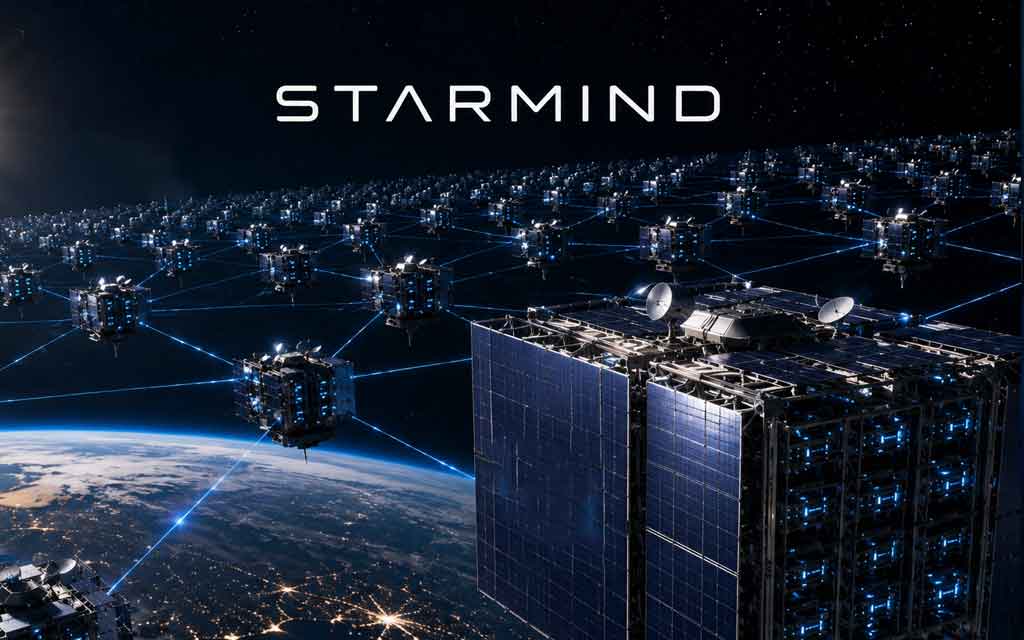
Elon Musk has a name for it: Starmind.
It’s not Starlink. Starlink beams internet. Starmind beams intelligence.
According to details tied to SpaceX’s recent IPO filing and Musk’s own comments, the vision involves deploying one million AI satellites — each a self-contained orbital data center. These “AI1” satellites would carry roughly 150 kilowatts of onboard compute, powered by expansive solar arrays spanning about 70 meters, run advanced AI models directly in space, and beam answers back to Earth.
No massive buildings. No terrestrial power grids. No cooling water.
This is Musk’s proposed answer to the physical limits threatening the explosive growth of AI on the ground.
Why Space? The Bottleneck on Earth
The AI market is projected to reach an almost unimaginable scale — with some valuations pointing toward $26.5 trillion. But Musk has flagged a hard wall: Earth simply cannot supply the electricity and water needed at a reasonable cost and speed.
Traditional data centers are extraordinarily power-hungry. Training and running frontier models already strain grids in many regions. Cooling them adds another massive burden — especially in water-scarce areas, where evaporative cooling towers can consume millions of gallons per facility annually.
Space changes the equation fundamentally.
In orbit, the sun shines nearly constantly. Solar power becomes far more reliable and abundant. Even more critically, cooling — one of the biggest constraints on Earth — becomes almost trivial thanks to the laws of physics.
Radiative Cooling: The 147-Year-Old Advantage
In the vacuum of space, heat cannot be carried away by air or water. It escapes only as infrared radiation.
This is governed by the Stefan-Boltzmann law (formulated in 1879): the power radiated by a surface is proportional to the fourth power of its temperature. Double the absolute temperature of a panel, and it radiates heat 16 times faster.
Starmind satellites would use large radiating panels facing the 3-Kelvin cold of deep space. These panels can run hot — efficiently dumping waste heat from the onboard AI accelerators straight into the void with no water and minimal energy penalty.
What terrestrial data centers achieve by burning through rivers of water and enormous amounts of electricity for chillers and cooling towers, a glowing wing in orbit can accomplish for essentially nothing.
The result: AI factories that are simultaneously water-neutral and dramatically more energy efficient.
Not Just Compute — A New Kind of Infrastructure
Each Starmind satellite wouldn’t just store or relay data. It would run the model on board and deliver inference directly. This distributed, orbital approach could reduce latency for certain global queries while bypassing Earth-based bottlenecks entirely.
Additional upsides Musk and SpaceX have highlighted include:
- Heat reuse potential on Earth (though harder from orbit).
- Greater resilience and scalability.
- The ability to turn these orbital assets into flexible components of a future energy and compute grid.
The Challenges Are Real
This is still very much on the drawing board:
- Chip Supply: SpaceX has publicly noted it cannot yet secure enough advanced chips to build at this scale. The proposed Terafab — a semiconductor facility envisioned to be ten times the size of Tesla’s Austin Gigafactory — is critical but not guaranteed to succeed on the needed timeline.
- Timeline: Prototypes are not expected to fly until 2027 at the earliest.
- Astronomy Pushback: A constellation of one million satellites would dramatically increase the number of moving objects in the night sky, raising serious concerns among astronomers about light pollution and interference with ground-based telescopes.
- Technical and Regulatory Hurdles: Launch cadence, orbital debris management, international coordination, and the sheer engineering complexity of maintaining reliable, high-performance compute in the harsh space environment remain significant.
Musk vs. the Ground-Based Vision
The contrast is striking. Masayoshi Son (SoftBank), who has poured enormous capital into terrestrial AI infrastructure, has reportedly dismissed space-based data centers as largely pointless. His approach focuses on scaling massive ground-based clusters.
Musk, by contrast, is reading the physical constraints in SpaceX’s own financial documents and betting that the vacuum of space — with its free solar energy and perfect radiative cooling — offers a superior long-term path.
One is doubling down on Earth’s existing systems. The other is betting the laws of physics will ultimately reward moving the hardest part of AI infrastructure off the planet.
The Void May Decide
Whether Starmind ever reaches a million satellites remains to be seen. The technical, financial, regulatory, and even aesthetic hurdles are enormous. Yet the core insight is hard to dismiss: as AI demand explodes, the marginal cost of power and cooling on Earth keeps rising, while the marginal cost in orbit — once the infrastructure exists — trends toward the physical minimum.
Starmind represents more than just another SpaceX project. It’s a philosophical bet that the ultimate solution to scaling intelligence isn’t to build bigger on a crowded, resource-constrained planet — but to move the heaviest lifting into the one environment that offers effectively unlimited energy and perfect heat rejection.
The universe doesn’t charge for sunlight or the 3-Kelvin background. Earth does — in electricity, water, land, and increasingly, political capital.
Musk has named his answer. Now the real question is whether physics — and execution — will reward it.
What do you think? Could orbital AI data centers like Starmind actually solve the scaling crisis, or are the challenges (chips, launches, astronomy) too great? Would you rather see massive investment in terrestrial nuclear + advanced cooling or a push into space?
Sources: SpaceX-related IPO filings and statements, Musk commentary on AI infrastructure limits, and physics principles of radiative cooling (2026 context). This remains an emerging vision rather than deployed technology.



Leave a Comment