
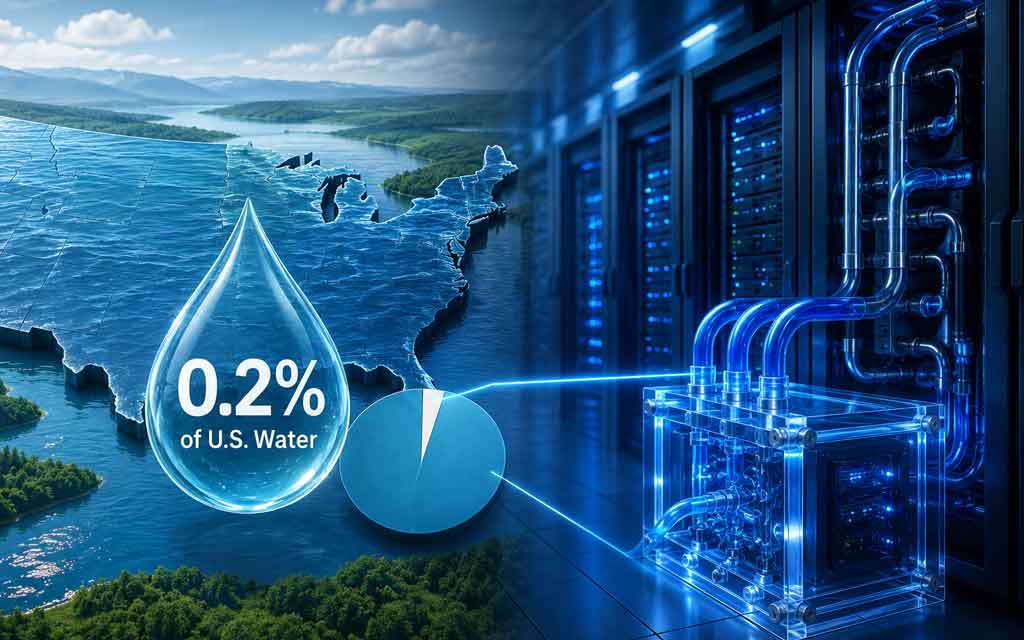
Contrary to viral claims, data centers consume only about 0.2% of U.S. daily water use. New 45°C liquid cooling from NVIDIA is slashing that further — often to near zero — while boosting energy efficiency and enabling heat reuse.
Water usage in AI data centers has become a flashpoint in public debates about the environmental cost of the AI boom. Critics often highlight dramatic numbers from specific facilities in drought-prone areas, sparking concerns about resource strain. But the broader picture, backed by recent analysis, tells a very different story — one of rapid improvement driven by technological innovation.
According to the Manhattan Institute, data centers account for roughly 0.2% of daily water usage across the United States. That figure has already declined sharply in recent years, and emerging liquid cooling technologies are accelerating the trend even further.
The Reality Behind the Numbers Data centers do use water, primarily for cooling. Traditional air-cooled systems often rely on evaporative cooling towers, which consume significant volumes of water through evaporation to dissipate heat. In hot or arid climates, this can add up — especially at massive AI training clusters.
However, when you zoom out to the national level:
Data centers represent a tiny fraction of overall U.S. water consumption. Most water use tied to data centers is indirect (via electricity generation for power plants). Direct on-site consumption is far smaller and concentrated in specific regions. For context, agriculture, power generation, and even residential lawn irrigation dwarf data center usage in most areas. The panic around AI “draining” water supplies often overlooks these proportions and the industry’s ongoing shift toward more efficient designs.
The Game-Changer: Liquid Cooling at 45°C The biggest leap forward is coming from liquid cooling — specifically higher-temperature systems. NVIDIA’s latest reference designs for its Blackwell and Rubin AI platforms support coolant temperatures up to 45°C (113°F).
Here’s why this matters:
Traditional cooling towers typically require colder water and rely on evaporation, consuming roughly 2.6 million gallons of water per megawatt per year in many facilities. With 45°C liquid cooling, AI factories in favorable climates can switch to dry coolers (essentially large radiators that use air instead of water evaporation). This can reduce direct facility cooling water use to near zero for most of the year. In suitable locations, operators can often eliminate chillers entirely or use them only during the hottest periods (potentially ~1% of the year). This isn’t theoretical. NVIDIA’s DSX reference architecture for AI factories is explicitly designed around closed-loop liquid cooling that dramatically cuts both power and water demands. The higher coolant temperature allows heat rejection through more efficient, water-free methods.
Beyond Water Savings: Energy Efficiency and Heat Reuse Liquid cooling delivers multiple wins:
Energy Efficiency — Moving heat directly from chips via liquid is far more effective than blowing cold air across servers. This reduces overall power consumption for cooling, which can represent a large portion of a data center’s energy bill. Heat Reuse Opportunities — The warmer coolant carries usable heat. Forward-thinking operators are exploring ways to pipe this warmth to nearby buildings, greenhouses, district heating systems, or even industrial processes. What was once waste heat becomes a community asset. Grid Assets — Efficient, flexible AI factories with advanced cooling can better integrate with the power grid. They can ramp operations, provide demand response, or even support renewable integration by managing their thermal loads intelligently. In short, modern liquid-cooled AI infrastructure isn’t just less thirsty — it’s becoming a more responsible and potentially beneficial neighbor.
Addressing Legitimate Concerns While national averages are low, localized impacts in water-stressed regions deserve attention. Companies like Google, Microsoft, and Meta have faced scrutiny in places like Arizona or parts of Europe. Responsible operators are responding with:
Greater transparency on water usage. Investments in water recycling and alternative cooling. Strategic siting in areas with abundant water or strong renewable energy. The shift to higher-temperature liquid cooling and dry coolers directly addresses many of these localized concerns by minimizing or eliminating evaporative water loss.
The Bigger Picture for AI’s Future As AI training and inference scale dramatically, infrastructure efficiency becomes critical. Liquid cooling at scale isn’t just a nice-to-have — it’s enabling the next generation of AI factories to grow sustainably.
Key takeaways:
Water use is modest nationally and trending sharply downward. Technological solutions like 45°C liquid cooling are delivering near-zero water consumption in many deployments. Multiple benefits extend beyond water to energy savings and potential heat reuse. Responsible innovation is already underway, countering the narrative of unchecked resource consumption. The AI revolution will continue to demand significant infrastructure. But the data shows the industry is moving quickly toward smarter, more efficient designs. Liquid cooling represents one of the most promising pathways to making AI factories both powerful and sustainable.
As these technologies mature and spread, the conversation around AI’s environmental footprint should evolve from alarm to informed optimism — grounded in the real engineering progress happening today.
What are your thoughts? Do you think liquid cooling will fully resolve water concerns around AI data centers, or are there other challenges we should focus on? How should communities and tech companies collaborate on heat reuse projects?
Sources: Manhattan Institute analysis, NVIDIA technical updates on liquid cooling architectures, and industry reports on data center resource use (2026).




Leave a Comment