
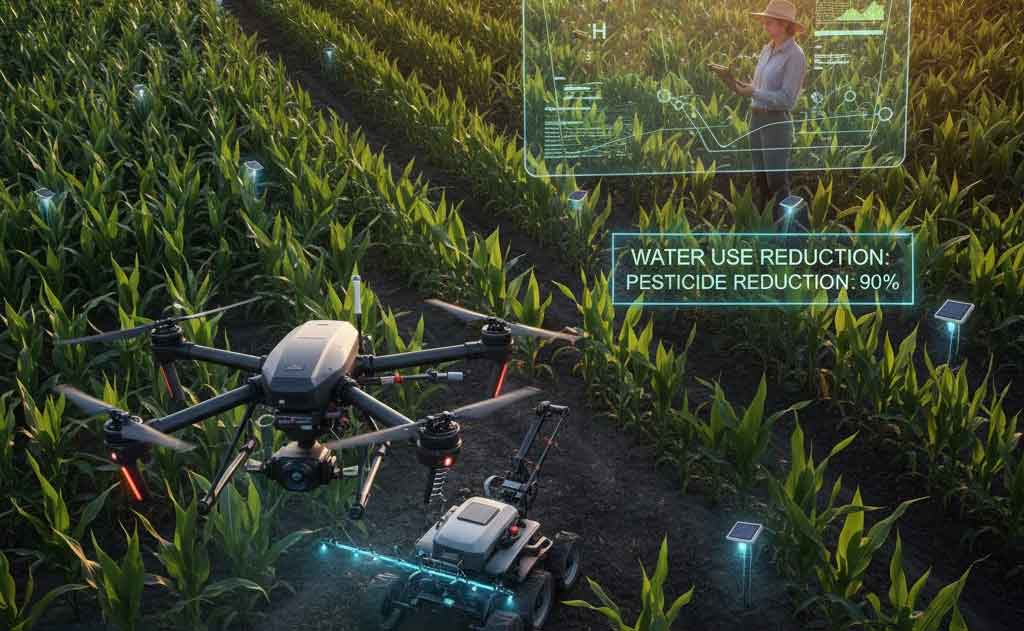
Introduction: The Digital Transformation of Modern Farming
AI in agriculture is no longer a futuristic concept—it’s reshaping farms worldwide in 2025. As climate change intensifies and global food demand surges toward a projected 10 billion people by 2050, farmers are turning to artificial intelligence, robotics, and precision agriculture to grow more food with fewer resources.
The results are remarkable: AI-powered farming systems reduce water consumption by up to 30%, slash pesticide use by 90%, and boost crop yields by 20-30%—all while protecting the environment. This convergence of agricultural technology (AgTech) and sustainability represents one of the most significant green tech innovations of our time.
In this comprehensive guide, we’ll explore how AI in agriculture works, profile the innovative startups leading this revolution, and reveal how precision farming technology is creating the sustainable farms of tomorrow.
What is AI in Agriculture? Understanding Precision Farming Technology
AI in agriculture, also known as precision agriculture or smart farming, uses artificial intelligence, machine learning, and advanced sensors to optimize every aspect of crop production. Unlike traditional farming methods that apply uniform treatments across entire fields, AI-powered systems analyze data from multiple sources to make targeted, intelligent decisions.
Core Technologies Powering Agricultural AI
1. Agricultural Drones and Aerial Monitoring
Drones equipped with multispectral cameras and AI algorithms provide real-time field intelligence that would take human scouts weeks to gather. These flying sensors detect:
- Early signs of crop stress and nutrient deficiencies
- Pest infestations before visible symptoms appear
- Water stress in specific field zones
- Optimal harvest timing for individual sections
Precision spraying drones equipped with AI vision systems apply pesticides only to affected plants, achieving up to 90% reduction in chemical use compared to blanket applications.
2. IoT Sensors and Smart Field Monitoring
Ground-based sensor networks continuously measure critical parameters:
- Soil moisture at multiple depths
- Temperature and humidity microclimates
- Nutrient levels (nitrogen, phosphorus, potassium)
- pH balance and soil conductivity
These sensors feed data into AI platforms that generate real-time recommendations for irrigation, fertilization, and pest management—enabling 25-40% water savings through precision irrigation alone.
3. Machine Learning and Predictive Analytics
Big data platforms process information from satellites, drones, weather stations, and historical farm records. Machine learning models deliver:
- Yield predictions with 95%+ accuracy
- Disease outbreak forecasts weeks in advance
- Optimal planting and harvesting windows
- Variable-rate application maps for inputs
This predictive capability transforms reactive farming into proactive farm management.
4. Agricultural Robotics and Automation
Autonomous robots handle labor-intensive tasks with superhuman precision:
- Robotic weeders use computer vision to distinguish crops from weeds, removing intruders mechanically or with targeted lasers
- Harvesting robots gently pick ripe produce, reducing waste and labor costs
- Autonomous tractors follow GPS-guided paths for optimal efficiency
- Solar-powered field robots operate continuously with zero emissions
Together, these technologies form an integrated ecosystem where AI in agriculture connects data collection, analysis, and automated action—the foundation of sustainable smart farming.
The Environmental Impact: How AI Reduces Water and Pesticide Use
The sustainability benefits of AI in agriculture extend far beyond the farm gate, addressing some of agriculture’s most pressing environmental challenges.
Water Conservation Through Precision Irrigation
Traditional irrigation methods waste 50-60% of applied water through evaporation, runoff, and over-application. AI-powered irrigation systems revolutionize water management by:
- Using soil sensors to deliver water only when moisture drops below optimal levels
- Creating zone-specific irrigation plans based on field variability mapping
- Integrating weather forecasts to adjust schedules proactively
- Monitoring plant water stress through drone thermal imaging
Real-world results: California almond growers report 35% water savings, while Indian farmers using smart irrigation cut water use by 40% while maintaining or increasing yields.
Dramatic Pesticide Reduction Through Targeted Application
Blanket pesticide spraying harms beneficial insects, contaminates watersheds, and contributes to resistance. AI-driven pest management changes this equation through:
- “See and spray” technology that identifies and treats only affected plants
- Early detection systems that prevent outbreaks before they spread
- Micro-dosing applications that use 70-95% less chemicals
- Mechanical and laser weeding that eliminates herbicides entirely
European vineyards using AI-guided robots have completely eliminated broad-spectrum herbicides while improving grape quality and meeting organic certification standards.
Broader Climate and Ecosystem Benefits
Beyond water and pesticide savings, AI in agriculture contributes to:
- Lower greenhouse gas emissions from reduced fertilizer production and machinery fuel consumption
- Improved soil health and carbon sequestration through reduced chemical inputs
- Biodiversity protection by preserving beneficial insects and soil microorganisms
- Cleaner water sources through minimized runoff and nutrient leaching
These environmental wins make AI-powered farming a critical component of climate change mitigation strategies.
Leading AgTech Startups Transforming Farming with AI
Innovative startups are pioneering practical applications of AI in agriculture, making precision farming accessible to operations of all sizes.
Greeneye Technology: 90% Herbicide Reduction Through Computer Vision
Location: Israel
Technology: AI-powered precision spraying systems
Greeneye retrofits conventional sprayers with real-time computer vision and intelligent nozzles. Their system identifies weeds at high speed and activates only the nozzles targeting unwanted plants.
Impact: Up to 90% herbicide reduction with improved crop health from reduced chemical exposure. California farmers report significant cost savings and environmental benefits.
ecoRobotix: Solar-Powered Autonomous Weeding Robots
Location: Switzerland
Technology: Autonomous robots with AI vision and ultra-precise application
The ARA robot navigates fields independently using solar power, identifying and eliminating weeds with pinpoint herbicide dots or mechanical tools. Their AVO model serves specialty crops like vineyards.
Impact: 70-95% herbicide savings, reduced soil compaction, and compliance with organic farming standards across European operations.
Fasal: Democratizing AI for Smallholder Farmers
Location: India
Technology: IoT sensor networks with AI-driven advisory platform
Fasal deploys affordable sensor systems monitoring soil, weather, and plant conditions. Their AI analyzes data to provide actionable advice via smartphone apps tailored for resource-constrained farmers.
Impact: 40% irrigation reduction, 30% pesticide savings, and 20-30% yield increases among Indian horticulture farmers.
Taranis: Leaf-Level Crop Intelligence at Scale
Location: USA/Israel
Technology: High-resolution imaging with predictive AI analytics
Taranis combines ultra-high-resolution drone imagery with weather and satellite data to monitor crops at the individual leaf level, detecting threats invisible to conventional scouting.
Impact: 25% lower fungicide applications through early disease detection in large-scale U.S. row-crop operations.
CropX: Adaptive Soil Analytics for Water Optimization
Location: Israel/USA
Technology: Wireless soil sensors with cloud-based AI
CropX’s multi-depth soil sensors measure moisture, temperature, and conductivity, generating adaptive irrigation plans that respond to changing conditions in real time.
Impact: 30-50% water savings and reduced nutrient leaching in operations ranging from California vineyards to Midwestern corn fields.
Iron Ox: Fully Autonomous Indoor Farming
Location: USA
Technology: Robotic greenhouse systems with AI optimization
Iron Ox operates completely autonomous indoor farms where robots handle all physical tasks while AI optimizes growing conditions for each plant variety.
Impact: Zero pesticide use, 90% less water than field farming, and year-round production in urban locations.
These startups represent just a fraction of the AgTech innovation ecosystem, but collectively they demonstrate how AI in agriculture is moving from concept to commercial reality.
Real-World Success Stories: AI in Agriculture Case Studies
California Almond Orchards: 78% Herbicide Reduction
Almond growers facing severe drought and strict environmental regulations adopted Greeneye precision spraying technology. Results included:
- 78% reduction in herbicide applications
- Maintained weed control standards
- 35% water savings from AI-optimized irrigation
- Significant cost reductions despite initial technology investment
Indian Horticulture: Transforming Smallholder Operations
Farmers in Maharashtra using Fasal’s sensor platform experienced dramatic improvements:
- 40% decrease in irrigation water use
- 30% reduction in pesticide applications
- 25% income increase from higher yields and lower input costs
- Improved resilience to monsoon variability
European Wine Production: Meeting Organic Standards
Vineyards across France, Italy, and Spain deploying ecoRobotix robots achieved:
- Complete elimination of broad-spectrum herbicides
- Improved wine quality ratings
- Organic certification for previously conventional operations
- Reduced labor costs for manual weeding
These case studies prove that AI in agriculture delivers measurable return on investment while advancing sustainability goals.
Overcoming Adoption Barriers: Making AI Accessible to All Farmers
Despite compelling benefits, several challenges slow widespread adoption of AI in agriculture:
High Initial Investment Costs
Challenge: Advanced sensors, drones, and robots require significant upfront capital.
Solutions:
- Subscription and equipment-as-a-service models
- Government subsidies and incentive programs
- Cooperative purchasing for small farm groups
- Startups focused on affordable solutions for emerging markets
Rural Connectivity Limitations
Challenge: Many farming regions lack reliable internet for cloud-based AI platforms.
Solutions:
- Edge computing that processes data locally
- Satellite connectivity services
- Hybrid systems with offline capabilities
- Mobile data integration
Technical Knowledge Gaps
Challenge: Farmers need training to effectively use precision agriculture technology.
Solutions:
- Intuitive, smartphone-based interfaces
- Partnerships with agricultural extension services
- Peer-to-peer farmer education networks
- Vendor-provided training and support programs
Data Privacy Concerns
Challenge: Farmers worry about proprietary farm data security.
Solutions:
- Blockchain-based data ownership systems
- On-device processing options
- Transparent data usage policies
- Industry standards for data protection
As these barriers diminish through innovation and policy support, AI in agriculture adoption rates continue accelerating globally.
The Future of Farming: AI-Powered, Sustainable, and Resilient
Looking toward 2030 and beyond, AI in agriculture will become increasingly sophisticated and integrated:
Fully Autonomous Farm Operations
Coordinated drone swarms will map fields while ground robot fleets execute precise interventions—all orchestrated by central AI systems with minimal human oversight.
Climate Adaptation AI
Generative AI will simulate countless scenario variations to help farmers adapt to changing weather patterns, selecting optimal crop varieties and planting strategies for shifting conditions.
Quantum Sensing Technology
Next-generation sensors may detect subtle plant stresses at the molecular level, enabling interventions before any physical symptoms appear.
Carbon-Positive Farming
AI-optimized regenerative practices will enable farms to sequester more carbon than they emit, with blockchain systems tracking and monetizing environmental benefits through carbon credits.
Integrated Urban and Vertical Farming
AI-managed indoor farms will supplement traditional agriculture, bringing production closer to cities while using 95% less water and zero pesticides.
The convergence of AI in agriculture with other green technologies ensures that future farms will be productive, profitable, and environmentally regenerative.
Frequently Asked Questions About AI in Agriculture
How much does AI farming technology cost?
Costs vary widely based on farm size and technology. Basic soil sensor systems start at $1,000-5,000, while autonomous robots can cost $50,000-500,000. Many vendors offer subscription models starting at $100-500 monthly, making AI in agriculture accessible to smaller operations.
Can small farms benefit from agricultural AI?
Absolutely. Startups like Fasal specifically target smallholders with affordable sensor networks and smartphone apps. Even small operations see ROI through reduced input costs and increased yields. Cooperative purchasing and government programs further reduce barriers.
Is AI farming technology difficult to use?
Modern agricultural AI platforms prioritize user-friendly interfaces designed for farmers without technical backgrounds. Most systems provide actionable recommendations via smartphone apps, eliminating the need to interpret complex data.
How quickly can farms see ROI from AI investments?
Most farms report positive ROI within 1-3 growing seasons through reduced water, pesticide, and fertilizer costs combined with higher yields. Water savings alone often justify the investment in drought-prone regions.
Does AI replace farm workers?
AI in agriculture primarily automates repetitive, physically demanding tasks while creating new roles in technology management, data analysis, and precision agriculture consulting. The technology addresses critical labor shortages rather than eliminating jobs.
Conclusion: Embracing Smart Farming for Global Food Security
The integration of AI in agriculture represents a fundamental transformation in how humanity produces food. By combining artificial intelligence, robotics, sensors, and data analytics, precision agriculture delivers what seemed impossible just decades ago: significantly higher yields with dramatically lower environmental impact.
The startups profiled here—from Greeneye’s precision sprayers achieving 90% herbicide reduction to Fasal’s affordable sensors empowering Indian smallholders—prove that smart farming technology works across diverse contexts and scales.
As we face mounting challenges from climate change, water scarcity, and population growth, AI in agriculture offers a clear path forward: farms that feed the world while healing the planet. The technology exists today. The results are proven. The future of sustainable food production is already growing in fields worldwide.
For farmers, investors, and policymakers: The time to embrace agricultural AI is now. The farms of tomorrow—smarter, cleaner, and more abundant—are being built today by those willing to innovate.
Take Action: Explore AI Agriculture Solutions
Ready to learn more about implementing AI in agriculture on your operation or investing in AgTech innovation?
[Explore More Green Tech Innovations →]
[Read Our Latest AgTech Analysis →]
[Subscribe to VFutureMedia Newsletter →]
Stay informed about the latest developments in agricultural technology, sustainability innovations, and the future of food production with VFutureMedia—your trusted source for green tech insights.
If you found this useful, the best thing you can do is share it with someone who’d actually appreciate it. And if you want more like it, we’re here every week.




Leave a Comment