
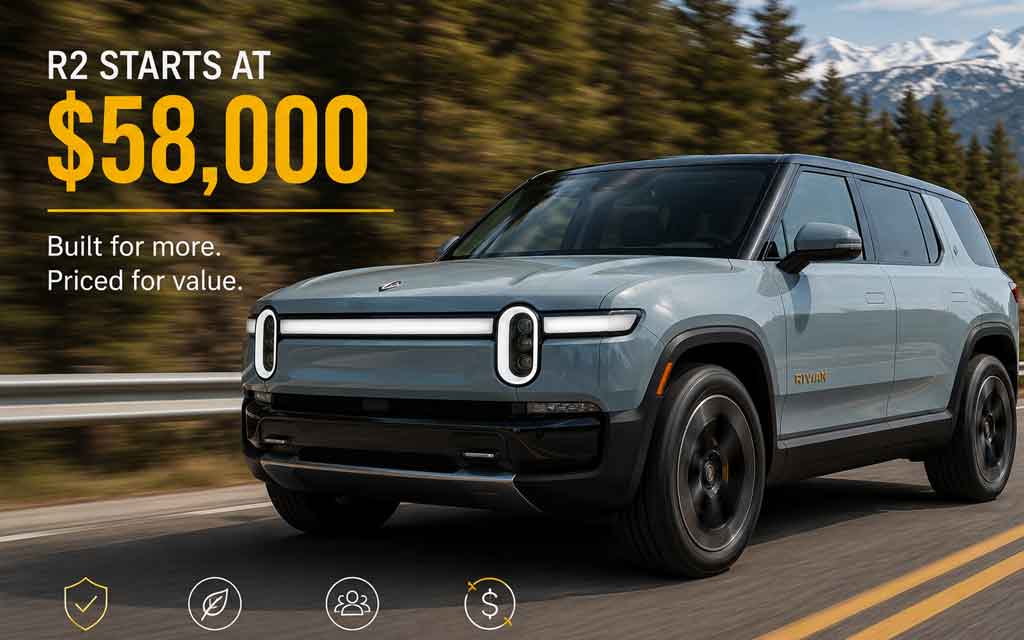
Rivian’s R2 represents one of the most important product launches in the electric vehicle industry in 2026. After years of building its reputation with the premium R1T pickup and R1S SUV, Rivian is finally entering the more competitive mid-size SUV segment with a vehicle explicitly designed to challenge the Tesla Model Y.
The company revealed its full pricing structure in March 2026, and the strategy is anything but straightforward. Instead of launching at the long-promised ~$45,000 price point, Rivian is taking a phased, premium-first approach — starting with higher-priced trims in 2026 before introducing the more affordable version in 2027.
This article provides a detailed analysis of Rivian’s R2 pricing strategy, its competitive positioning, business rationale, risks, and long-term implications.
Rivian R2 Official Pricing Breakdown
Here’s how Rivian structured the R2 lineup:
Performance (with Launch Package)
- Starting Price: $57,990
- Availability: Spring 2026
- Powertrain: Dual-Motor / Triple-Motor
- Key Highlights: Highest capability, off-road focused, Launch Package included
- Target Buyer: Early adopters and enthusiasts
Premium
- Starting Price: $53,990
- Availability: Late 2026
- Powertrain: Dual Motor
- Key Highlights: Elevated interior, premium features, and enhanced comfort
- Target Buyer: Mainstream premium buyers
Standard
- Starting Price: ~$44,990–$45,000
- Availability: 2027
- Powertrain: RWD or AWD options
- Key Highlights: Most affordable entry point into the lineup
- Target Buyer: Volume-market customers and broader audience buyers
Important notes:
- The first vehicles customers can actually purchase in 2026 start at nearly $58,000.
- The long-awaited ~$45,000 base model is delayed until 2027.
- Rivian is including a “Launch Package” (with extras like all-terrain wheels and Autonomy+ features) on early Performance models at no extra cost for a limited time.
The Strategic Logic Behind Rivian’s Pricing
Rivian’s decision to launch at higher prices before introducing the cheaper version is a calculated business move. Here’s why:
1. Cash Flow and Margin Protection
Rivian has burned through significant capital building its brand and factories. Starting with the higher-margin Performance trim allows the company to generate stronger revenue per vehicle in the early stages while production volumes are still ramping up. This is a common strategy among startups (Tesla used a similar approach with the Model S and Model 3).
2. Brand Positioning
Rivian has positioned itself as a premium adventure vehicle maker. Launching the R2 too aggressively at $45,000 from day one could have undermined the premium perception it built with the R1 lineup. By starting in the mid-to-high $50,000 range, Rivian maintains pricing power and brand integrity.
3. Time to Reduce Costs
Bringing a vehicle to market at true high-volume pricing requires significant scale in battery procurement, manufacturing, and supply chain. Rivian is using 2026 to refine production processes before introducing the lower-priced Standard model in 2027.
4. Testing Demand at Different Price Points
By offering multiple trims over time, Rivian can gather real market data on price sensitivity before committing to high-volume production of the base model.
Competitive Analysis: Rivian R2 vs Tesla Model Y
The R2 is widely viewed as Rivian’s direct answer to the Tesla Model Y. Here’s how they compare:
| Factor | Rivian R2 (2026 Launch) | Tesla Model Y (2026) | Winner |
|---|---|---|---|
| Starting Price | $57,990 | ~$44,000–$50,000 | Tesla |
| Adventure Capability | Excellent (off-road focused) | Average | Rivian |
| Software & Autonomy | Good | Industry-leading | Tesla |
| Charging Network | Good (NACS access) | Best-in-class | Tesla |
| Interior & Build Quality | Premium feel | Very good | Slight edge Rivian |
| Cargo & Practicality | Strong | Excellent | Tesla |
| Brand & Ecosystem | Growing | Extremely strong | Tesla |
Key takeaway: In 2026, the R2 is not a direct price competitor to the base Model Y. It competes more directly with the Model Y Long Range or Performance versions. Rivian is betting that a meaningful portion of buyers will pay a premium for better off-road ability, a more premium interior, and a distinct adventure-oriented design.
Business and Financial Context
Rivian’s pricing strategy must be viewed through the lens of its current financial situation:
- The company has yet to achieve consistent profitability.
- Production scale remains relatively low compared to Tesla.
- The U.S. EV market became more challenging in 2025–2026 after federal tax credits were reduced or eliminated.
By starting at higher prices, Rivian is attempting to improve its gross margins on early R2 sales. However, this approach carries risk — if demand at the $54k–$58k level is weaker than expected, the company could face slower sales growth in its most important upcoming product.
Risks in the Current Pricing Approach
1. Expectation Gap Many potential buyers were led to believe a ~$45,000 Rivian would arrive in 2026. Launching significantly higher could create disappointment and negative sentiment.
2. Market Timing The U.S. EV market is more price-sensitive in 2026. Launching a vehicle in the upper $50,000 range during a softer market is ambitious.
3. Competitive Pressure Tesla continues to have strong pricing power and an unmatched charging + software ecosystem. Many buyers may simply wait for a cheaper R2 in 2027 rather than pay the premium in 2026.
4. Brand Dilution Risk (Reverse) If Rivian eventually drops the price significantly in 2027, it could create a perception that early buyers overpaid.
Opportunities and Bull Case
Despite the risks, Rivian’s strategy has several positive aspects:
- Strong differentiation in the adventure/luxury crossover space
- Excellent early reviews of R2 driving dynamics and interior quality
- Opportunity to build a loyal customer base with the higher trims before going after volume
- Potential for strong residual values due to premium positioning
- Growing charging network access through NACS
If Rivian can successfully deliver the $45k Standard model in 2027 with competitive range and features, it could significantly expand its addressable market and put real pressure on the Model Y.
Final Verdict: Calculated but High-Stakes Strategy
Rivian’s R2 pricing strategy is pragmatic and financially disciplined, but it is also high-risk. The company is prioritizing short-term margins and brand positioning over immediate volume — a reasonable approach for a company that has historically struggled with profitability.
Success will depend on three factors:
- Strong demand for the $54k–$58k versions in 2026–early 2027
- Successful cost reduction to deliver a compelling ~$45k model in 2027
- Effective differentiation against the Tesla Model Y on capability and experience rather than pure price
Rivian is essentially saying: “We’re not going to race Tesla to the bottom on price. We’re going to build a better adventure vehicle and charge accordingly — at least at first.”
Whether this strategy pays off will be one of the most important stories in the EV industry over the next 18–24 months.



Leave a Comment