
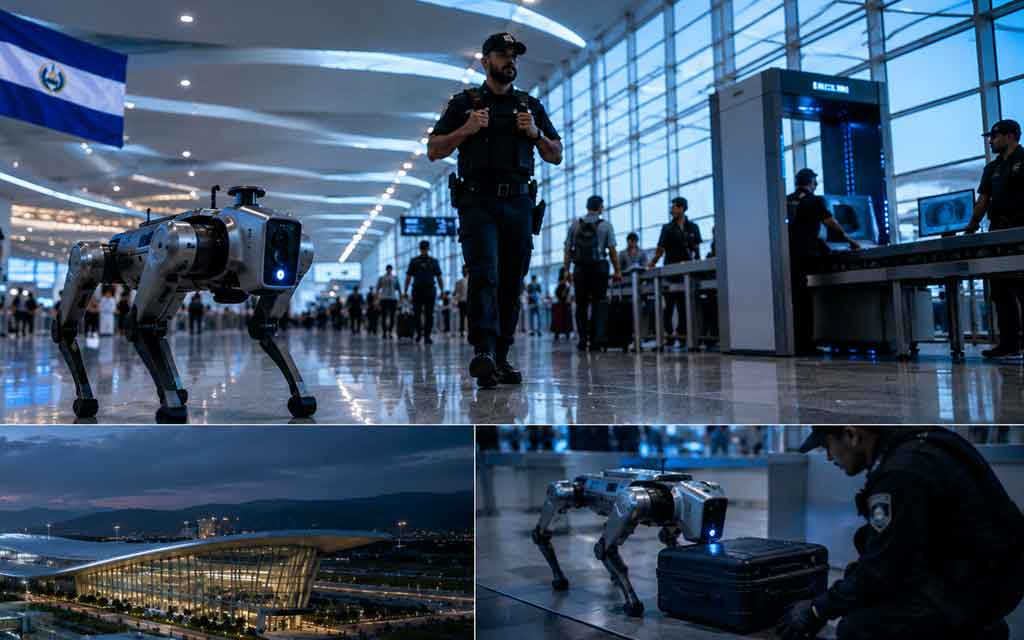
El Salvador is using advanced robot dogs branded “Aduna” to screen for drugs and controlled substances in its newly opened airport terminal. The move highlights President Bukele’s high-tech approach to security and tourism growth.
El Salvador has taken a futuristic step in airport security by deploying robot dogs to screen passengers and baggage for drugs and controlled substances at its newly expanded terminal.
The robots, branded Aduna (likely based on Boston Dynamics’ Spot platform or a customized variant), were unveiled as part of the $50 million passenger terminal expansion at El Salvador International Airport, officially opened on June 23, 2026. The project, funded by airport revenues and completed in just eight months, significantly boosts capacity and modernizes operations.
How the Robot Dogs Are Being Used
The Aduna robot dogs are equipped with advanced sensors for detecting narcotics, explosives, and other contraband. Key capabilities include:
- Autonomous Patrol and Screening: They can navigate crowded terminals, scan luggage, vehicles, and individuals without fatigue.
- Sensor Integration: Olfactory-like chemical sensors, cameras, and possibly UV or Raman spectroscopy for precise identification.
- Remote Operation and Data Integration: Operators can control or monitor them in real-time, feeding data into central security systems.
- Public Engagement: Early reports note the robots have captivated travelers — especially children — adding a novel, high-tech element to the airport experience.
The new terminal also features family-priority lines with zero wait times, a dedicated surfboard baggage carousel (nodding to El Salvador’s surfing tourism), tripled baggage handling capacity (up to 16,500 bags per hour), and high-tech Orion scanners.
Context: Bukele’s Tech-Driven Security Vision
Under President Nayib Bukele, El Salvador has aggressively pursued innovative security and infrastructure projects. The robot dogs align with his administration’s emphasis on technology to combat crime, gangs, and trafficking while boosting tourism — a key economic pillar.
The country has seen a surge in visitors thanks to improved safety perceptions and attractions like surfing and Bitcoin adoption. Modernizing the main international airport with cutting-edge tools like robot dogs signals a commitment to world-class standards and efficient border control.
Advantages of Robot Dogs in Airports
Compared to traditional K9 units, robotic counterparts offer several benefits:
- Consistency and Endurance: No fatigue, handler dependency, or biological limitations.
- Safety: Reduce risk to human officers and live animals in high-threat environments.
- Scalability: Can be deployed in greater numbers and integrated with AI for pattern recognition and predictive analytics.
- Data Collection: Generate detailed logs for analysis and training future systems.
Similar deployments (or tests) have appeared at airports in Miami and other locations for threat detection, showing a growing global trend toward robotics in aviation security.
Broader Implications and Future Tech Angle
This initiative fits into the expanding use of autonomous systems in public safety — from Boston Dynamics Spot robots in policing and inspections to AI-powered drones and scanners. For vfuturemedia readers interested in emerging tech:
- AI + Robotics Synergy: Sensor fusion and machine learning allow robots to improve detection accuracy over time.
- Privacy and Ethics: While effective for contraband screening, widespread deployment raises questions about surveillance scope and data handling.
- Tourism and Image: High-tech features can enhance a destination’s modern appeal, especially in regions modernizing rapidly.
El Salvador’s move could inspire other nations in Latin America and beyond facing similar security and capacity challenges at airports. As robot dogs become more affordable and capable, expect wider adoption in transportation hubs worldwide.
President Bukele’s government continues to blend bold infrastructure with technology — positioning El Salvador as a forward-looking player in regional tourism and security innovation.
What do you think? Are robot dogs a smart addition to airport security, or does this raise too many privacy concerns? How else could robotics transform travel?
Sources: Official announcements, local reports, and airport updates (June 23, 2026). This reflects ongoing tech integration in public infrastructure.




Leave a Comment