
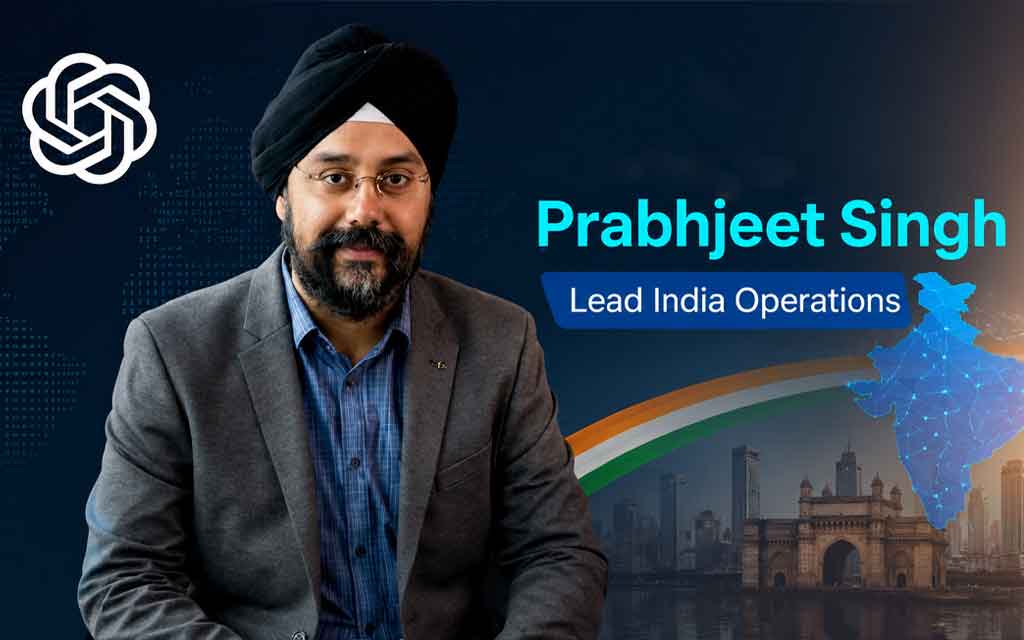
OpenAI has made a strategic leadership move that underscores its aggressive push into one of the world’s most important AI growth markets. The company has appointed Prabhjeet Singh, former President of Uber India and South Asia, as its Managing Director for India.
Singh will join OpenAI in September 2026 and report to Kiran Mani, Managing Director for Asia Pacific. He will serve as OpenAI’s most senior executive in the country, overseeing consumer growth, enterprise adoption, strategic partnerships, regulatory engagement, and overall operations.
India is already OpenAI’s second-largest market after the United States, with approximately 100 million weekly active ChatGPT users. This appointment signals that OpenAI is no longer just serving Indian users — it is building deep, localized operations to capture long-term value in the world’s largest democracy and one of its fastest-growing digital economies.
Who is Prabhjeet Singh?
Prabhjeet Singh brings more than a decade of experience scaling consumer technology platforms in India’s complex regulatory and competitive environment.
- Education: B.Tech from IIT Kharagpur and MBA from IIM Ahmedabad.
- Early Career: Started at Lehman Brothers in London, then spent over nine years at McKinsey & Company as an Associate Partner, advising clients across financial services, telecom, and consumer technology in India and Southeast Asia.
- Uber Tenure (2015–2026): Joined Uber in August 2015 as Head of Strategy. Rose through leadership roles including Director of Cities & Growth and General Manager for Delhi & North India before becoming President, India & South Asia in 2020.
During his 11-year stint at Uber, Singh helped transform the company’s mobility business across India, Bangladesh, and Sri Lanka. He oversaw expansion into new verticals (Auto, Moto, Shuttle), strengthened partnerships with public transport authorities, and aligned operations with India’s digital public infrastructure push.
His track record of navigating regulatory challenges, driving hyper-growth in a price-sensitive market, and building trusted relationships with government and ecosystem players makes him an ideal fit for OpenAI’s next phase in India.
OpenAI’s India Ambitions: From Users to Deep Operations
OpenAI’s interest in India has accelerated rapidly. In February 2026, the company launched its “OpenAI for India” initiative at the India AI Impact Summit in Delhi. Key pillars included:
- Partnership with Tata Group for sovereign AI infrastructure (starting with 100 MW capacity, with potential to scale significantly).
- Plans to open new offices in Mumbai and Bengaluru (in addition to existing presence in New Delhi).
- Large-scale enterprise adoption programs, including ChatGPT Enterprise deployments with major Indian corporates.
- Workforce skilling initiatives and expansion of OpenAI certification programs.
India’s ChatGPT user base has shown exceptional engagement. Young users (18–34) account for roughly 80% of consumer messages, with particularly strong adoption in coding, data analysis, and education use cases. OpenAI has even published a dedicated report titled “How India Uses ChatGPT,” highlighting advanced usage patterns.
Despite massive adoption, converting free users to paid subscribers remains a challenge in India’s price-sensitive market. OpenAI previously introduced a lower-priced “ChatGPT Go” plan to address this gap.
Why This Hire Matters: The Strategic Fit
Prabhjeet Singh’s Uber experience is highly relevant to OpenAI’s current priorities:
Uber Challenges in India
- Complex, state-level regulations
- Price-sensitive mass market
- Building trust and local partnerships
- Scaling operations across 28+ states
- Product diversification
Singh’s Likely Value to OpenAI
- Regulatory navigation & government relations (DPDP Act, AI governance)
- Consumer growth & pricing strategy
- Enterprise & sovereign AI deals
- Ecosystem partnerships (Tata, etc.)
- Pan-India enterprise & developer adoption
- Operational excellence & city-level execution
- Product localization & go-to-market
- Multimodal, voice & agentic AI for India
India’s AI market demands leaders who understand both hyper-growth consumer dynamics and sophisticated enterprise/government engagement. Singh has proven expertise in both.
What Prabhjeet Singh Will Focus On
As Managing Director, Singh’s mandate is expected to include:
- Consumer Growth: Accelerating ChatGPT adoption and improving conversion to paid plans through localized pricing, vernacular support, and India-specific features.
- Enterprise Adoption: Deepening penetration among Indian enterprises, IT services companies, BFSI, healthcare, and education sectors.
- Strategic Partnerships: Strengthening ties with Indian tech giants, startups, and government initiatives under the IndiaAI Mission.
- Regulatory Engagement: Representing OpenAI in policy discussions around AI safety, data sovereignty, and responsible innovation.
- Operational Excellence: Building out local teams in Delhi, Mumbai, and Bengaluru while ensuring smooth execution across a diverse market.
Implications for India’s AI Ecosystem
This move has several ripple effects:
- Talent Magnet Effect: OpenAI’s elevated presence will intensify the war for AI talent in India. Expect more competition for top researchers, engineers, and product talent in Bengaluru, Hyderabad, and Delhi-NCR.
- Enterprise AI Acceleration: Indian companies (especially mid-market and large enterprises) will see faster, more localized support for deploying generative AI.
- Startup Ecosystem Boost: Stronger OpenAI presence often correlates with increased investment and partnership activity for Indian AI startups.
- Sovereign AI Momentum: Combined with the Tata partnership, this leadership appointment reinforces India’s push for domestic AI infrastructure and capabilities.
- Global AI Race: It highlights how frontier AI labs are treating India not just as a user market but as a strategic pillar alongside the US.
Challenges and Opportunities Ahead
While the opportunity is massive, execution will not be easy. Key challenges include:
- Converting India’s massive free user base into sustainable revenue.
- Competing with well-entrenched players like Google, Microsoft, and emerging Indian AI startups.
- Navigating evolving AI regulations and data localization requirements.
- Building truly localized experiences (Indic languages, voice-first interfaces, domain-specific fine-tuning).
On the opportunity side, India offers one of the world’s largest pools of AI talent, rapidly improving digital infrastructure, and a government actively pushing AI adoption through the IndiaAI Mission.
What This Means for Global Tech and NRI Audiences
For American and NRI readers, this development is a reminder that the center of gravity in AI adoption and talent is shifting. Indian engineers and entrepreneurs are playing an increasingly important role in shaping global AI tools. Companies like OpenAI are making structural bets on India’s market and talent — a trend that is likely to accelerate.
This also creates opportunities for cross-border collaboration, enterprise AI deployments by global firms operating in India, and investment themes around India’s AI infrastructure and application layer.
Frequently Asked Questions
When will Prabhjeet Singh join OpenAI? He is scheduled to join in September 2026.
What was Prabhjeet Singh’s role at Uber? He served as President of Uber India and South Asia for nearly six years (2020–2026) after joining the company in 2015. He led mobility operations across India, Bangladesh, and Sri Lanka.
Why is India so important to OpenAI? India is OpenAI’s second-largest market by users (after the US), with ~100 million weekly active ChatGPT users. It represents massive future growth potential in both consumer and enterprise segments.
Will this change anything for ChatGPT users in India? Users can expect more localized features, better support, and potentially more India-specific pricing and product experiments over time. Enterprise customers may see faster deployment support.
Does OpenAI have offices in India already? Yes. OpenAI has an existing presence in New Delhi and announced plans in early 2026 to open additional offices in Mumbai and Bengaluru.
Final Takeaway
OpenAI’s decision to bring in a proven India market scaler like Prabhjeet Singh marks a clear evolution in its India strategy — from user acquisition to deep market building. With India already delivering enormous user numbers and showing sophisticated adoption patterns, this leadership hire positions OpenAI to compete more effectively for both consumer mindshare and enterprise budgets in one of the most important AI markets of the decade.
The coming months will reveal how Singh translates his Uber playbook into AI leadership — and how quickly OpenAI can turn India’s massive user base into sustainable growth and deeper ecosystem influence.
Tags: OpenAI, Prabhjeet Singh, AI India, ChatGPT India, OpenAI India, tech leadership, Uber India, generative AI, enterprise AI, India tech news
“What do you think about OpenAI’s latest leadership move in India? Will it accelerate enterprise AI adoption? Share your thoughts in the comments below. For more on frontier AI and India’s tech ecosystem, subscribe to our newsletter.”



Leave a Comment