
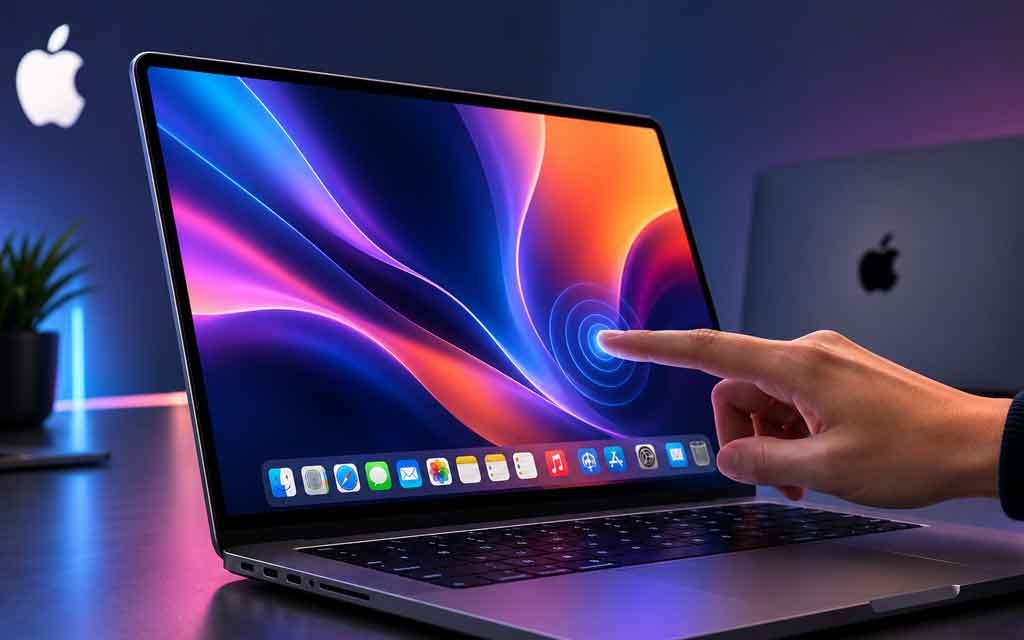
Apple is reportedly planning to introduce a touchscreen display on the next-generation MacBook Pro, marking a significant shift in the company’s long-standing design philosophy for its laptop lineup.
According to multiple supply chain sources and industry analysts, Apple is actively testing touchscreen technology for future MacBook Pro models, with a potential launch as early as late 2026 or 2027. This would be the first time Apple has offered a touchscreen on its MacBook Pro line since the product’s inception.
A Major Departure from Apple’s Traditional Approach
For years, Apple has resisted adding touchscreens to MacBooks, even as Windows-based laptops widely adopted the feature. Former Apple CEO Steve Jobs famously dismissed the idea, arguing that touchscreens on laptops lead to “gorilla arm” fatigue and that the trackpad offered a superior experience for precise work.
Apple has instead pushed users toward its iPad lineup for touch-based interactions, promoting Continuity features that allow seamless switching between Mac and iPad. However, the company appears to be reconsidering this stance as user expectations evolve and competition intensifies.
Industry reports suggest that Apple’s decision is being driven by several factors, including advancements in display technology, changing user workflows, and the need to differentiate its premium laptops in an increasingly competitive market.
Why Apple Might Be Changing Course
Several developments appear to be influencing Apple’s reported plans:
- Advanced display technology: The transition to OLED panels on future MacBook Pros could make touchscreen implementation more practical and power-efficient than previous LCD-based designs.
- AI and creative workflows: Many professionals now expect more direct interaction with their screens, especially when working with AI tools, photo editing, video timelines, and design software.
- Competition from Windows laptops: High-end Windows machines from Dell, HP, Lenovo, and Microsoft have successfully combined powerful performance with touchscreen capabilities, pressuring Apple to respond.
- M-series chip capabilities: Apple’s latest silicon provides enough power and efficiency to support additional display features without major battery trade-offs.
- User demand: Surveys and feedback from creative professionals have shown growing interest in touchscreen MacBooks, particularly for specific tasks.
While Apple has historically been cautious about adding features simply because competitors offer them, the combination of technological readiness and shifting user expectations appears to have changed the internal calculus.
What a Touchscreen MacBook Pro Might Look Like
If Apple moves forward with a touchscreen MacBook Pro, it is expected to integrate touch in a way that feels natural to the macOS experience rather than simply copying Windows implementations.
Potential features could include:
- Support for multi-touch gestures directly on the display
- Apple Pencil support for precise drawing and annotation (especially valuable for designers and note-takers)
- Enhanced interaction with creative apps like Final Cut Pro, Logic Pro, and Adobe Creative Cloud
- Better integration with Stage Manager and other macOS window management tools
- Context-sensitive controls that appear when needed and disappear when not in use
Apple is also expected to maintain the large, high-quality trackpad that users love, meaning the touchscreen would serve as a complementary input method rather than a replacement.
Potential Challenges
Despite the excitement, adding a touchscreen to the MacBook Pro presents several technical and design challenges that Apple must solve:
- Battery life impact: Touch layers can increase power consumption. Apple will need to optimize this carefully to maintain its industry-leading battery performance.
- macOS interface adaptation: Many macOS interface elements are designed for cursor interaction. Significant UI refinements may be needed to make touch feel native.
- Thermal and structural considerations: Adding touch capability could affect the laptop’s thin and light design goals.
- Price positioning: A touchscreen model would likely command a premium, potentially pushing the starting price of the MacBook Pro higher.
Apple’s history of careful product development suggests the company will not release a touchscreen MacBook Pro until these issues are properly addressed.
Implications for Users and the Mac Ecosystem
A touchscreen MacBook Pro would represent one of the biggest changes to the Mac experience in over a decade. For many users — particularly creative professionals, students, and power users — it could make the MacBook Pro significantly more versatile.
It would also strengthen Apple’s ecosystem story. Users who already own iPads could enjoy more consistent touch interactions across devices, while those who prefer a single device might find the MacBook Pro sufficient for both laptop and tablet-like use cases.
On the software side, developers would likely begin optimizing their Mac apps for touch input, potentially accelerating the evolution of macOS interfaces.
Competitive Context
The move would come as Apple faces increasing pressure in the premium laptop segment. Windows manufacturers have made significant strides with OLED displays, powerful AI PCs, and flexible form factors. A touchscreen MacBook Pro would help Apple respond directly to these trends while leveraging its strengths in hardware-software integration and build quality.
It could also influence how Apple positions the MacBook Air versus MacBook Pro in the future, with the Pro line becoming the more advanced, touch-enabled option.
What to Expect Next
While no official confirmation has come from Apple, the consistency of recent supply chain reports suggests the company is seriously exploring this direction. Analysts expect more concrete information during Apple’s typical fall product announcements, though a 2026 launch remains the most commonly cited timeframe.
Apple is also expected to continue refining its iPad lineup and Continuity features regardless of whether a touchscreen MacBook Pro arrives. The two approaches may eventually coexist, giving users multiple ways to interact with Apple devices.
Final Thoughts
The reported inclusion of a touchscreen on future MacBook Pro models would mark a notable evolution in Apple’s laptop strategy. After years of resisting the feature, the company appears to be responding to both technological advancements and changing user needs.
If executed well, a touchscreen MacBook Pro could offer the best of both worlds — the power and precision of a traditional laptop combined with the direct, intuitive interaction that touch enables. It would also reinforce Apple’s reputation for thoughtful innovation, even when that means eventually embracing ideas it once rejected.
As with any major Apple product decision, the final implementation will likely determine whether this becomes a defining feature or simply another option in an increasingly diverse laptop market.
The coming months should bring more clarity on Apple’s plans and timeline. Until then, the possibility of a touchscreen MacBook Pro remains one of the most interesting developments to watch in the personal computing space.



Leave a Comment