
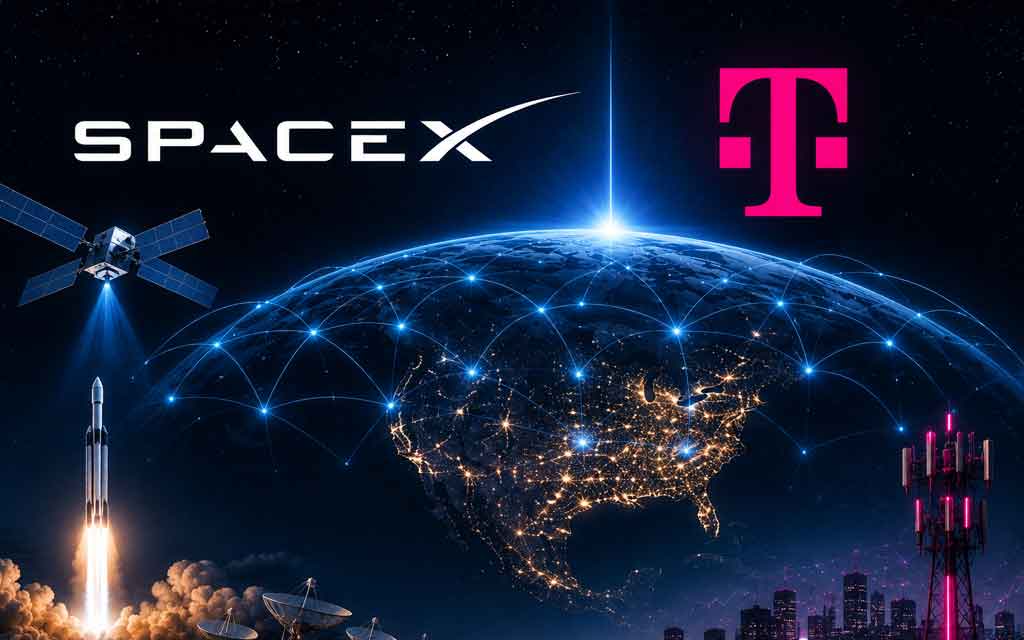
Analysts are increasingly discussing the possibility of SpaceX acquiring T-Mobile, a move that would combine the world’s most advanced satellite network with one of America’s largest terrestrial wireless carriers. While no formal talks have been confirmed, the speculation highlights the growing convergence between space-based and ground-based connectivity.
Such an acquisition would represent one of the most ambitious vertical integrations in tech and telecommunications history — and could fundamentally reshape how Americans access mobile service.
Why Analysts Are Talking About a SpaceX-T-Mobile Deal
The logic behind the speculation centers on the powerful synergies between Starlink’s direct-to-cell technology and T-Mobile’s extensive terrestrial network.
Starlink has already begun rolling out direct-to-cell service through a partnership with T-Mobile, enabling compatible phones to connect to satellites for texting (with voice and data expected later). A full acquisition would give SpaceX ownership of both the satellite constellation and the ground infrastructure, spectrum, customer base, and retail presence needed to deliver seamless hybrid connectivity.
Key drivers include:
- End-to-end control — Owning both layers would allow SpaceX to optimize coverage, pricing, and features without relying on a partner.
- Rural and coverage gaps — T-Mobile’s network is strong in many areas but still has limitations in remote regions. Starlink satellites could fill those gaps instantly.
- Competitive differentiation — A combined entity could offer truly ubiquitous coverage — something no traditional carrier can match today.
- Scale and economics — Combining Starlink’s global satellite infrastructure with T-Mobile’s domestic customer base and spectrum holdings could create significant cost and capability advantages.
- Future of connectivity — As devices increasingly support satellite connectivity (from phones to vehicles and IoT), owning both terrestrial and non-terrestrial networks becomes strategically valuable.
Forbes and other outlets have noted that Elon Musk and SpaceX have shown interest in expanding Starlink’s role in mobile communications. Acquiring a major carrier would accelerate that vision dramatically.
What a Combined Company Would Look Like
A SpaceX-T-Mobile merger would create a unique hybrid telecommunications powerhouse:
- Ubiquitous coverage — Customers could stay connected in cities via traditional towers and in remote or disaster-affected areas via satellite.
- New service models — Potential for integrated plans that blend terrestrial 5G with satellite fallback, or even standalone satellite service for specific use cases.
- Innovation velocity — SpaceX’s engineering culture and rapid iteration approach could accelerate features like seamless handoff between networks, advanced satellite capabilities, and integration with other Musk ecosystem products (Tesla vehicles, for example).
- Global ambitions — While T-Mobile is primarily a U.S. carrier, Starlink’s international reach could help expand the combined company’s footprint or influence global standards.
The result would be a company positioned at the intersection of terrestrial wireless, satellite communications, and next-generation device ecosystems.
Strategic Fit with SpaceX’s Broader Vision
SpaceX has consistently pursued ambitious, vertically integrated strategies — from reusable rockets to Starlink’s full-stack satellite internet. Adding a major mobile carrier would extend that philosophy into consumer telecommunications.
It would also align with Musk’s long-stated goal of making humanity multi-planetary while improving life on Earth through better connectivity. Reliable mobile service is foundational to education, healthcare, emergency response, and economic opportunity — areas where Starlink has already made an impact in underserved regions.
Furthermore, direct control over both satellite and terrestrial assets could strengthen SpaceX’s position in the emerging “direct-to-device” market, where phones connect to satellites without traditional carrier mediation (a topic gaining attention as SpaceX explores more consumer-facing Starlink mobile options).
Challenges and Regulatory Hurdles
Despite the strategic appeal, a SpaceX acquisition of T-Mobile would face significant obstacles:
- Regulatory approval — The deal would require clearance from the FCC, Department of Justice, and potentially other agencies. Concerns about market concentration in wireless could arise, especially given T-Mobile’s position as one of the “big three” U.S. carriers.
- Valuation and financing — T-Mobile has a substantial market capitalization. SpaceX would need to structure a deal that satisfies shareholders while preserving capital for its core space and satellite businesses.
- Cultural and operational integration — Merging SpaceX’s fast-moving, engineering-driven culture with a large, established telecom operator would present integration challenges.
- Spectrum and competition issues — Questions around spectrum holdings, roaming agreements, and competitive dynamics would need careful navigation.
- Public and political scrutiny — Given Elon Musk’s high profile and SpaceX’s government contracts, the deal would likely attract intense media and political attention.
These hurdles are substantial but not unprecedented. Major tech and telecom combinations have succeeded in the past when the strategic rationale was strong enough.
Implications for Consumers and the Industry
If a deal were to happen, consumers could eventually benefit from:
- Better coverage in rural and hard-to-reach areas
- More resilient service during outages or natural disasters
- Potentially more competitive pricing as the combined entity leverages scale
- Faster innovation in satellite-terrestrial integration
For the broader industry, a SpaceX-T-Mobile combination would intensify competition and force other carriers to accelerate their own satellite strategies or partnerships. It could also accelerate the blurring of lines between traditional telecom and space-based communications.
Competitors like Verizon and AT&T would likely respond with their own satellite initiatives or deeper collaborations with providers like AST SpaceMobile or Amazon’s Project Kuiper.
The Bigger Picture: American Leadership in Connectivity
A potential SpaceX acquisition of T-Mobile would reinforce U.S. leadership in next-generation communications infrastructure. American companies are already at the forefront of satellite internet (Starlink), reusable launch systems, and advanced wireless technology. Combining satellite and terrestrial strengths under one innovative company could further solidify that position globally.
It would also support national goals around digital equity, rural broadband access, and resilient communications — priorities that have gained importance as remote work, telehealth, and emergency preparedness become more central to daily life.
What Happens Next?
At this stage, the idea remains speculative. No official discussions have been publicly confirmed, and both companies have other priorities (SpaceX with Starship development and Starlink expansion; T-Mobile with 5G network upgrades and customer growth).
However, the underlying technology and market trends are real. As direct-to-cell capabilities mature and consumer demand for ubiquitous connectivity grows, consolidation or deeper integration between satellite and terrestrial players becomes increasingly logical.
Whether through acquisition, deeper partnership, or independent development, the future of mobile connectivity will almost certainly involve hybrid satellite-terrestrial networks.
Frequently Asked Questions
Has SpaceX officially said it wants to buy T-Mobile? No. The idea is currently analyst speculation and media discussion based on strategic logic.
How would this affect current T-Mobile customers? In the near term, little would change. Over time, customers could gain access to expanded satellite coverage and new service options.
Would this create too much market power? Regulators would scrutinize any deal closely. The combination would need to demonstrate clear consumer benefits to gain approval.
What about other carriers? Verizon and AT&T would likely accelerate their own satellite strategies or partnerships in response.
When could something like this happen? Any deal would take years to negotiate and receive regulatory approval, assuming it moves forward at all.
The Bottom Line
The idea of SpaceX acquiring T-Mobile represents one of the most intriguing “what if” scenarios in technology and telecommunications today. While still speculative, it highlights the powerful convergence happening between space-based and ground-based networks.
SpaceX has repeatedly shown an ability to execute ambitious, vertically integrated visions. Adding a major U.S. wireless carrier would extend that approach into consumer mobile service at massive scale.
Whether through acquisition or other forms of deeper collaboration, the integration of Starlink’s satellite capabilities with terrestrial networks appears increasingly inevitable. The companies that successfully bridge these worlds will define the next era of connectivity — and American innovation is once again at the center of that transformation.
The future of mobile service may not be purely terrestrial or purely satellite. It may be both — delivered by companies bold enough to own the entire stack.
Do you think a SpaceX-T-Mobile combination would be good for consumers? What concerns or opportunities stand out most to you? Share your thoughts in the comments.



Leave a Comment