
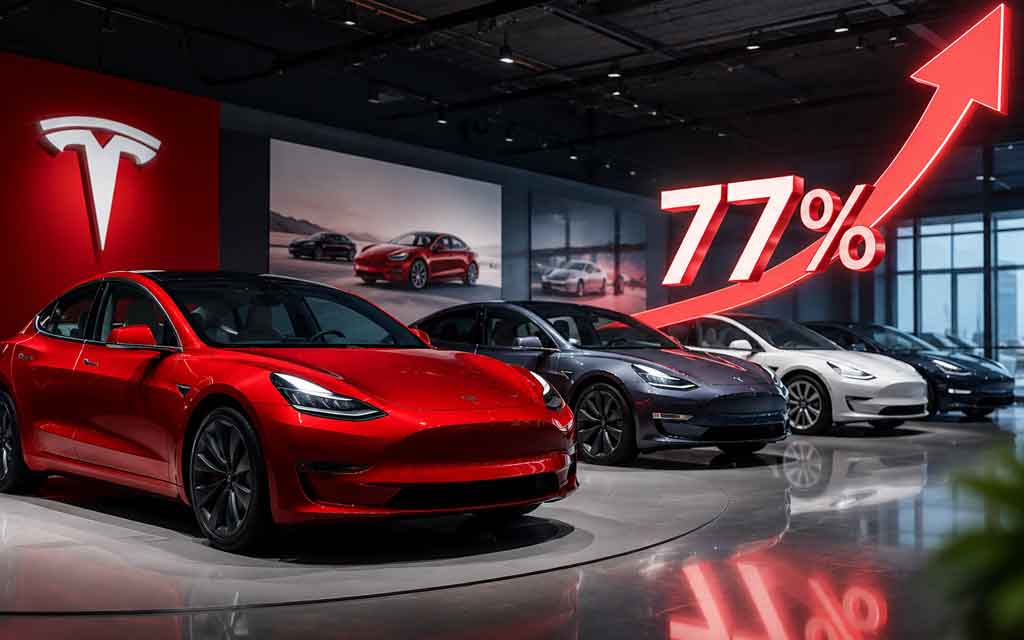
Tesla delivered a strong performance in Europe, with sales surging 77% from January through May 2026 compared to the same period last year. The result stands out against a European EV market that has faced stabilization challenges, policy shifts, and slower overall growth in several countries.
This rebound highlights Tesla’s continued ability to drive demand through product refreshes, pricing discipline, and its expanding charging infrastructure — even as competitors struggle with inventory and shifting consumer incentives.
The Numbers Behind the Surge
Tesla’s European registrations grew sharply in the first five months of 2026. The Model Y remained the dominant contributor, supported by refreshed versions and competitive pricing in key markets such as Germany, the UK, France, and the Netherlands.
The 77% increase represents one of Tesla’s strongest European performances in recent years and comes after a more mixed 2025 that saw some softening in certain segments. Year-to-date growth has outpaced most legacy automakers and many newer EV entrants.
This momentum is particularly notable because overall EV sales in Europe have not grown at the same pace. Many traditional manufacturers reported flat or declining volumes in the same period, citing higher interest rates, reduced subsidies in some countries, and consumer caution around new technology.
Why Tesla Is Gaining Ground in Europe
Several factors appear to be driving Tesla’s outsized performance:
- Product refreshes and value — Updated Model Y variants with improved range, interior features, and pricing have resonated with European buyers. The company has maintained a strong value proposition even as some competitors raised prices or faced supply constraints.
- Charging network advantage — Tesla’s Supercharger network continues to be a major differentiator. European buyers increasingly factor in real-world charging reliability and speed when making purchase decisions. The continued expansion and opening of the network to non-Tesla vehicles has also strengthened brand perception.
- Software and ecosystem — Over-the-air updates, Full Self-Driving (where available), and the broader Tesla app experience remain competitive advantages that legacy automakers have struggled to match at scale.
- Brand strength and awareness — Despite occasional controversies, Tesla maintains high brand recognition and consideration among European EV intenders, particularly in the premium and performance segments.
These elements have allowed Tesla to capture share even in a market where overall EV adoption growth has moderated.
Broader European EV Market Context
Europe’s EV transition has entered a more complex phase. While long-term policy support for electrification remains in place, near-term headwinds include:
- Reduced or restructured purchase incentives in several countries.
- Higher interest rates affecting financing costs for new vehicles.
- Increased competition and inventory build-up among legacy brands.
- Consumer hesitation around charging infrastructure outside major corridors.
Against this backdrop, Tesla’s 77% growth stands out as a clear outlier. It suggests that when product, pricing, and infrastructure align, demand remains robust — particularly for vehicles perceived as technologically advanced and practically usable.
The result also provides a counterpoint to narratives suggesting EV demand has peaked in Europe. Instead, it points to a market that is becoming more selective: buyers are gravitating toward brands and models that deliver clear advantages in ownership experience.
Implications for Tesla and Global EV Leadership
For Tesla, strong European results provide important validation as the company continues to ramp new products globally and navigates a more competitive landscape in China and the United States.
Europe has historically been a key profit center and brand showcase for Tesla. Sustained growth here supports overall scale, helps amortize fixed costs (including R&D and manufacturing), and reinforces Tesla’s position as the leading EV brand in one of the world’s most important auto markets.
The performance also carries strategic weight in the broader US-China-Europe EV competition. While Chinese manufacturers have gained share in some segments through aggressive pricing, Tesla’s ability to grow significantly in Europe demonstrates that brand, technology, and ecosystem advantages can still prevail.
For the wider industry, Tesla’s results serve as a reminder that execution matters. Companies that deliver consistent product updates, reliable charging access, and strong ownership experiences are better positioned to capture demand even when overall market growth slows.
Challenges and Risks Ahead
Despite the strong start to 2026, Tesla faces ongoing challenges in Europe and globally:
- Intensifying competition from both legacy European automakers (VW Group, BMW, Mercedes) and Chinese entrants with competitive offerings.
- Potential changes in trade policy or tariffs that could affect pricing and supply chains.
- Execution risks around new vehicle launches and software feature rollouts.
- Macroeconomic sensitivity — higher interest rates or economic uncertainty could still dampen demand for higher-priced vehicles.
Tesla will need to sustain product momentum and continue improving its European charging and service experience to maintain this growth trajectory through the second half of the year and into 2027.
What This Means for the Global EV Transition
Tesla’s European surge reinforces that the shift to electric vehicles remains fundamentally intact, even if the pace varies by region and brand. Demand is becoming more discerning rather than disappearing.
Buyers in mature EV markets are increasingly choosing vehicles and brands that solve real ownership pain points — range confidence, charging convenience, software reliability, and total cost of ownership. Tesla’s ability to deliver on these dimensions continues to differentiate it.
At the same time, the result highlights the importance of American innovation in the global EV story. Tesla’s technology, manufacturing scale, and software-first approach originated in the United States and continue to set benchmarks that competitors around the world are working to match.
Frequently Asked Questions
How significant is a 77% sales increase for Tesla in Europe? It represents very strong growth, especially in a market where many competitors have seen flat or declining volumes. It suggests Tesla is gaining meaningful share.
Which models are driving the growth? The refreshed Model Y has been the primary contributor, supported by competitive pricing and strong demand for Tesla’s performance and Long Range variants.
Does this mean the European EV market is recovering overall? Not necessarily across the board. Tesla’s growth has outpaced the wider market, indicating brand-specific strength rather than a broad rebound in EV demand.
How does this compare to Tesla’s performance in other regions? Europe has been a bright spot. Performance in China has been more competitive, while the US market has seen its own dynamics tied to incentives and new model availability.
What should investors watch next? Continued European momentum through the summer, updates on new model launches (including any right-hand-drive or market-specific variants), and progress on charging network expansion and utilization.
The Bottom Line
Tesla’s 77% sales surge in Europe from January through May 2026 demonstrates that strong product execution and ecosystem advantages can still drive significant growth even in a more challenging EV market environment.
While broader European EV adoption has moderated, Tesla has shown it can expand volumes meaningfully by delivering vehicles and supporting infrastructure that meet customer expectations. This performance provides important momentum as the company scales new products and competes globally.
The result also serves as a reminder that the electric vehicle transition is not a straight line. Demand can accelerate for brands that solve real customer problems — and Tesla has once again shown it remains capable of doing exactly that in one of the world’s most important auto markets.
American innovation in electric vehicles continues to set the pace. Tesla’s European results are the latest evidence that when technology, product, and infrastructure align, buyers respond.
How do you see Tesla’s European momentum affecting the broader EV competitive landscape in the second half of 2026? Share your thoughts in the comments.

Leave a Comment