
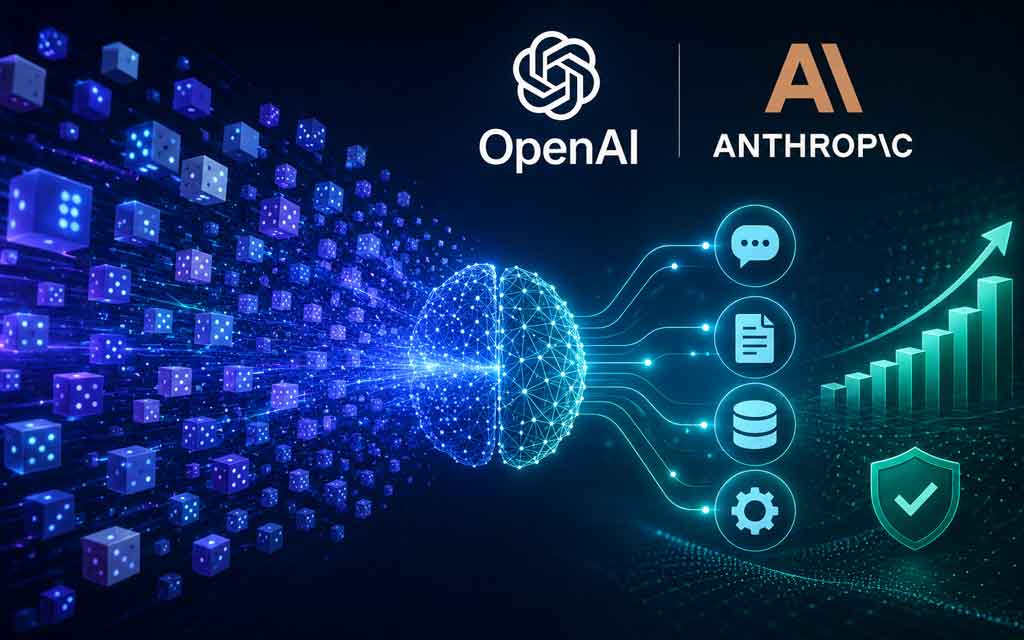
Businesses are moving away from “tokenmaxxing” — the practice of maximizing token usage in large language models to unlock more capability — and toward efficiency-focused strategies. This shift is raising questions about the long-term revenue trajectory for frontier AI companies like OpenAI and Anthropic, whose growth has been closely tied to rising token consumption.
As organizations gain experience with generative AI, many are discovering they can achieve strong results with fewer tokens through better prompting, model selection, caching, and workflow optimization. While this is positive for customers, it introduces headwinds for the companies selling the most advanced (and expensive) models.
What Tokenmaxxing Actually Means
In the early days of widespread ChatGPT and Claude adoption, many enterprises followed a simple strategy: throw more context, longer prompts, chain-of-thought reasoning, and multiple model calls at problems to get better outputs. This “tokenmaxxing” approach drove rapid increases in usage and spending.
Frontier models from OpenAI and Anthropic excelled in this environment because their superior reasoning and context handling rewarded heavier token consumption. Higher usage translated directly into higher revenue for the labs, especially as enterprises moved from experimentation to production workloads.
However, as AI deployment matures, the economics are changing. Companies are now asking: How do we get 80-90% of the performance at a fraction of the token cost?
The Efficiency Turn Is Underway
Several trends are accelerating the shift:
- Prompt engineering and optimization — Teams are investing in reusable, highly efficient prompts and templates that deliver consistent results with far fewer tokens.
- Model routing and distillation — Organizations are routing simpler tasks to smaller, cheaper models while reserving frontier models for high-value work.
- Caching and retrieval strategies — Vector databases, semantic caching, and RAG (retrieval-augmented generation) reduce the need to re-process the same context repeatedly.
- Agentic workflow redesign — Instead of one massive token-heavy call, companies are breaking tasks into smaller, more efficient steps that can be parallelized or handled by specialized tools.
- Fine-tuning and smaller models — Many businesses are fine-tuning or distilling smaller models on their specific data, achieving near-frontier performance at dramatically lower inference costs.
This efficiency focus is not limited to cost-cutting. It often improves reliability, reduces latency, and makes AI more practical to deploy at scale across an organization.
Implications for OpenAI and Anthropic
OpenAI and Anthropic have built highly profitable businesses on the back of high token consumption from their most advanced models. As customers become more sophisticated about token usage, several pressures emerge:
- Slower growth in average revenue per user if efficiency gains outpace new use case expansion.
- Increased competition from smaller, cheaper models (both open-source and proprietary) that can handle a larger share of workloads.
- Margin compression if labs must offer more aggressive pricing or volume discounts to retain large enterprise customers.
- Need for new monetization approaches beyond pure token-based pricing.
The risk is particularly relevant as agentic systems and multi-step workflows become more common. These applications can be highly token-intensive in their early forms, but they are also prime candidates for optimization once teams understand the patterns.
If enterprises successfully reduce token consumption per task by 30-50% while maintaining output quality, the revenue math for frontier labs changes meaningfully.
Why Growth May Still Continue
The efficiency shift does not necessarily mean the end of rapid growth for OpenAI and Anthropic. Several countervailing forces are at play:
- New high-value use cases continue to emerge. Complex reasoning, long-horizon planning, and multi-agent systems often require substantial context and multiple model calls. These workloads can offset efficiency gains in simpler tasks.
- Agentic AI adoption (such as tools like Codex) tends to increase overall token usage even as individual tasks become more efficient. Autonomous agents that plan, act, and iterate can consume significant tokens over time.
- Enterprise expansion is still early. Many large organizations are only beginning to move AI from pilots to core business processes. The absolute volume of work being automated is still growing fast.
- Premium capabilities command premium pricing. Organizations continue to pay for the best performance on their most important tasks, even while optimizing elsewhere.
The most successful frontier labs are already responding by building more efficient architectures, offering tiered models, and developing tools that help customers optimize usage while still encouraging adoption of their most capable systems.
The Broader Industry Impact
This transition from tokenmaxxing to efficiency is healthy for the overall AI ecosystem. It makes AI more economically sustainable for businesses and accelerates real-world deployment. However, it also compresses the window during which pure frontier model providers can enjoy extremely high margins on undifferentiated token consumption.
Companies that win in this new phase will likely be those that combine frontier capabilities with strong efficiency tooling, workflow orchestration, and domain-specific optimizations. Pure “raw intelligence” providers may face more pricing pressure unless they also deliver measurable efficiency gains for customers.
This dynamic also favors vertical integration and platform plays. Organizations that control both the model and the surrounding infrastructure (prompt management, caching layers, agent frameworks) are better positioned to capture value even as raw token usage per task declines.
What Businesses Are Doing in Practice
Forward-thinking companies are taking concrete steps:
- Implementing internal AI centers of excellence focused on cost and performance optimization.
- Adopting usage analytics and token-budgeting tools.
- Building libraries of optimized prompts and reusable agent templates.
- Experimenting with hybrid architectures that combine frontier models with smaller specialized models.
- Negotiating enterprise agreements that include efficiency commitments or volume-based optimizations.
These efforts are turning AI from a high-variance experimental spend into a more predictable and optimized part of the technology stack.
Frequently Asked Questions
What is “tokenmaxxing”? It refers to the early strategy of using very large prompts, extensive context, and multiple model calls to maximize output quality, often at high token cost.
Why are companies shifting to efficiency now? As AI moves from experimentation to production at scale, cost control, latency, and reliability become critical. Efficiency techniques deliver strong results at lower cost.
Does this mean OpenAI and Anthropic will stop growing? Not necessarily. New use cases, agentic systems, and continued enterprise expansion can still drive significant token volume growth, even if efficiency improves on existing workloads.
How are the labs responding? They are developing more efficient model architectures, offering model tiers, building optimization tools, and focusing on high-value agentic and reasoning workloads that benefit from frontier capabilities.
Is this shift good or bad for AI progress overall? It is largely positive. More efficient AI deployment accelerates adoption across industries and makes the technology more economically sustainable long-term.
The Bottom Line
The move from tokenmaxxing to efficiency represents a natural maturation of the AI market. Early adopters maximized capability at any cost. Mature deployments are now focused on maximizing value per token.
For OpenAI, Anthropic, and other frontier labs, this creates both pressure and opportunity. The companies that help customers achieve better results with fewer tokens — while still delivering breakthrough performance on the hardest problems — will be best positioned for the next phase of growth.
American AI leadership has always adapted to new realities. The current efficiency wave is another test of that adaptability. The labs that treat efficiency not as a threat but as a core product capability are likely to maintain their momentum even as the market becomes more sophisticated.
The era of simply scaling tokens is evolving. The era of delivering intelligence efficiently at scale is beginning.
How is your organization approaching AI cost and efficiency optimization? Are you seeing meaningful reductions in token usage while maintaining performance? Share your experience in the comments.




Leave a Comment