
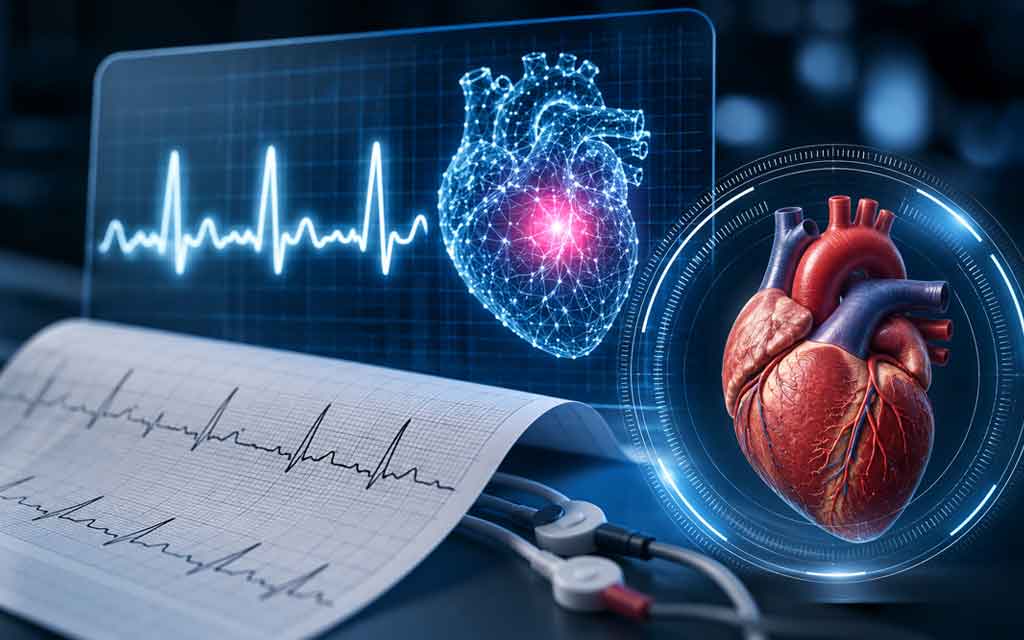
A groundbreaking new study suggests that artificial intelligence could soon help doctors identify people at high risk of sudden cardiac death (SCD) using nothing more than a standard 10-second electrocardiogram (ECG) — often before any symptoms appear or traditional tests flag a problem.
Led by researchers at UC Berkeley, in collaboration with MIT and the University of Chicago, the AI model analyzed hundreds of thousands of ECGs and uncovered a previously unrecognized biomarker in the heart’s electrical activity. The findings were published in the journal Nature in late June 2026 and have already sparked excitement — and important discussions — in the cardiology community.
The Problem: Sudden Cardiac Death Often Strikes Without Warning
Sudden cardiac death claims hundreds of thousands of lives every year in the United States alone. Many victims have no prior diagnosis of heart disease, and current screening tools — primarily measuring left ventricular ejection fraction (LVEF) — miss the majority of at-risk individuals.
Implantable defibrillators can save lives when placed in the right patients, but identifying those patients remains extremely difficult with today’s methods.
What the AI Model Found
The research team trained a deep learning model on a massive dataset of ECGs from Sweden, linked to death certificates and electronic health records. They then used a second generative model to visualize exactly what the predictive AI was “seeing” in the waveforms.
Key Results:
- The model identified a high-risk group representing just 2.2% of the population with a 7.0% annual rate of sudden cardiac death — significantly higher than the risk in patients flagged by reduced LVEF.
- Remarkably, 86.1% of the model’s high-risk patients were not identified by traditional LVEF screening.
- In patients who received defibrillators, the high-risk group saw a 54.4% lower likelihood of death than expected — strong evidence that the AI is pointing doctors toward people who would actually benefit from intervention.
- The model was externally validated in a US health system (predicting ventricular arrhythmias) and a Taiwanese hospital registry (predicting arrhythmic cardiac arrests).
A New Visible Biomarker
One of the most exciting parts of the study is that the researchers made the AI’s discovery interpretable. By pairing the predictive model with a generative model of the ECG waveform, they revealed a specific, visible pattern in the electrical signal that human experts can now learn to recognize.
This “explainable AI” approach is a major step forward — doctors don’t have to blindly trust a black-box algorithm. They can see and verify the warning sign themselves.
Why This Matters for the Future of Heart Care
If validated at scale and integrated into clinical workflows, this technology could:
- Save lives by identifying high-risk patients who currently slip through the cracks.
- Reduce unnecessary defibrillator implants by better targeting those who truly need them.
- Enable population-level screening using routine ECGs already performed millions of times every year.
- Lower healthcare costs by focusing expensive interventions on the patients most likely to benefit.
The researchers emphasize that this is not about replacing cardiologists but giving them a powerful new tool to make better, earlier decisions.
Limitations and Next Steps
As with any new medical AI tool, important caveats remain:
- The model needs further prospective clinical trials to confirm real-world effectiveness and safety.
- Performance may vary across different populations and ECG machine types.
- Ethical questions around false positives, over-treatment, and access to the technology must be addressed.
- Integration into electronic health records and clinical guidelines will take time.
Still, the external validations in US and Asian cohorts suggest strong generalizability.
Broader Context: AI’s Growing Role in Cardiology
This study joins a growing list of AI breakthroughs in heart care, including earlier detection of heart failure, arrhythmia prediction, and personalized treatment recommendations. Cardiology has emerged as one of the fields where AI is moving fastest from research labs into potential clinical practice.
For Americans, where heart disease remains the leading cause of death, tools like this could have enormous public health impact.
What Patients and Doctors Should Know Now
- Patients: Routine ECGs during annual check-ups or before surgery may soon provide more predictive power than ever. Talk to your doctor about heart risk assessment.
- Doctors: Watch for upcoming guidelines and tools that incorporate ECG-AI risk scores alongside traditional metrics like LVEF.
- Investors & Innovators: Companies working on explainable medical AI, ECG analysis platforms, and integrated cardiology software are likely to see increased interest.
Frequently Asked Questions
Can this AI detect risk from any standard ECG? Yes. The model works on routine 10-second ECGs that are already widely performed in clinics and hospitals.
How much better is the AI than current methods? It identified many high-risk patients missed by LVEF screening and showed clear mortality benefit in those who received appropriate interventions.
Is this technology available today? Not yet for routine clinical use. The study represents a major research advance, with clinical deployment likely still a few years away pending further validation and regulatory approval.
Does this mean everyone should get more frequent ECGs? Not necessarily. The value lies in better interpreting existing ECGs rather than dramatically increasing testing volume, though high-risk groups may benefit from more proactive screening.
What’s the next step for this research? Prospective clinical trials, broader validation across diverse populations, and integration into real-world cardiology workflows.
Bottom Line AI is unlocking hidden signals in one of medicine’s oldest and simplest tests — the ECG — that could help prevent thousands of sudden cardiac deaths every year. The UC Berkeley-led research published in Nature represents a significant step toward more precise, proactive heart care.
As AI continues to mature in medicine, tools like this one could fundamentally change how we identify and protect the most vulnerable patients — turning routine check-ups into powerful predictive opportunities.
For more on AI in healthcare, future medical technology, and life-saving innovations, stay tuned to vfuturemedia.com.
Tags: AI ECG, sudden cardiac death, AI heart risk prediction, UC Berkeley AI study, medical AI 2026, cardiology innovation
CTA:
What do you think about AI analyzing routine ECGs to predict sudden cardiac death? Would you want this kind of screening as part of your annual check-up? Share your thoughts in the comments below!


Leave a Comment