
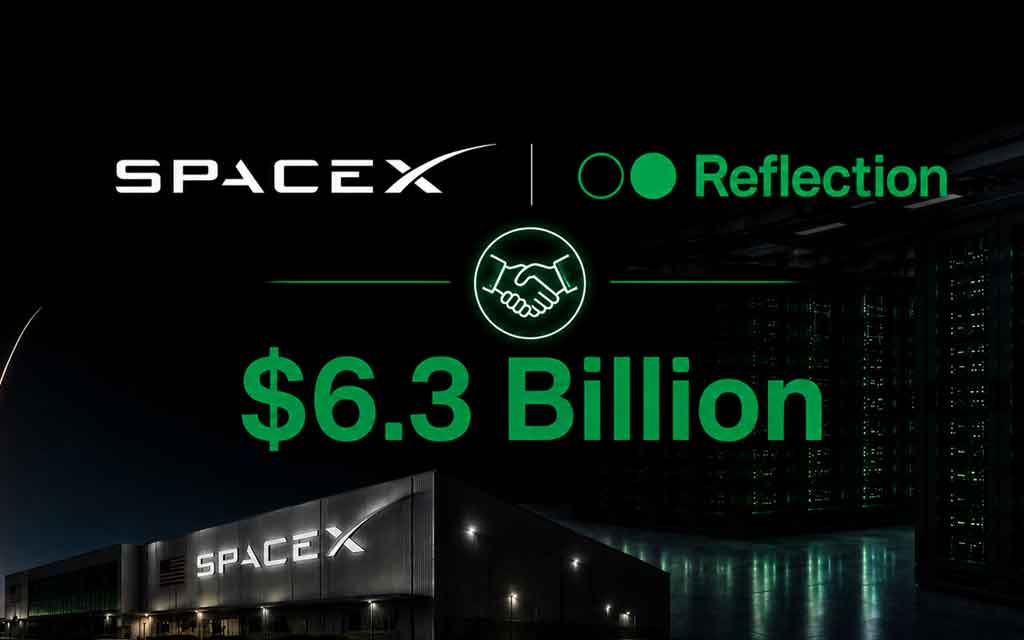
SpaceX has entered into a massive computing power agreement with open-source AI startup Reflection AI, in a deal that could be worth up to $6.3 billion through 2029. The agreement gives Reflection immediate access to Nvidia GB300 chips inside SpaceX’s Colossus 2 supercluster in Memphis, Tennessee.
Under the terms of the deal, Reflection AI will pay SpaceX $150 million per month starting July 1, 2026. The contract allows either party to terminate the agreement with 90 days’ notice after the initial three-month period.
Deal Overview
This is one of the largest known compute leasing agreements in the AI industry to date. Reflection AI, a relatively new startup founded in 2024 by former Google DeepMind researchers, is rapidly expanding its infrastructure needs to train and deploy advanced open-source AI models.
The company is positioning itself as a champion of “American open intelligence,” developing flexible and inspectable AI systems as an alternative to closed, proprietary models. Reflection has already secured U.S. government contracts and is reportedly seeking a $25 billion valuation, with backing from Nvidia and other prominent investors.
SpaceX’s Colossus Infrastructure
SpaceX (through its infrastructure initiatives tied to xAI) has been aggressively building out one of the world’s largest AI supercomputers. The Colossus cluster in Memphis is designed to house tens of thousands of Nvidia GPUs and is already being used to train frontier AI models.
By leasing excess capacity to other AI companies, SpaceX is turning its massive compute infrastructure into a significant revenue stream. Previous reports indicated that SpaceX has also leased capacity to companies like Anthropic and Google, generating billions in annual revenue from AI infrastructure alone.
This move represents a major diversification play for SpaceX, leveraging its expertise in large-scale engineering and power infrastructure beyond its core rocket and satellite businesses.
Why This Matters
The deal underscores several key trends in the AI industry:
- Exploding demand for compute: Training and running advanced AI models requires enormous amounts of specialized hardware. Even well-funded startups are struggling to secure enough GPU capacity.
- Open-source AI competition: Reflection AI’s focus on open models is part of a broader push to create transparent, auditable AI systems that can compete with closed models from OpenAI, Anthropic, and Google.
- Infrastructure monetization: Companies with large-scale data centers and power access (like SpaceX) are increasingly acting as compute providers for the broader AI ecosystem.
- Strategic importance of Memphis: The Colossus 2 facility is becoming a central hub for next-generation AI development in the United States.
Strategic Context
Reflection AI’s decision to lease capacity from SpaceX rather than building its own infrastructure highlights the practical challenges of scaling AI training. Building and powering large GPU clusters is extremely capital-intensive and logistically complex.
By partnering with SpaceX, Reflection gains immediate access to cutting-edge Nvidia GB300 hardware without having to wait for its own facilities to come online. This allows the company to accelerate its model development timeline significantly.
For SpaceX, the deal further validates its Colossus infrastructure investments and creates a high-margin recurring revenue stream that complements its existing businesses in space launch, Starlink, and xAI.
Outlook
As AI capabilities continue to advance rapidly, demand for specialized computing power is expected to keep growing. Deals like this one between SpaceX and Reflection AI are likely to become more common as AI companies seek flexible, scalable access to infrastructure.
The $6.3 billion potential value of this agreement reflects just how valuable compute capacity has become in the current AI race — and how companies with the ability to provide it at scale are positioning themselves as critical players in the ecosystem.
SpaceX’s move into large-scale AI infrastructure leasing adds another dimension to Elon Musk’s growing influence across both space technology and artificial intelligence.


Leave a Comment