
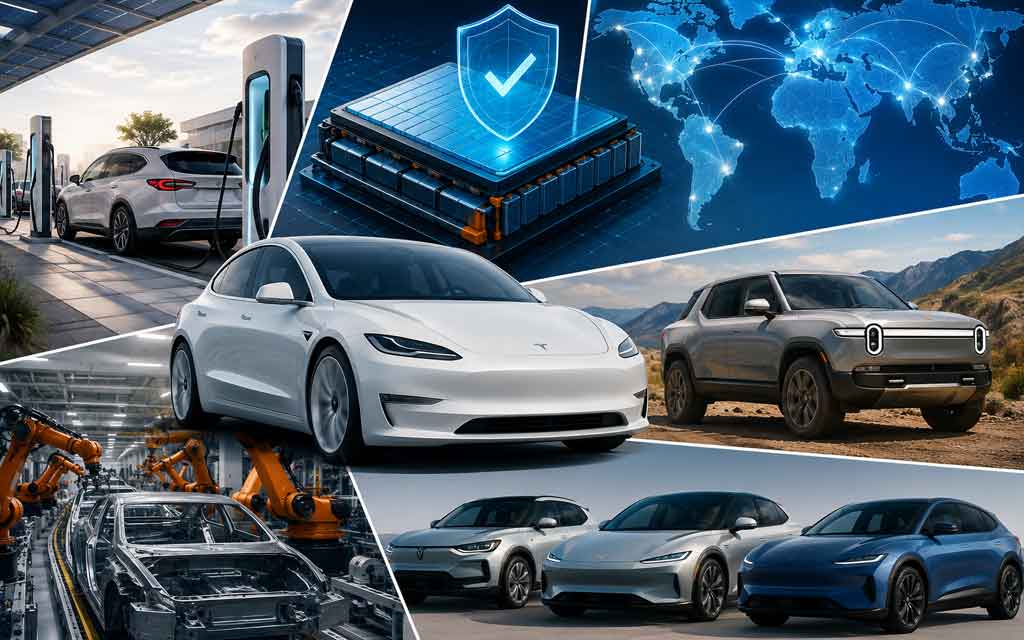
As an international journalist reporting from the USA, the electric vehicle sector delivered exciting developments in late June to early July 2026. From record deliveries and new model launches to policy shifts and technological advancements, the industry is accelerating toward broader adoption. This in-depth report covers the key stories, their implications, and what they mean for the future of sustainable mobility.
Tesla’s Strong Q2 2026: Deliveries Exceed Expectations
Tesla kicked off July with impressive Q2 results announced on July 2. The company produced over 450,000 vehicles and delivered more than 480,000, marking a solid recovery and growth trajectory. Energy storage deployments reached 13.5 GWh, underscoring the strength of its diversified business.
These numbers come after a softer start to the year and reflect improving demand, production efficiency, and global interest. Wall Street had anticipated around 400,000+ deliveries, so the beat is a positive catalyst. Investors are also eyeing upcoming updates on Optimus humanoid robots (expected late July/early August reveal) and Full Self-Driving (FSD) progress, which could unlock new revenue streams.
Analysis: Tesla’s ability to scale amid competition highlights its manufacturing prowess and brand power. For consumers, this translates to potentially more available inventory and faster deliveries. Energy storage growth is particularly noteworthy as it supports grid stability for increased EV charging. Challenges like regional incentive changes persist, but Tesla’s vertical integration gives it resilience.
Rivian R2 Enters the Market: Affordable EV Expansion
Rivian made headlines by commencing public customer deliveries of its R2 lineup and opening orders for reservation holders. The R2 is positioned as a more accessible EV, with an entry-level model around $45,000 pulled forward in timeline. Trims include performance variants delivering strong horsepower and range suitable for daily driving and adventures.
The company raised its full-year 2026 delivery outlook following robust Q2 demand. This launch is critical for Rivian, aiming to broaden its customer base beyond the premium R1 models and compete in the crowded crossover/SUV space. Partnerships, such as with Uber for robotaxis, further signal ambitions in autonomy.
Details on R2 Variants: Performance models offer quick acceleration (0-60 in ~3.6 seconds in some configs), while premium trims emphasize range up to 330+ miles. Features include advanced suspension, off-road capabilities, and seamless software integration.
Impact: Rivian’s move could pressure competitors on pricing and features. For buyers seeking a versatile, modern EV without ultra-premium costs, the R2 is a strong contender. Production ramp-up will be key to meeting demand.
Upcoming EV Models: Pipeline Heats Up for Late 2026
Several major automakers unveiled or reiterated plans for new electric offerings:
- BMW iX3 and i3: Expected summer/late 2026. The iX3 SUV boasts ~400 miles range, 463 hp dual-motor setup, and fast 400 kW charging. The i3 sedan shares the Neue Klasse platform with innovative interior displays.
- Hyundai Ioniq 6 N and Genesis GV60 Magma: High-performance variants with up to 641 hp boost modes, aggressive styling, and track-ready features. These target enthusiasts seeking EV excitement.
- Other Notables: Jeep Recon, Rivian expansions, Scout Terra, and Bentley’s first EV. Consumer Reports and Car and Driver highlight a rich pipeline despite some delays from policy and market shifts.
These models emphasize longer ranges, faster charging, and platform innovations like 800-volt architectures.
Policy and Regulatory Developments Shaping the Industry
- China’s New Battery Rules (Effective July 1): All new EV battery packs must withstand severe thermal runaway tests for up to 2 hours without fire/explosion risks or passenger cabin smoke ingress. This raises global safety benchmarks and may influence supply chains.
- Delhi’s EV Policy Notified: Effective immediately, offering incentives for buyers and aiming to boost adoption in India’s capital region.
- Broader Market Trends: Global EV sales showed mixed but resilient performance. Europe leads growth, while North America stabilizes and China adjusts. Automakers are taking varied approaches—some expanding lineups (Toyota, Kia), others recalibrating.
Market Analysis: Sales, Challenges, and Opportunities
Early 2026 saw some softness in EV sales (e.g., North America declines earlier in the year), but recent data points to recovery driven by new models, improving infrastructure, and consumer interest in total cost of ownership.
Key Drivers:
- Falling battery costs in some segments and better range/charging.
- Corporate fleets and robotaxi ambitions (e.g., Rivian-Uber).
- Government policies balancing incentives and regulations.
Challenges:
- Competition from hybrids in some markets.
- Supply chain issues, including potential memory/compute overlaps with AI.
- Tariffs and geopolitical factors affecting imports/exports.
Investment Angle: Companies with strong software, energy ecosystems, and scalable production (Tesla, Rivian) are well-placed. Watch for advancements in solid-state batteries and autonomous tech, which could redefine the sector.
Consumer Guidance: What This Means for Buyers
This week’s news suggests a buyer’s market in select segments with more options arriving. Consider factors like:
- Range and Charging: Prioritize 300+ mile models with NACS or fast-charging compatibility.
- Total Cost: Factor in incentives, insurance, and home charging setup.
- Use Case: Family SUVs (R2, iX3), performance (Ioniq 6 N), or adventure vehicles.
- Future-Proofing: Look for over-the-air update support and autonomy readiness.
Test drives and local incentives (e.g., Delhi) are crucial. For US buyers, monitor federal/state programs amid evolving policies.
Future Outlook: Toward Mass Adoption
By late 2026 and into 2027, expect more affordable EVs, refined autonomy, and integration with smart grids. The convergence of AI (for predictive maintenance, routing) and EVs will create smarter mobility ecosystems. Challenges like raw materials and infrastructure remain, but momentum is building.
This week’s developments reinforce that EVs are not just viable but increasingly desirable. Whether you’re an enthusiast, investor, or first-time buyer, the pace of innovation is accelerating.
FAQs
- Did Tesla beat expectations in Q2 2026? Yes, with strong production and deliveries.
- When can I buy a Rivian R2? Customer deliveries are underway; check Rivian site for availability.
- How do new China rules affect global EVs? They set higher safety standards likely influencing manufacturers worldwide.



Leave a Comment