
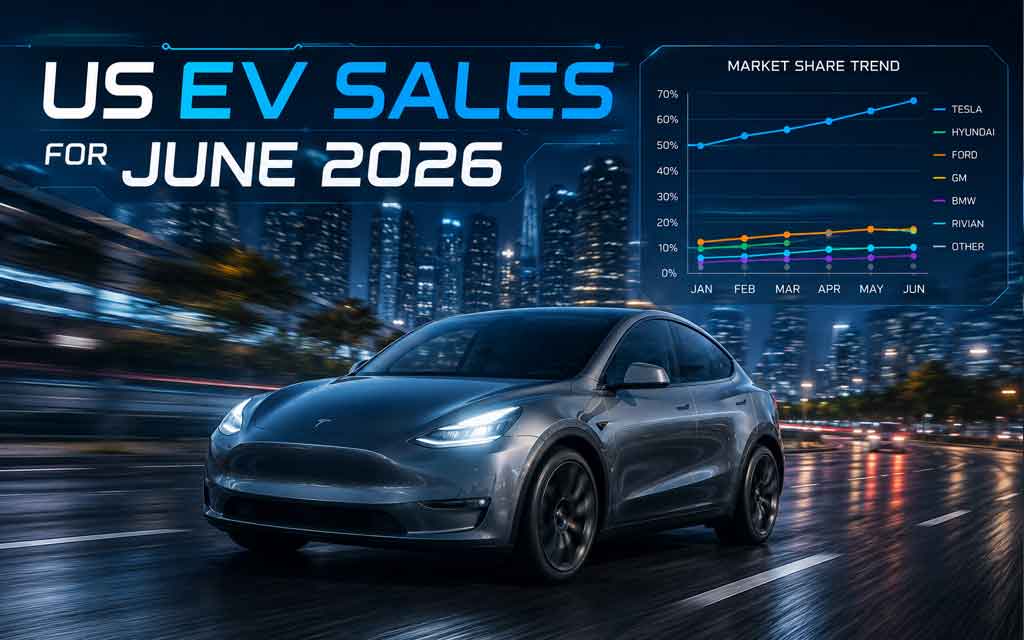
June 2026 brought a mixed picture for the US electric vehicle (EV) market. While Tesla continued its strong dominance, the broader industry faced ongoing headwinds from the end of federal tax credits in late 2025, shifting consumer preferences, and increased competition from hybrids.
Preliminary and estimated data point to Tesla maintaining a commanding lead, with the Model Y remaining the best-selling EV by a wide margin. Overall EV market share hovered in the mid-single digits, reflecting a stabilization after sharp declines in late 2025.
Here’s a complete, data-driven look at US EV sales for June 2026.
Overall US EV Sales Performance (June 2026)
Exact final June figures from sources like Cox Automotive and Kelley Blue Book were still being finalized in early July, but available estimates and trends show:
- New EV sales: Approximately 80,000–90,000 units (preliminary estimates based on May trends and early June reporting).
- Market share: Roughly 5.5–6.5% of total new vehicle sales.
- Year-over-year trend: Down compared to June 2025, consistent with the post-incentive slowdown that began in Q4 2025.
- Month-over-month: Likely modest growth or stabilization from May’s estimated 84,746 units.
The used EV market continued to show strength, with rising demand helping to support overall electrification momentum even as new sales faced pressure.
Tesla’s Performance: Still the Undisputed Leader
Tesla remained the clear #1 EV brand in the US throughout 2026.
Key June Highlights (Estimates):
- Tesla captured approximately 45–55% of total US EV sales (consistent with Q1 and May trends).
- Model Y continued as the top-selling EV model by a large margin — likely 35,000–45,000+ units.
- Model 3 remained a strong #2, with solid sedan demand.
- Cybertruck deliveries contributed meaningfully to the pickup segment.
Tesla’s combination of brand strength, Supercharger network advantage, software updates, and competitive pricing (including inventory discounts) helped it weather the broader market slowdown better than most competitors.
Top-Selling EV Models in the US (2026 Trends)
Based on Q1 2026 data and May trends, here are the models dominating the charts:
1. Tesla Model Y
- Brand: Tesla
- Approx. Monthly Sales: 35,000–45,000+
- Segment: Compact SUV
- Notes: Continues to dominate the U.S. EV market as the best-selling electric vehicle.
2. Tesla Model 3
- Brand: Tesla
- Approx. Monthly Sales: 12,000–18,000
- Segment: Sedan
- Notes: Remains one of the strongest-selling electric sedans in the U.S.
3. Hyundai Ioniq 5
- Brand: Hyundai
- Approx. Monthly Sales: 4,000–7,000
- Segment: Compact SUV
- Notes: The most consistent high-volume non-Tesla EV.
4. Ford Mustang Mach-E
- Brand: Ford
- Approx. Monthly Sales: 3,500–6,000
- Segment: Compact SUV
- Notes: Maintains strong sales with growing consumer demand.
5. Chevrolet Equinox EV
- Brand: Chevrolet
- Approx. Monthly Sales: 3,000–5,500
- Segment: Compact SUV
- Notes: GM’s highest-volume electric vehicle, helping expand mainstream EV adoption.
6. Tesla Cybertruck
- Brand: Tesla
- Approx. Monthly Sales: 2,000–4,000
- Segment: Electric Pickup
- Notes: Continues to gain traction in the electric pickup market.
7. Kia EV6 / Lexus RZ
- Brand: Kia / Lexus
- Approx. Monthly Sales: 2,000–3,500
- Segment: Compact SUV
- Notes: Strong mix of mainstream and premium EV buyers.
8. Rivian R1S
- Brand: Rivian
- Approx. Monthly Sales: 1,500–3,000
- Segment: Midsize SUV
- Notes: Leads the adventure-focused premium electric SUV segment.
Notes: Exact June model-level data was still emerging at the time of reporting. Tesla models consistently accounted for the majority of top-10 spots.
Brand-Level Breakdown (Recent 2026 Trends)
- Tesla: 45–59% market share in various recent periods — far ahead of the field.
- Hyundai/Kia: Strong performers with Ioniq 5, EV6, and related models.
- General Motors (Chevy, Cadillac, GMC): Equinox EV and Cadillac models helping GM stay competitive.
- Ford: Mustang Mach-E and F-150 Lightning providing steady (if not explosive) volume.
- Rivian: Solid in the premium adventure segment with R1S and R1T.
- Others: BMW, Mercedes, Audi, Volvo, and luxury brands holding smaller but loyal shares. Japanese brands (Toyota, Honda, Subaru) gaining some ground with newer entries.
Key Market Context for June 2026
Several factors shaped the June landscape:
- End of Federal Tax Credits — The removal of the $7,500 incentive in late 2025 continued to impact affordability, especially for non-Tesla brands.
- Rising Hybrid Demand — Many buyers opted for hybrids amid concerns over charging infrastructure and range anxiety.
- Used EV Market Strength — Strong growth in used EV sales helped keep overall electrification momentum alive.
- Tesla Pricing & Incentives — Tesla’s ability to adjust pricing and offer inventory deals helped maintain volume.
- New Model Launches — Ongoing introductions from multiple brands provided some tailwinds.
Used EV Market Continues to Grow
While new EV sales faced pressure, the used EV segment showed robust growth:
- Used EV sales were up significantly year-over-year in recent months.
- Tesla models dominated used sales through non-Tesla dealers.
- Lower prices on used EVs made electrification more accessible for budget-conscious buyers.
This divergence between new and used markets is becoming a defining feature of the 2026 EV landscape.
Outlook for the Second Half of 2026
Analysts expect:
- Continued Tesla dominance but with pressure from new competitors.
- Potential stabilization or modest recovery in overall EV sales as inventory normalizes and new models arrive.
- Increased focus on affordable EVs and improved charging infrastructure.
- Hybrid vehicles likely remaining strong competitors in the short term.
Longer-term, falling battery costs, new model launches, and potential policy support could support renewed growth.
Frequently Asked Questions
What was the top-selling EV in the US in June 2026? The Tesla Model Y remained the clear leader by a wide margin.
How much market share did Tesla have? Tesla typically captured 45–55%+ of US EV sales in recent 2026 periods.
Did overall EV sales grow or decline in June? Preliminary trends suggested stabilization or modest sequential improvement from May, but still down year-over-year due to the end of federal incentives.
Which non-Tesla brands performed well? Hyundai (Ioniq 5), Ford (Mustang Mach-E), Chevrolet (Equinox EV), and Rivian showed consistent strength.
Is the used EV market helping? Yes — used EV sales have been growing strongly, making electric vehicles more accessible.
Bottom Line June 2026 reinforced Tesla’s commanding position in the US EV market while highlighting ongoing challenges for the broader industry following the end of major federal incentives. The Model Y continued its reign as America’s best-selling electric vehicle, and the gap between new and used EV demand became even more pronounced.
As new models launch and charging infrastructure improves, the second half of 2026 will be critical in determining whether the US EV market stabilizes or enters a new growth phase.
For the latest on EVs, clean tech, and automotive innovation, stay tuned to vfuturemedia.com.
Tags: US EV sales June 2026, Tesla Model Y, electric vehicle market US, Rivian sales, Mustang Mach-E sales, EV market share 2026
CTA: What do you think about Tesla’s continued dominance? Are you considering an EV purchase this year? Share your thoughts in the comments below!



Leave a Comment