
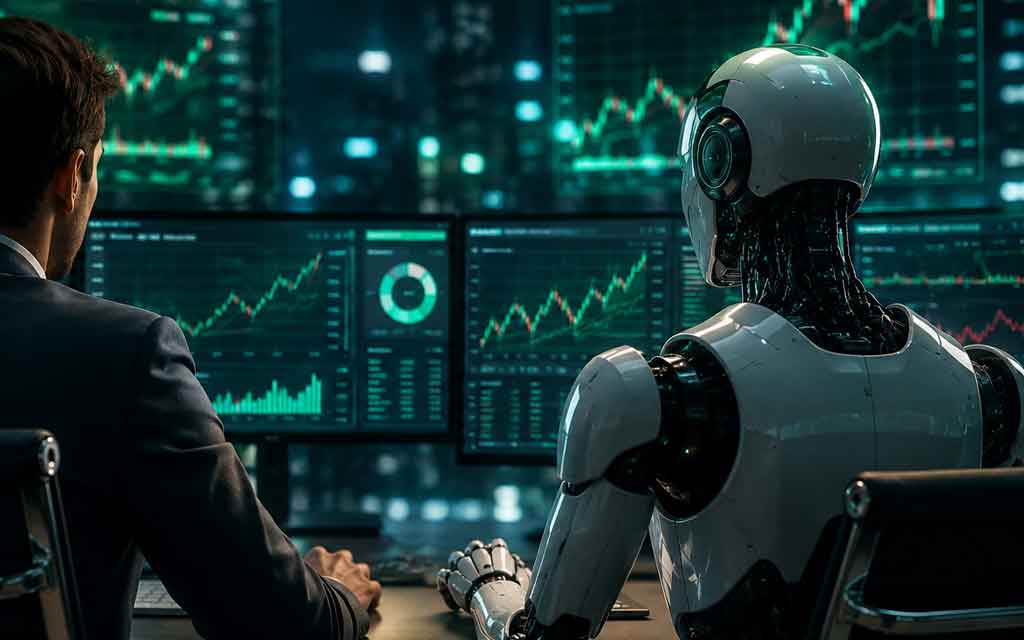
Robinhood CEO Vlad Tenev believes artificial intelligence agents are rapidly advancing toward matching — and potentially surpassing — the capabilities of human traders. In a July 2, 2026, interview with CNBC, Tenev highlighted the rise of “agentic trading,” where autonomous AI systems can perform nearly every task a human trader can, from analysis and decision-making to execution.
This vision positions AI not just as a tool for assistance but as a near-equal participant in markets, potentially democratizing sophisticated trading strategies long reserved for institutional players and high-frequency trading (HFT) firms.
What Tenev Said: The Vision for Agentic Trading
Speaking on CNBC, Tenev explained:
“The idea behind agentic trading…[is] every capability a human can do will be available to an AI agent.”
He noted that large portions of trading are already automated and AI-powered in institutional settings, but that level of intelligence and complexity has historically been out of reach for everyday investors. Robinhood’s goal, according to Tenev, is to give retail users access to the same tools, computation power, and sophistication that institutional investors and HFT firms have used for decades.
The company has already begun rolling out capabilities that allow third-party AI agents to connect to the platform for stock trading and even credit card purchases on behalf of users. These “agentic” features represent an early step toward fully autonomous AI-driven trading experiences.
What Are AI Agents in Trading?
Unlike traditional algorithmic trading (which follows pre-programmed rules), agentic AI systems are designed to:
- Reason and plan multi-step strategies
- Adapt to new information in real time
- Execute trades autonomously within defined parameters or goals
- Integrate with external tools, data sources, and even other agents
In the context of Robinhood, this could mean an AI agent that monitors markets, analyzes news and data, decides on trades, manages risk, and executes — all while learning and improving over time.
Tenev emphasized that this isn’t about replacing human judgment entirely but augmenting retail investors with institutional-grade capabilities.
Robinhood’s Moves in AI-Powered Trading
Robinhood has been expanding its AI toolkit aggressively:
- Introduction of tools allowing third-party AI agents to trade on the platform (rolled out or expanded around May 2026).
- Focus on making advanced trading accessible to its user base of millions of retail investors.
- Integration of AI for personalized insights, automated strategies, and potentially fully autonomous execution.
This aligns with broader industry trends where fintechs and brokerages are racing to incorporate generative and agentic AI to differentiate their offerings and retain users in a competitive market.
Implications for Retail Investors
Potential Benefits:
- Democratization of sophisticated tools — Retail investors could access strategies similar to those used by hedge funds and HFT firms.
- 24/7 monitoring and execution — AI agents don’t sleep, get emotional, or suffer from decision fatigue.
- Personalization at scale — Agents could tailor strategies to individual risk tolerance, goals, and market conditions.
- Lower barriers — Potentially reduce the need for deep financial expertise.
Risks and Challenges:
- Over-reliance and black-box decisions — Users may not fully understand why an agent makes certain trades.
- Market volatility amplification — Widespread autonomous trading could increase flash crashes or herding behavior.
- Regulatory uncertainty — How will securities regulators treat fully autonomous AI trading? Questions around accountability, disclosure, and investor protection remain.
- Performance gaps — While promising, AI agents are still maturing and may underperform in certain market regimes or during black swan events.
- Security and privacy — Connecting AI agents to brokerage accounts raises data security concerns.
Broader Industry Context
Robinhood’s push reflects a larger shift in fintech and trading:
- Other platforms and institutions are exploring similar agentic capabilities.
- High-frequency trading firms have used advanced algorithms for years; AI is now making comparable (or superior) intelligence accessible more broadly.
- The rise of agentic AI in finance coincides with advancements in multimodal models, better reasoning capabilities, and integration with real-time data feeds.
Tenev’s comments come amid ongoing debates about AI’s role in markets, including concerns from regulators and traditional traders about fairness, transparency, and systemic risk.
What This Means for Markets and Investors
If AI agents do reach or exceed human-level trading performance at scale:
- Market efficiency could increase as more participants react faster to information.
- Volatility patterns might shift, with AI-driven moves potentially creating new dynamics.
- Retail vs. institutional edge could narrow in some strategies, though institutions will likely retain advantages in data, infrastructure, and capital.
- New opportunities will emerge for developers of AI trading agents, risk management tools, and oversight platforms.
For everyday investors, the key will be education, responsible use, and choosing platforms with strong safeguards and transparency.
Outlook: How Close Are We?
Tenev’s prediction is optimistic but grounded in rapid recent progress in AI reasoning and agentic systems. While fully autonomous, human-matching AI traders may still be months or years away from widespread, reliable deployment, early versions are already being tested and rolled out.
Key milestones to watch:
- Regulatory clarity on autonomous trading.
- Performance benchmarks comparing AI agents vs. human traders in live markets.
- Adoption rates among retail users.
- Integration of safety/guardrail features in agentic systems.
Final Thoughts
Robinhood’s CEO is betting big on a future where AI agents don’t just assist traders — they operate at or beyond human capability, leveling the playing field for retail investors. Whether this vision materializes smoothly or encounters significant hurdles remains to be seen, but the direction is clear: agentic AI is coming to trading, and platforms like Robinhood are positioning themselves at the forefront.
For investors, this represents both opportunity and a call to stay informed about the tools shaping the future of markets.
Frequently Asked Questions
What did Robinhood’s CEO actually say about AI agents? Vlad Tenev stated that AI agents will soon have the capability to match every task a human trader can perform, as part of “agentic trading” that brings institutional-level tools to retail users.
Are AI agents already trading on Robinhood? Robinhood has introduced tools allowing third-party AI agents to connect and execute trades (and even purchases) on behalf of users. Full autonomous “human-level” agents are still evolving.
What are the risks of AI agents in trading? Risks include over-reliance on opaque systems, potential for amplified market volatility, regulatory gaps, security concerns, and performance limitations in unpredictable conditions.
Will this replace human traders? It’s more likely to augment and compete with them. Many experts expect a hybrid future where humans oversee or collaborate with advanced AI agents.
How can retail investors prepare? Stay educated on AI tools, understand platform safeguards, start with supervised or limited-scope agents, and maintain a diversified, long-term approach alongside any automated strategies.
Tags: Robinhood AI agents, agentic trading, AI in finance 2026, Vlad Tenev AI, retail trading AI, fintech innovation
CTA:
What do you think about AI agents potentially matching human traders? Would you trust an AI agent with your investments? Share your thoughts in the comments below. Subscribe for more on AI, fintech, and the future of markets.


Leave a Comment