
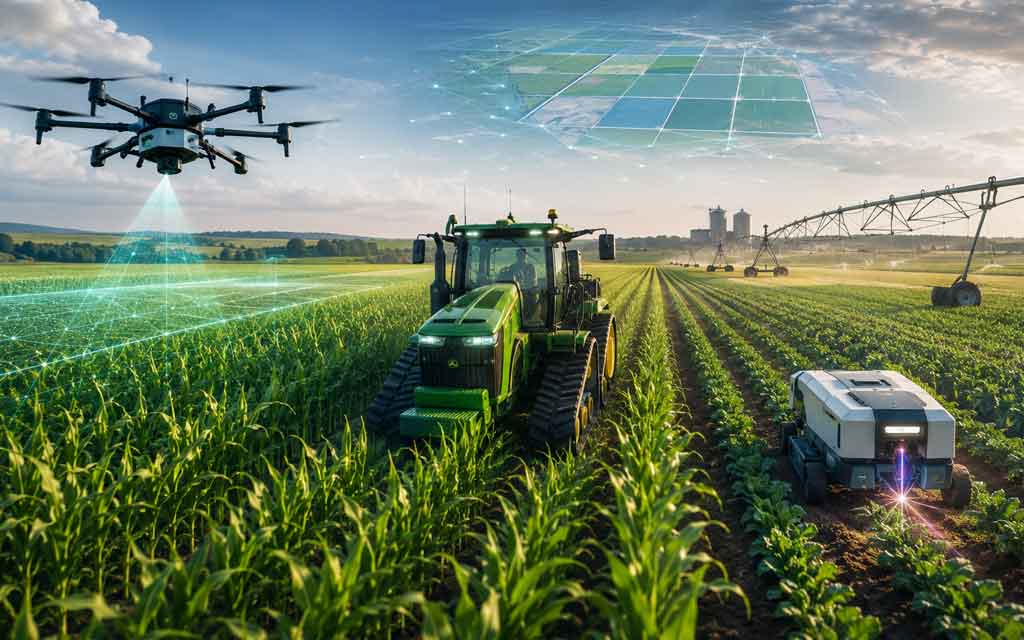
Discover the best AI tools and gadgets transforming American agriculture in 2026. From autonomous tractors to AI-powered drones and smart sprayers, see what US farmers are actually using.
American agriculture is undergoing a major technological shift. In 2026, AI-powered tools and smart gadgets are no longer experimental — they’re becoming essential for many farmers across the United States.
From Midwest cornfields to California orchards, American farmers are adopting AI to increase yields, reduce costs, minimize chemical use, and address labor shortages.
Here’s a practical guide to the best AI tools and gadgets currently being used by farmers in the US.
Why American Farmers Are Embracing AI in 2026
US agriculture faces several challenges:
- Labor shortages
- Rising input costs (fertilizer, fuel, chemicals)
- Climate variability
- Need for higher efficiency and sustainability
AI helps solve these problems by enabling precision agriculture — applying the right input, at the right place, at the right time.
According to recent industry reports, adoption of AI and automation in US farming has accelerated significantly since 2024, especially among mid-to-large operations.
Top AI Tools and Gadgets Used by American Farmers
Here are the most impactful AI-powered technologies currently in use across US farms:
1. John Deere Autonomous Tractors & AI Equipment
John Deere remains the leader in US agricultural machinery with its AI-integrated autonomous tractors and combines.
Key Features:
- AI-powered computer vision for obstacle detection
- Autonomous planting, spraying, and harvesting
- Real-time data collection and analysis
- Integration with John Deere Operations Center
Used by: Large-scale corn, soybean, and wheat farmers in the Midwest and Great Plains.
2. Blue River Technology “See & Spray” (John Deere)
Originally a startup, now part of John Deere, See & Spray uses AI and computer vision to detect and spray only weeds.
Benefits:
- Reduces herbicide use by up to 77%
- Lowers chemical costs significantly
- More environmentally friendly
Popular in: Cotton, soybean, and specialty crop farming.
3. AI-Powered Agricultural Drones
Drones equipped with AI analytics are widely used for crop monitoring.
Top Platforms:
- DroneDeploy – AI field mapping and health analysis
- DJI Agras series with AI flight planning
- PrecisionHawk and Taranis for detailed crop intelligence
Common Uses:
- Early disease and pest detection
- Yield estimation
- Irrigation problem identification
- Plant counting and stand assessment
Many US farmers now use drones weekly during the growing season.
4. FarmBeats & Microsoft Azure AI for Agriculture
Microsoft’s FarmBeats platform combines IoT sensors, drones, and AI to give farmers actionable insights.
Features:
- Soil moisture and weather prediction using AI
- Crop health monitoring
- Equipment optimization
Used by both large commercial farms and smaller operations through partnerships with cooperatives.
5. Autonomous Weeding Robots
Smaller AI-powered robots are gaining traction, especially in specialty crops.
Notable Examples:
- FarmBot (open-source, used by smaller farms)
- Carbon Robotics LaserWeeder – Uses AI + lasers to kill weeds without chemicals
- Verdant Robotics – AI weeding and spraying robots
These are particularly popular in California vegetable and fruit farms.
6. AI Livestock Monitoring Systems
AI is also transforming animal agriculture.
Popular Tools:
- Cainthus – AI-powered cameras that monitor cattle behavior and health
- Connecterra – AI platform for dairy farms that predicts health issues
- Smart collars and ear tags with AI analytics
These tools help reduce veterinary costs and improve animal welfare.
7. AI Crop Analytics Platforms
Software platforms that turn farm data into insights:
- The Climate Corporation (Bayer) – FieldView platform with AI recommendations
- Granular (Corteva) – Farm management with predictive analytics
- FarmLogs and Farmers Edge – AI-driven decision support
These platforms are widely used across the US for planning, scouting, and yield forecasting.
8. Smart Irrigation Systems with AI
AI is optimizing water usage, especially important in drought-prone states.
Examples:
- The Yield (now part of Telstra) and US-based systems using soil sensors + AI weather prediction
- Valley Irrigation and Lindsay Corporation smart pivots with AI scheduling
Farmers in California, Texas, and the Midwest are seeing major water savings.
Comparison Table: Best AI Agriculture Tools 2026
Smart Farming Technologies in the US (2026)
- John Deere Autonomous Tractors
- Category: Autonomous Machinery
- Best For: Large row crop farms
- Key Benefit: Reduces labor needs and improves precision farming
- US Adoption: High
- John Deere See & Spray
- Category: AI-Powered Spraying
- Best For: Weed control
- Key Benefit: Uses up to 77% less herbicide
- US Adoption: Growing rapidly
- AI Agricultural Drones
- Category: Crop Monitoring
- Best For: Crop scouting and field inspections
- Key Benefit: Early detection of pests, diseases, and crop stress
- US Adoption: Very High
- Carbon Robotics LaserWeeder
- Category: Weeding Robot
- Best For: Specialty crop farms
- Key Benefit: Chemical-free weed control using lasers
- US Adoption: Medium
- Cainthus / Connecterra
- Category: Livestock AI
- Best For: Dairy and cattle operations
- Key Benefit: Animal health monitoring and real-time alerts
- US Adoption: Medium–High
- Microsoft FarmBeats
- Category: Farm Analytics Platform
- Best For: Data-driven farm management
- Key Benefit: Improves yield through AI-powered insights
- US Adoption: Medium
- Smart Irrigation Systems
- Category: Water Management
- Best For: Farms in dry and drought-prone regions
- Key Benefit: Saves water while reducing operating costs
- US Adoption: High, especially in the western United States
Benefits American Farmers Are Seeing
- Reduced input costs (fertilizer, chemicals, fuel)
- Higher yields through better decision-making
- Labor efficiency — especially important amid worker shortages
- Environmental benefits — less chemical runoff and water waste
- Better risk management through predictive analytics
Many mid-sized and large US farms report ROI within 1–3 seasons after adopting AI tools.
Challenges Still Facing US Farmers
While adoption is growing, challenges remain:
- High upfront costs for equipment
- Need for reliable internet connectivity in rural areas
- Learning curve for older farmers
- Data privacy concerns
Many farmers start small — with drones or analytics software — before moving to autonomous machinery.
Future Outlook for AI in US Agriculture
By 2028–2030, experts expect even greater integration of AI, including:
- Fully autonomous fleets of machines
- AI-driven supply chain and market prediction
- Greater use of generative AI for farm planning
- More affordable AI tools for small and mid-sized farms
The US is expected to remain a leader in agricultural robotics and precision technology, even as China leads in overall EV-style adoption in farming equipment.
Final Thoughts
AI is no longer a future concept in American agriculture — it’s actively helping farmers become more efficient, profitable, and sustainable in 2026.
Whether it’s autonomous tractors from John Deere, AI weed detection systems, smart drones, or livestock monitoring platforms, American farmers are selectively adopting tools that deliver clear returns.
The farms that combine traditional knowledge with modern AI technology are positioning themselves for long-term success.




Leave a Comment