
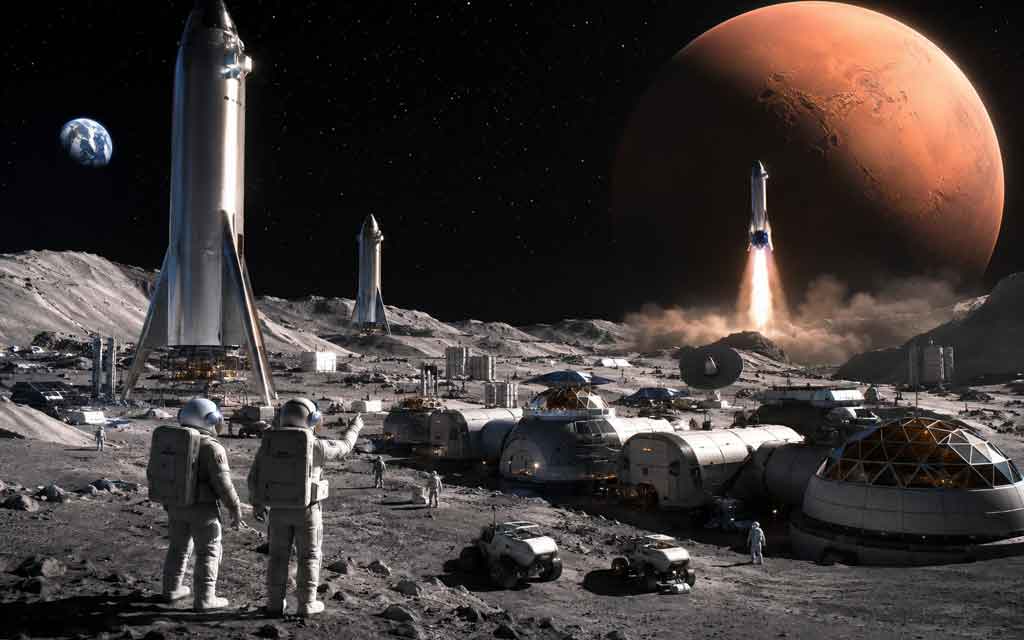
Elon Musk has once again set ambitious timelines for humanity’s expansion into space. In recent statements, the SpaceX CEO claimed the company could send tens of thousands of people to a Moon base within the next decade and land the first humans on Mars within five years.
These bold predictions continue Musk’s long-standing vision of making humanity a multi-planetary species — but they also raise important questions about feasibility, timeline realism, and the massive technical and financial challenges involved.
Musk’s Latest Space Ambitions
According to Musk, SpaceX is targeting an aggressive roadmap that includes:
- Moon Base Development: Establishing a sustainable lunar presence capable of supporting tens of thousands of people within 10 years.
- Mars Mission: Landing the first human crew on Mars within the next five years, with Starship playing the central role.
These goals build on SpaceX’s ongoing work with the Starship program, which aims to create a fully reusable spacecraft capable of carrying large numbers of passengers and cargo to the Moon, Mars, and beyond.
The Starship Factor
Starship remains the cornerstone of Musk’s vision. The massive vehicle is designed to be fully reusable, drastically reducing the cost of space travel. Recent test flights have shown promising progress, though challenges remain in areas such as heat shield performance, in-orbit refueling, and reliable landing systems.
Musk has repeatedly emphasized that rapid iteration and learning from test flights will be key to achieving the timelines he has set. SpaceX has conducted multiple Starship flight tests, with each iteration bringing the vehicle closer to operational readiness.
Why the Moon First?
A lunar base serves several strategic purposes in Musk’s broader plan:
- Testing Ground: The Moon provides a closer and safer environment to test technologies needed for Mars missions.
- Resource Utilization: Potential extraction of lunar water ice for fuel and life support.
- Economic Activity: Establishing a permanent human presence could open opportunities for lunar mining, research, and tourism.
- Stepping Stone: Experience gained on the Moon would be invaluable for the much more challenging journey to Mars.
Challenges on the Path to Mars
While Musk’s vision is inspiring, the road to Mars is filled with significant hurdles:
- Radiation Protection — Long-duration spaceflight exposes crews to dangerous cosmic radiation.
- Life Support Systems — Reliable systems for air, water, and food production over multi-year missions.
- Landing Large Payloads — Safely landing heavy Starships on the Martian surface.
- In-Situ Resource Utilization — Producing fuel and oxygen on Mars using local resources.
- Human Factors — Psychological and physiological effects of long-duration space travel and Mars gravity.
Despite these challenges, SpaceX continues to make progress on Starship development, with increasing test flight success rates.
Timeline Realism
Musk’s timelines have historically been optimistic. Critics often point out that many SpaceX milestones have taken longer than initially predicted. However, the company has also demonstrated remarkable ability to accelerate development once key technologies are proven.
The five-year timeline for first humans on Mars would represent an extraordinary acceleration of space exploration. For comparison, it took NASA approximately eight years from President Kennedy’s 1961 moon landing goal to actually landing astronauts on the Moon in 1969.
Broader Implications
If successful, Musk’s vision could fundamentally change humanity’s relationship with space:
- Scientific Discovery — Permanent bases would enable continuous research on the Moon and Mars.
- Economic Opportunities — New industries could emerge around space resources and tourism.
- Backup for Humanity — A self-sustaining presence beyond Earth would provide insurance against planetary risks.
- Inspiration — Bold goals could motivate the next generation of scientists and engineers.
International and Commercial Context
SpaceX’s ambitions exist alongside other major players:
- NASA’s Artemis program aims to return humans to the Moon.
- China is pursuing its own lunar and Mars exploration plans.
- Other private companies are also developing lunar landers and space infrastructure.
The competition — and collaboration — in this new space race could accelerate progress across the board.
Final Thoughts
Elon Musk’s latest declarations about Moon bases and Mars missions continue to push the boundaries of what many consider possible in our lifetime. While the specific timelines may prove optimistic, the direction is clear: SpaceX is committed to making humanity multi-planetary.
Whether these ambitious goals are achieved in five years, ten years, or longer, the progress being made with Starship and related technologies represents one of the most exciting chapters in human exploration. The journey to becoming a spacefaring civilization is well underway.
As we watch these developments unfold, one thing remains certain: the next decade of space exploration promises to be nothing short of extraordinary.



Leave a Comment