
NASA is recruiting volunteers for a groundbreaking year-long simulation that will mimic the challenges of living and working on the Moon and Mars.
The Moon and Mars Exploration Analog (MMEA) mission, set to begin no earlier than August 2027 at Johnson Space Center in Houston, will place four crew members in isolated habitats to test human performance under deep-space conditions.
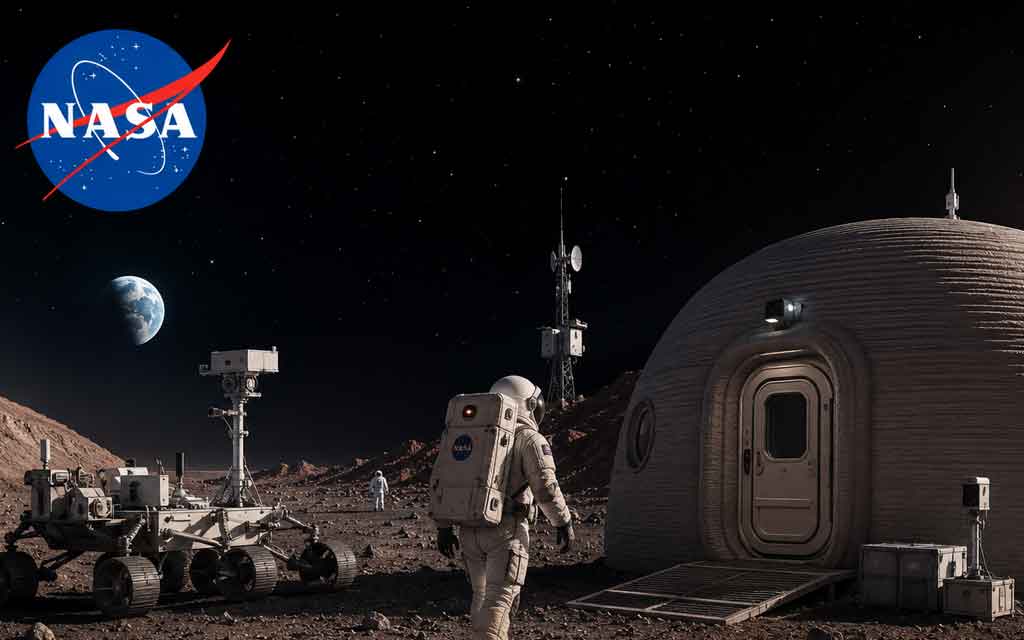
The setup includes a 3D-printed surface habitat and a rover equipped with a non-flushable toilet — just one of the realistic constraints designed to replicate planetary exploration.
What the Simulation Will Entail
Participants will experience two main phases:
1. Transit Simulation Living in a confined habitat that mimics the journey to another planetary body, complete with delayed communications and limited resources.
2. Surface Operations Moving into a one-story 3D-printed habitat that simulates living on the lunar or Martian surface. Crew members will conduct:
- Simulated spacewalks (EVAs)
- Scientific research and maintenance tasks
- Rover operations for exploration
- Crop growth for food production
- Health monitoring and team dynamics studies
The non-flushable toilet on the rover highlights the resource constraints and waste management challenges of real missions.
Who Can Apply?
NASA is looking for US citizens or permanent residents who are:
- Aged 30-55 (preferred)
- In good physical and mental health
- With STEM backgrounds (highly desirable)
- Able to commit to the full program, including pre- and post-mission periods (total ~14 months)
The selection process will prioritize candidates who can work effectively in small teams under stress and isolation.
Why NASA Is Running This Analog
Analog missions like MMEA (which builds on previous CHAPEA and HERA programs) are critical for preparing for Artemis lunar missions and eventual Mars exploration. They help NASA:
- Understand human health and performance in isolated, confined environments
- Test habitat designs, life support systems, and operational procedures
- Identify psychological and team dynamic challenges
- Refine protocols for communication delays (up to 20+ minutes one-way to Mars)
Data from these simulations directly informs spacecraft and mission design, reducing risks for actual astronauts.
Previous CHAPEA Missions
This new analog builds on the success of the Crew Health and Performance Exploration Analog (CHAPEA) series:
- Crews lived for a full year in a 3D-printed Mars habitat
- Conducted science, maintenance, and simulated EVAs
- Provided valuable data on nutrition, exercise, sleep, and group dynamics
The MMEA expands the scope to include full transit + surface phases in an integrated campaign.
The Challenges Volunteers Will Face
Participants should expect:
- Strict isolation with no physical contact with the outside world
- Delayed communications simulating deep space
- Limited resources and recycling systems
- Rigorous daily schedules combining work, exercise, and research
- Potential interpersonal stress in a small crew
- Realistic equipment malfunctions and problem-solving scenarios
Compensation and benefits are provided, though specific details are available in the application materials.
How to Apply
Interested candidates can apply through NASA’s official channels. The agency emphasizes that this is a serious scientific endeavor requiring commitment and resilience.
Applications are open now, with selection expected to be competitive given the unique opportunity to contribute to humanity’s future in space.
Broader Significance for Space Exploration
Programs like MMEA are essential stepping stones toward sustainable human presence beyond Earth orbit. By studying how people cope with the physical and psychological demands of long-duration missions in controlled settings, NASA can design better habitats, schedules, and support systems.
The inclusion of 3D-printed habitats also advances in-situ resource utilization (ISRU) concepts — building with local materials on the Moon or Mars to reduce launch mass.
As NASA targets crewed lunar returns in the late 2020s and Mars missions in the 2030s+, data from these analogs will be invaluable.
What Volunteers Can Expect to Gain
Beyond contributing to science, participants often describe the experience as transformative:
- Unique skills in teamwork under pressure
- Deep insight into human spaceflight
- Personal growth from overcoming isolation challenges
- The satisfaction of helping pave the way for future explorers
It’s not a vacation — it’s rigorous research that demands dedication.
Frequently Asked Questions
How long is the simulation? One full year inside the habitats, plus pre- and post-mission periods (total commitment ~14 months).
Where does it take place? At NASA’s Johnson Space Center in Houston, Texas.
What is the habitat like? A combination of a transit simulator and a 3D-printed surface habitat, designed to mimic Moon/Mars living conditions.
Do volunteers get paid? Yes, participants receive compensation. Specific details are in the application materials.
Is previous experience required? A strong STEM background is preferred, but the agency looks for well-rounded candidates who can handle isolation and teamwork.
When does the mission start? No earlier than August 2027 for the first crew.
Bottom Line NASA is actively recruiting volunteers willing to spend a year in isolation to simulate Moon and Mars missions. The program uses advanced 3D-printed habitats and realistic constraints (including a rover with a non-flushable toilet) to gather critical data for future human space exploration.
This is a rare opportunity to contribute directly to humanity’s push beyond Earth while experiencing the challenges of planetary exploration firsthand. Applications are open — the next generation of spacefarers could start with a year on “Mars” in Houston.
For more on NASA’s analog missions, human spaceflight, and the future of Mars exploration, stay tuned to vfuturemedia.com.



Leave a Comment