
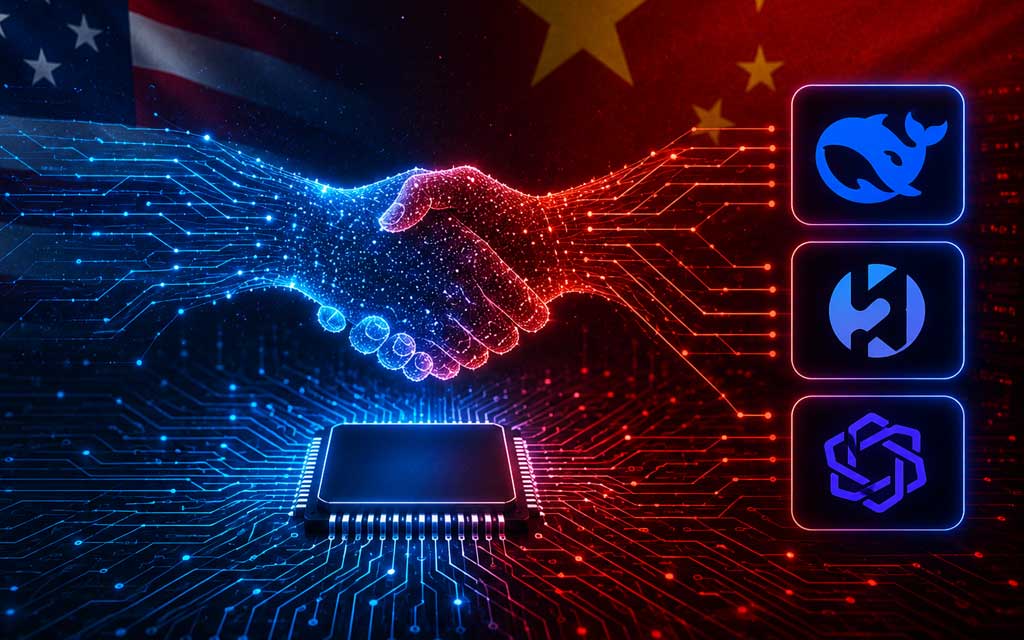
US firms increasingly prefer cheaper, high-performing Chinese AI models like DeepSeek, Kimi, and Qwen over OpenAI and Anthropic. Full analysis of costs, performance, risks, and the new AI reality.
The Quiet Revolution: Chinese AI Models Dominate US Corporate Usage
In a striking reversal of expectations, American companies are increasingly turning to Chinese AI models — often more than US-developed ones — for everyday operations. Reports from mid-2026 reveal that cost-conscious startups, established tech firms, and even Fortune 500 companies are routing significant workloads to models from DeepSeek, Moonshot AI (Kimi), Alibaba’s Qwen, Zhipu, and others.
What began as a fringe cost-saving tactic has become mainstream. Data from platforms like OpenRouter and Vercel shows Chinese models frequently leading in usage shares, while US giants like OpenAI and Anthropic retain the high-end frontier but lose volume on routine tasks.
Key Data: How Widespread Is the Shift?
- Startups Lead the Charge: Approximately 80% of US startups building on open-source AI are running Chinese models — a larger share than Google and OpenAI combined in some analyses.
- Enterprise Examples:
- DoorDash routes complex tasks to Anthropic but lower-level work to Moonshot’s Kimi.
- Airbnb uses limited China-origin models via US providers.
- Lindy (AI assistant startup) shifted 100% of traffic from Anthropic to DeepSeek, saving millions.
- Cursor built its Composer 2 coding model on Moonshot’s Kimi foundation.
- Siemens, Harvey, Vercel, and others report rising Chinese model usage.
- Cloud Platforms Enable It: Amazon Bedrock, Microsoft Azure, and Google Vertex AI all offer DeepSeek, Kimi, Qwen, and similar models as fully managed services, making adoption seamless.
Chinese open models now account for a leading share of Hugging Face downloads and real-world inference traffic among cost-sensitive users.
Why US Companies Prefer Chinese AI Models
- Dramatic Cost Savings: Chinese models often cost 10x–40x less for comparable performance on many tasks. “You don’t need God to write your email,” as one founder put it.
- Closing Performance Gap: Models like Kimi K3, DeepSeek R1/variants, and GLM series match or beat US counterparts in coding, reasoning, and specific benchmarks while remaining highly efficient.
- Open-Weight Advantage: Many Chinese models are open or semi-open, allowing fine-tuning, self-hosting, and customization without vendor lock-in.
- Speed and Iteration: Chinese labs release updates rapidly, keeping pace with or exceeding closed US models in practical utility.
- Cloud Convenience: Major US cloud providers integrate them securely, with data isolation guarantees.
For 80–90% of corporate AI workloads (customer service, coding assistance, content generation, internal tools), Chinese models deliver “good enough” or better results at a fraction of the price.
Risks and Controversies
Despite the benefits, adoption raises red flags:
- Data Security & Geopolitics: Concerns over potential backdoors, data leakage, or Chinese government influence (even if models run on US infrastructure).
- Lawmaker Scrutiny: US lawmakers are probing the trend, with some government agencies already banning certain Chinese models.
- IP and Distillation Debates: Accusations that Chinese models benefit from reverse-engineering or distilling US systems.
- Long-Term Dependency: Risk of over-reliance on foreign technology amid US-China tech tensions.
- China’s Response: Beijing is weighing export limits on popular models American firms love.
Companies mitigate by running models through approved US providers and using them only for non-sensitive tasks.
Impact on US AI Leaders and the Broader Industry
- OpenAI, Anthropic, Google: Pressure to lower prices or improve efficiency. High-end models remain preferred for critical work, but volume shifts hurt margins.
- Cloud Giants: AWS, Azure, and Google Cloud profit by hosting the competition.
- Investors & Markets: Reinforces the “AI commoditization” narrative — performance parity + price wins.
- National Strategy: Challenges the assumption that US companies would automatically prefer domestic AI. Fuels debates on export controls, subsidies, and open-source policy.
This trend echoes earlier shocks from DeepSeek’s R1 and continues with models like Kimi K3.
What This Means for Businesses and Developers in 2026
For Cost-Conscious Teams: Hybrid strategies (frontier US models for complex reasoning + Chinese models for scale) are becoming standard. For Startups: Lower barriers to building AI products. For Policymakers: Urgency to balance security with innovation competitiveness. For Users: Better, cheaper AI tools overall — regardless of origin.
Conclusion: Nationality Takes a Back Seat to Value
The rise of Chinese AI models in American companies marks a new chapter in the global AI race. Performance gaps have narrowed dramatically, and price sensitivity is winning. While geopolitical risks remain real, the market is voting with its tokens: capability and cost trump origin for most applications.
As one industry observer noted, “The market has started treating model nationality as secondary — and largely irrelevant — to whether the thing works well, ships fast, and costs less.”
US firms and policymakers must adapt quickly. The AI future is multipolar, and American companies are already living it.
Stay ahead with vfuturemedia.com for exclusive AI industry analysis, US-China tech competition updates, model comparisons, and business strategy insights. Are you using Chinese models? Share your experience below!




Leave a Comment