
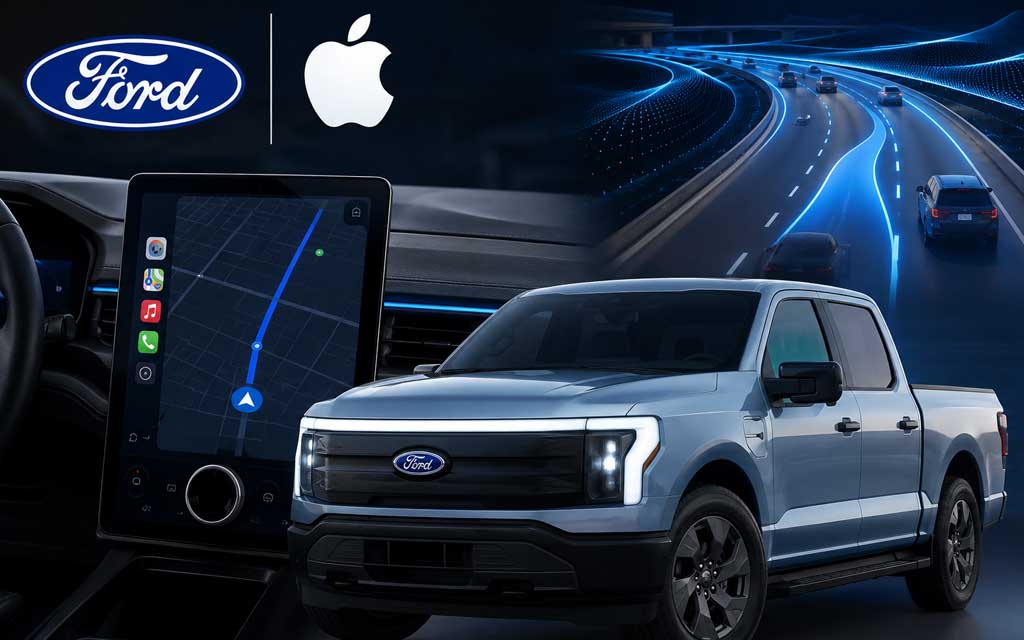
Ford announces deep integration of Apple Maps via new MapKit for Automotive SDK into its Universal Electric Vehicle (UEV) platform starting 2027. Apple software will enhance BlueCruise hands-free driving and support advanced autonomy. Full analysis of the deal, technology, implications for Tesla competition, and what it means for drivers.
In a major development announced on July 23, 2026, Ford Motor Company and Apple revealed a groundbreaking partnership that places Apple Maps software at the heart of Ford’s upcoming electric vehicles. Apple Maps will not only power native in-vehicle navigation but also supply critical road-level data to enhance Ford’s BlueCruise driver-assistance system and next-generation self-driving capabilities.
This marks one of the deepest integrations of Apple technology into a major automaker’s vehicle operating system to date, going far beyond traditional smartphone mirroring via CarPlay.
The Core of the Partnership: MapKit for Automotive SDK
Apple introduced its new MapKit for Automotive SDK, a software development kit that allows automakers to embed and deeply customize Apple Maps directly into vehicle displays and systems. Ford is the first major partner to adopt it.
Key features drivers can expect:
- Native turn-by-turn directions with natural language guidance
- Real-time traffic and incident information
- Intuitive search with detailed place cards
- Intelligent EV-specific routing that factors in battery range, charging stations, and topography
- Battery preconditioning recommendations based on destination and route
- Seamless integration with Ford’s own app and software suite
Importantly, drivers will not need an iPhone or Apple subscription to access the full Apple Maps experience inside the vehicle. CarPlay will remain available as an option alongside the native system.
Ford CEO Jim Farley described it as delivering “the ultimate navigation experience,” while Apple’s Eddy Cue emphasized the accuracy, privacy protections, and seamless daily-life integration of Maps.
Powering Self-Driving and BlueCruise Advancements
The partnership extends well beyond navigation. Ford will leverage road-level information from Apple Maps in the development of its next-generation BlueCruise hands-free highway driving system. This data includes precise details about on-ramps, off-ramps, interchanges, lane configurations, and road geometry.
The upgraded BlueCruise aims to deliver a more seamless “on-ramp to off-ramp” experience. Longer-term, Ford’s autonomy subsidiary Latitude AI is developing the Ford Large Driving Model — an in-house advanced driving system trained on millions of miles of real-world data. Apple Maps data will feed into this stack, supporting a spectrum of capabilities from advanced driver assistance toward point-to-point autonomy and eventual eyes-off driving targeted for later in the decade.
This hybrid approach — Ford’s proprietary AI models combined with Apple’s high-quality mapping data — positions the automaker to accelerate development while maintaining control over the core autonomy software.
Ford’s Universal Electric Vehicle (UEV) Platform
The technology will debut on Ford’s new Universal Electric Vehicle platform, designed for more affordable, high-volume electric models. The first vehicle is expected to be a midsize electric pickup launching around 2027 with a starting price near $30,000.
The UEV platform features a new zonal electrical architecture that enables richer software experiences. By embedding Apple Maps natively rather than relying solely on phone projection, Ford aims to create a more polished, always-available interface that feels integral to the vehicle.
Strategic Implications for Ford, Apple, and the Industry
For Ford:
- Strengthens the software experience of its next-generation EVs at a critical time when consumer expectations for in-car tech are rising rapidly.
- Accelerates BlueCruise and autonomy development by tapping into Apple’s mature, continuously updated mapping data.
- Differentiates its affordable EV lineup against competitors, particularly Tesla, which relies on its own proprietary mapping and vision systems.
- Demonstrates a pragmatic strategy: build core autonomy in-house via Latitude AI while partnering for best-in-class mapping.
For Apple:
- Expands Maps from a smartphone app into a foundational automotive platform layer.
- Creates a new distribution channel and potential advertising or data opportunities (while maintaining strong privacy claims).
- Positions Apple as a serious software partner for traditional automakers after years of speculation about a full Apple Car project.
- The MapKit for Automotive SDK could attract additional automakers, giving Apple broader influence in the car industry.
Industry Context: The deal highlights a broader trend of automakers selectively partnering with tech giants rather than building everything in-house. High-definition mapping remains one of the most expensive and complex elements of autonomous driving. By leveraging Apple’s data and continuous updates, Ford reduces some of that burden.
Tesla continues to emphasize end-to-end neural nets and vision-only approaches with its own mapping. Ford’s hybrid model (proprietary driving models + high-quality third-party map data) offers a different path that may prove more practical for highway-focused and eventual urban autonomy in the near term.
Privacy, User Experience, and Availability
Apple has emphasized that the MapKit for Automotive SDK follows the same privacy principles as the consumer Apple Maps app. Location data and map activity are not collected in ways that can be tied back to individual users in a personally identifiable manner.
The native integration should deliver a smoother experience than phone-based CarPlay for many users, with better performance, deeper vehicle system access (such as battery preconditioning), and availability even without a paired phone.
Vehicles based on the UEV platform will begin arriving in 2027. Existing Ford owners will continue to have access to CarPlay and current navigation options.
Challenges and Open Questions
While the announcement is significant, several questions remain:
- How deeply will Apple Maps data integrate with the actual control systems versus serving primarily as a high-quality planning and localization layer?
- Will other automakers follow Ford’s lead with the new MapKit SDK?
- How will regulators view the use of third-party mapping data in increasingly autonomous systems?
- Can Ford maintain competitive differentiation if Apple offers similar capabilities to multiple brands?
Additionally, true unsupervised self-driving remains years away for most players. Ford’s near-term focus appears to be on making advanced hands-free highway driving more reliable and expanding its operational design domain using better map data.
What This Means for Consumers
For buyers of Ford’s upcoming affordable EVs, the partnership promises:
- One of the best native navigation experiences available in any vehicle
- Improved BlueCruise performance, especially around complex highway interchanges
- Seamless EV-specific features like smart routing and preconditioning
- Continued access to CarPlay for those who prefer it
In a market where software quality increasingly influences purchase decisions, this collaboration gives Ford a strong card to play against both traditional rivals and pure-play EV makers.
Looking Ahead
This partnership represents a pragmatic and powerful collaboration between a legacy automaker with deep manufacturing expertise and a technology company with world-class mapping and software capabilities. By embedding Apple Maps deeply into both the user interface and the underlying driver-assistance development process, Ford is positioning its next generation of electric vehicles as software-forward while accelerating its autonomy roadmap.
As the first vehicles roll out in 2027, the real-world performance of this Apple-powered navigation and enhanced BlueCruise system will be closely watched. If successful, it could set a new standard for how traditional automakers integrate third-party tech platforms — and further blur the lines between the auto and tech industries.
Stay tuned to vfuturemedia.com for hands-on coverage, deeper technical analysis, and updates as Ford and Apple move from announcement to production vehicles.


Leave a Comment