
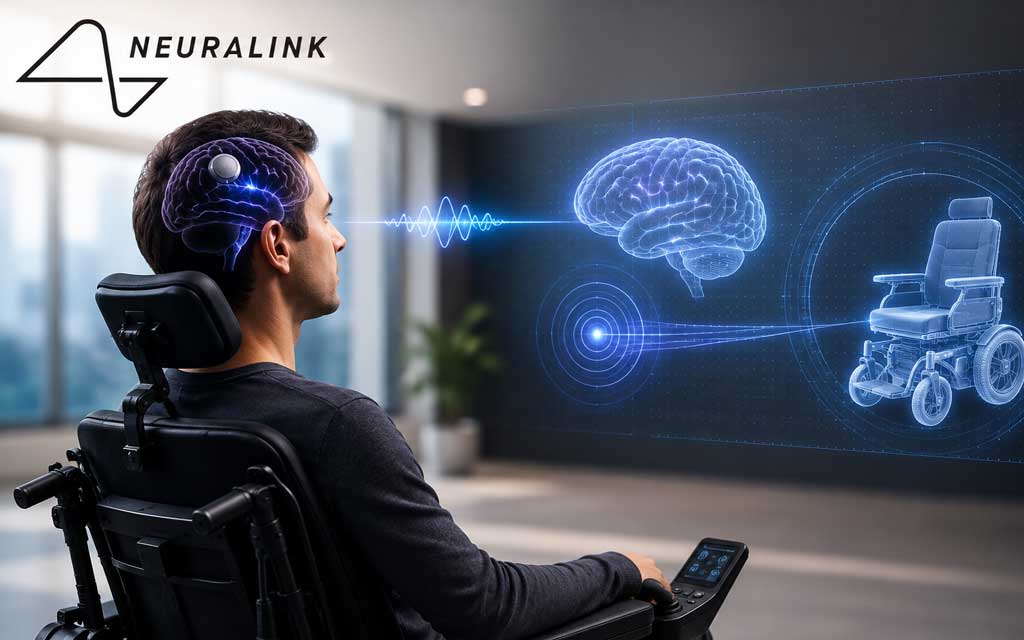
Neuralink clinical trial participants with paralysis control powered wheelchairs via brain implants in a major 2026 milestone. Details on the technology, trial progress, and implications for autonomy.
In a significant advance for brain-computer interfaces, Neuralink has demonstrated clinical trial participants with paralysis independently driving powered wheelchairs using only their thoughts. Shared around July 23, 2026, the update highlights how the company’s N1 implant enables real-world mobility control beyond computer cursors and robotic arms.
How the Thought-Controlled Wheelchair Works
Participants with the Neuralink implant (typically placed in the motor cortex) generate movement intentions that electrodes detect as neural signals. A machine-learning model decodes these signals in real time and converts them into wheelchair commands:
- Forward and reverse movement
- Steering left/right
- Seat adjustments
Many participants view a live video feed from a camera mounted on the wheelchair, allowing them to navigate while controlling direction with their thoughts. This builds directly on earlier successes in cursor control, smartphone use, and robotic arm operation.
Neuralink executive Shivon Zilis has described the capability as an early step toward greater physical autonomy for people with severe paralysis.
Clinical Trial Context
Neuralink’s PRIME study and related trials focus on individuals with quadriplegia from spinal cord injury or ALS. As of early 2026, the company reported more than 20 participants enrolled across multiple countries, with numbers continuing to grow. No serious device-related adverse events have been reported in updates, though the technology remains investigational.
Participants have already used the system for daily digital activities (browsing, gaming, posting online) and physical tasks such as feeding themselves with a robotic arm. Wheelchair control represents a meaningful expansion into independent mobility.
Broader Implications
This development advances the field of invasive brain-computer interfaces by showing reliable, multi-degree-of-freedom control of a complex physical device in real environments. Potential benefits include:
- Increased independence for people with high-level paralysis
- Reduced reliance on caregivers for basic mobility
- Foundation for future applications (robotic limbs, advanced prosthetics, or environmental control systems)
Challenges remain, including long-term implant durability, surgical accessibility, cost, regulatory approval pathways, and ensuring equitable access. Neuralink continues refining the implant, surgical robot, and decoding algorithms while expanding trials internationally.
What’s Next
Neuralink is progressing toward broader applications, including speech decoding trials for people with severe speech impairment. Longer-term goals include higher-bandwidth implants and eventual consumer-grade systems, though medical restoration of function remains the current priority.
For individuals living with paralysis, these early results offer tangible hope that thought-controlled mobility is moving from laboratory demonstration to practical reality.
This milestone underscores the rapid progress in neurotechnology and the potential for brain interfaces to restore meaningful autonomy. Stay tuned to vfuturemedia.com for ongoing coverage of Neuralink, brain-computer interfaces, and related AI-driven medical innovations.




Leave a Comment