
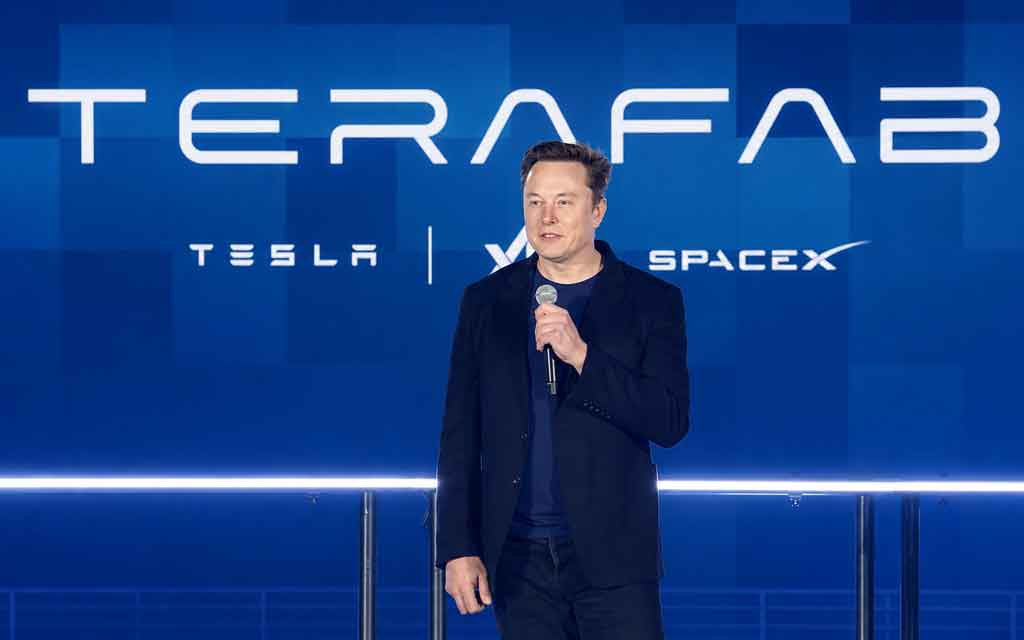
Elon Musk has revealed plans for Terafab, a massive semiconductor fabrication complex that could become one of the largest chip manufacturing facilities ever built. According to the announcement, the project will span roughly 100 million square feet — approximately 10 times the size of Tesla’s Giga Texas — and target an annual output of 1 terawatt of computing power.
The scale is unprecedented in the semiconductor industry and represents a bold vertical integration play by Musk’s companies to secure advanced AI and computing hardware for Tesla, SpaceX, and xAI.
What Is Terafab?
Terafab is a joint initiative involving Tesla, SpaceX, and xAI. It aims to design, manufacture, and package advanced semiconductors in-house rather than relying heavily on external foundries like TSMC or Samsung.
Key details from Musk’s announcements:
- Size: ~100 million square feet total. This dwarfs most existing fabs and even Tesla’s massive Giga Texas factory.
- Output goal: 1 terawatt of AI/compute capacity per year. For context, this is orders of magnitude beyond current global leading-edge chip production capacity when measured in AI-relevant performance.
- Two specialized fabs: One focused on chips for Tesla vehicles and Optimus humanoid robots; another for high-performance chips suited to SpaceX applications (rockets, satellites, and potentially orbital infrastructure).
- Vertical integration: The facility is designed to handle logic chips, memory, and advanced packaging under one roof to accelerate innovation and reduce external dependencies.
Musk has described it as essential for supporting the explosive compute demands of AI training, autonomous systems, robotics, and future space-based data centers.
Location and Development Status
- Austin, Texas area: Initial prototype and advanced technology fab work is planned near Tesla’s existing Giga Texas campus.
- Grimes County, Texas: The full-scale Terafab complex is slated for the former Gibbons Creek Steam Electric Station site. In early June 2026, Grimes County commissioners approved significant property tax incentives to attract the project.
- The project has moved from announcement (March 2026) into early planning and site preparation phases, though Musk and company filings have noted that full timelines, budgets, and binding agreements are still being finalized.
Why This Matters
Terafab sits at the intersection of several major trends:
1. AI Hardware Arms Race The world is facing severe constraints on advanced AI chips. By building its own massive production capacity, Musk’s ecosystem aims to control supply for Tesla’s Full Self-Driving, Optimus robots, and xAI’s large language models.
2. Semiconductor Independence The U.S. has been pushing to reshore advanced chip manufacturing through the CHIPS Act and other incentives. Terafab represents one of the most ambitious private-sector efforts in this direction, potentially producing cutting-edge nodes (reports have mentioned targets around 2nm-class technology).
3. Space + AI Convergence SpaceX’s involvement points toward ambitious ideas like orbital data centers or space-based compute infrastructure. Musk has linked terawatt-scale compute goals to the need for massive space launch capacity (tens of millions of tons to orbit annually) and space-based solar power.
4. Tesla’s Long-Term Ambitions For Tesla, secure access to custom AI chips is critical for scaling Optimus production and advancing autonomy. Owning part of the supply chain could dramatically lower costs and speed up iteration.
Challenges and Skepticism
While the vision is grand, Terafab faces enormous hurdles:
- Capital intensity: Estimates for the full project range from $20–25 billion initially, with some reports suggesting potential costs up to $119 billion across phases.
- Technical difficulty: Building and operating fabs at this scale — especially with advanced process nodes and vertical integration — is extremely complex. Even established players like Intel and TSMC face delays and cost overruns on new facilities.
- Timeline uncertainty: Company filings (including SpaceX-related documents) have indicated that detailed timelines and binding commitments are not yet finalized.
- Energy and infrastructure demands: A terawatt of annual compute output would require enormous amounts of electricity, cooling, and supporting infrastructure.
Critics have noted that the announcement has some “Battery Day” vibes — big, inspiring targets that may take longer and cost more than initially projected.
The Road Ahead
If successful, Terafab could significantly shift the balance of power in AI hardware. It would give Musk’s companies a degree of control over one of the most constrained resources in technology today: advanced semiconductors optimized for AI workloads.
For the broader industry, it adds another major player (alongside TSMC, Samsung, Intel, and others) in the race to expand global chip capacity. It also highlights how AI demand is driving unprecedented investment in manufacturing infrastructure.
Whether Terafab delivers on its ambitious targets remains to be seen, but the announcement underscores Elon Musk’s strategy of building vertically integrated empires across EVs, robotics, AI, and space.
What do you think about the scale of Terafab? Is this the kind of moonshot project needed to advance AI and computing, or overly ambitious? Share your thoughts below.
Stay updated on Tesla, SpaceX, xAI, semiconductors, and the future of AI hardware at vfuturemedia.com.
Tags: Terafab Elon Musk, SpaceX chip factory, Tesla Giga Texas scale, AI semiconductor manufacturing, 1 terawatt compute, xAI Tesla SpaceX joint venture, advanced chip fab Texas 2026




Leave a Comment