
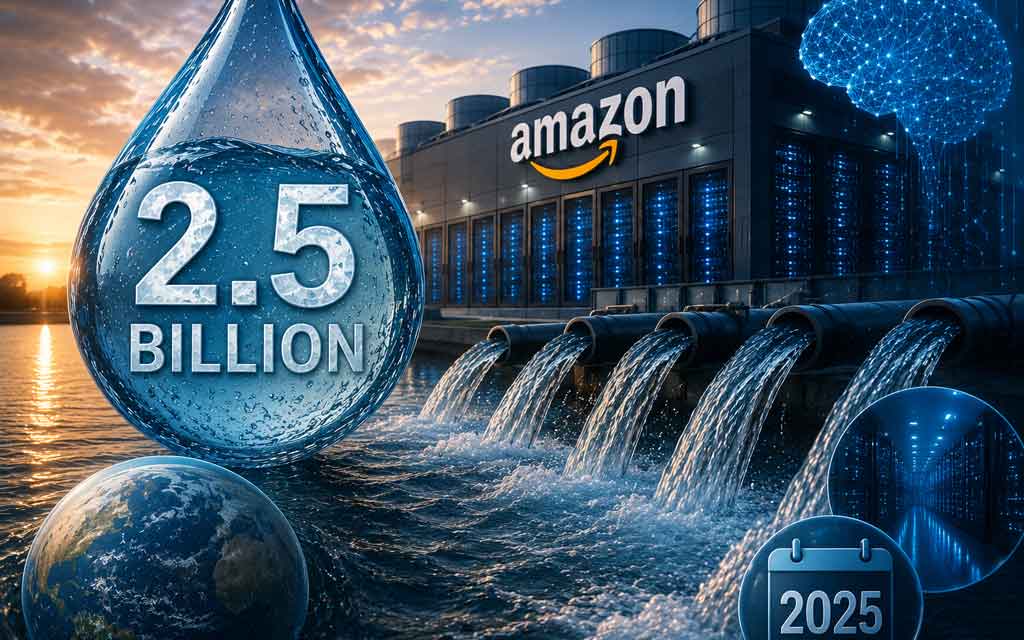
Amazon has disclosed that its data centers consumed approximately 2.5 billion gallons of water worldwide in 2025. The vast majority of this water was used for cooling servers in Amazon Web Services (AWS) facilities.
The figure, revealed in recent sustainability reporting and discussions, highlights the significant resource demands of the cloud computing and AI infrastructure boom.
Why Data Centers Use So Much Water
Data centers generate enormous amounts of heat from thousands of servers running continuously. Most large facilities use evaporative cooling systems, where water is evaporated to remove heat from the air or equipment. A substantial portion of the water is lost to evaporation and must be continuously replenished.
Key points about Amazon’s usage:
- The 2.5 billion gallons figure primarily reflects water used in cooling towers across AWS’s global network.
- Despite rapid growth in computing demand (driven heavily by AI workloads), Amazon reported that direct water withdrawals at its operated sites fell 2% year-over-year.
- Amazon claims strong efficiency, reporting a Water Usage Effectiveness (WUE) of 0.15 liters per kilowatt-hour — significantly better than the industry average.
Amazon’s Water Sustainability Efforts
Amazon has set an ambitious goal of becoming water positive by 2030, meaning it aims to return more water to communities and the environment than it consumes in its data center operations.
Progress and initiatives include:
- Expanding the use of recycled and reclaimed water for cooling. The company plans to use recycled water at more than 120 U.S. data center locations by 2030 (up from 24 previously).
- This shift is expected to preserve over 530 million gallons of fresh drinking water annually in local communities.
- Water replenishment projects that add billions of gallons back into watersheds each year.
- Efficiency improvements in cooling systems and facility design.
By the end of 2024, Amazon reported being about 53% of the way toward its water-positive target.
The Bigger Picture: AI and Data Center Resource Demands
Amazon’s water usage is part of a much larger industry trend. The explosion of AI training and inference is dramatically increasing electricity and water consumption at data centers worldwide.
Recent analyses project that AI-related data centers could consume hundreds of billions of gallons of water annually in the coming years. This has raised concerns in water-stressed regions where new data centers are being built.
Major tech companies (including Amazon, Microsoft, and Google) are under growing pressure from investors, regulators, and communities to improve transparency and reduce their environmental footprint — both in terms of energy and water.
What This Means Going Forward
Amazon’s disclosure of the 2.5 billion gallon figure adds to the ongoing conversation about the hidden costs of cloud computing and AI. While the company is making measurable progress on efficiency and recycled water use, the absolute scale of consumption continues to grow with demand.
For communities near large data center clusters (particularly in Virginia, Arizona, Texas, and other high-growth areas), water usage remains a sensitive local issue.
Amazon and other hyperscalers are responding with a mix of technological improvements (more efficient cooling, liquid cooling, recycled water), site selection strategies, and replenishment projects. Whether these efforts will keep pace with AI-driven demand growth is one of the key sustainability questions facing the tech industry.
Do you think tech companies are doing enough to address data center water usage? Should there be stricter regulations or greater transparency requirements? Share your thoughts in the comments.
For more on technology infrastructure, AI sustainability, cloud computing, and environmental impact of tech, follow vfuturemedia.com.



Leave a Comment