
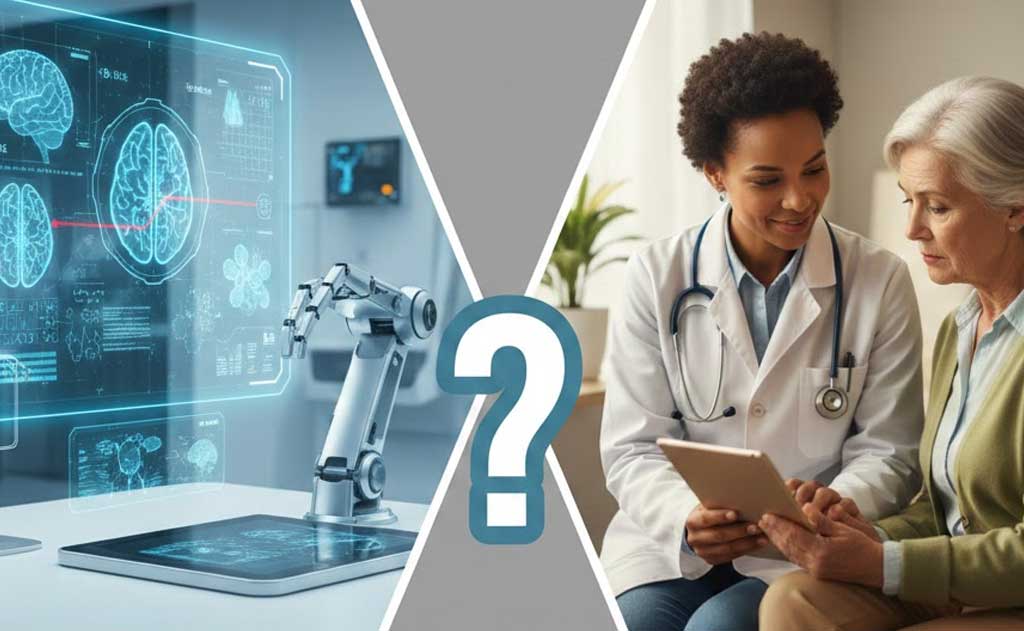
In January 2026, artificial intelligence (AI) has transformed medical diagnostics, moving from experimental tools to clinically deployed systems in hospitals worldwide. While human doctors bring empathy, nuanced judgment, physical examination skills, and holistic patient context, AI excels in processing vast datasets, spotting subtle patterns in images or data, and delivering consistent, fatigue-free analysis. Recent studies from 2025 show AI outperforming or matching specialists in specific areas, particularly image-based and pattern-heavy diagnostics.
This article examines where AI currently surpasses human doctors in diagnostic accuracy, backed by the latest research, while highlighting limitations and the ideal hybrid future. As AI adoption accelerates, understanding these strengths helps patients, clinicians, and policymakers navigate this evolving landscape.
Key Areas Where AI Outperforms or Matches Human Doctors
AI’s edge stems from deep learning models trained on millions of cases, enabling superhuman pattern recognition in structured data like medical images or lab results.
1. Radiology and Medical Imaging (e.g., Lung Nodules, Breast Cancer, Brain Tumors)
Radiology remains one of AI’s strongest domains. AI systems detect abnormalities in X-rays, CT scans, MRIs, and mammograms with remarkable precision.
- In lung nodule detection, AI achieved 94% accuracy in studies from Massachusetts General Hospital and MIT collaborations, far exceeding human radiologists’ 65% in the same tasks.
- For breast cancer screening via mammograms, AI reduces false positives and negatives, catching early cancers more effectively than traditional radiologist reads in multiple 2025 trials.
- Brain tumor radiology reports analyzed by GPT-4-based models showed competitive or superior performance compared to radiologists in real-world cases.
AI processes thousands of images instantly without fatigue, making it ideal for high-volume screening.
(Example: AI-highlighted lung nodule on CT scan — subtle patterns humans might miss under workload pressure.)
2. Diabetic Retinopathy and Ophthalmology Screening
Diabetic retinopathy (DR), a leading cause of blindness in diabetics, benefits hugely from AI. Systems analyze retinal fundus photos or OCT scans to grade severity.
- Google’s DeepMind and similar tools detect DR with 94% accuracy, often outperforming 9 out of 10 specialists.
- IDx-DR (now LumineticsCore) achieves ~87% accuracy, approved for autonomous screening and exceeding many human graders in sensitivity for referable cases.
- 2025 meta-analyses confirm AI sensitivity and specificity comparable to or exceeding clinicians, especially in primary care or resource-limited settings.
In regions like India with high diabetes prevalence, AI enables scalable screening where ophthalmologist shortages exist.
(Retinal image with AI-detected diabetic retinopathy lesions — color-coded for severity.)
3. Dermatology and Skin Cancer Detection
Skin lesion analysis via smartphone photos or dermoscopy images is another AI stronghold.
- Early models (e.g., from 2017 Nature studies) matched dermatologists; by 2025, advanced systems achieve 90%+ accuracy for melanoma and other cancers.
- Google’s 2025 research showed chatbots analyzing images diagnosing rashes and cancers accurately, sometimes surpassing specialists.
- Systematic reviews indicate AI reduces unnecessary biopsies while improving early detection rates.
AI democratizes access: patients upload photos for instant triage, reducing wait times for dermatology consults.
(Dermoscopy image of a suspicious mole with AI overlay identifying melanoma risk.)
4. General Diagnostic Reasoning (Text-Based Cases and Rare Diseases)
Large language models (LLMs) like GPT-4 and successors shine in synthesizing symptoms, histories, and test results.
- In 2025 studies, standalone LLMs scored 85-92% accuracy on complex case vignettes (e.g., NEJM-style challenges), outperforming physicians (often 70-76%).
- Microsoft’s MAI-DxO achieved up to 85% correct diagnoses on challenging NEJM cases — four times higher than human doctors in some benchmarks.
- Generative AI often provides broader differential diagnoses (4-5 options vs. humans’ 1-2), reducing misses of rare conditions.
However, this edge appears more in controlled, text-based scenarios than real-world messy presentations.
Comparative Table: AI vs. Human Diagnostic Performance (Selected 2025 Studies)
Lung Nodule Detection
- AI Accuracy / Sensitivity: 94%
- Human (Specialist) Accuracy: 65%
- Key Advantage for AI: Fatigue-free, high-volume screening
- Source/Reference/Year: MGH/MIT collaboration, 2025
Diabetic Retinopathy
- AI Accuracy / Sensitivity: 87–94%
- Human (Specialist) Accuracy: 80–90% (varies)
- Key Advantage for AI: Scalable in underserved areas
- Source/Reference/Year: Google/DeepMind & IDx-DR updates, 2025
Skin Cancer Detection
- AI Accuracy / Sensitivity: 90%+
- Human (Specialist) Accuracy: 65–85%
- Key Advantage for AI: Superior image pattern recognition
- Source/Reference/Year: Google Health & systematic reviews, 2025
Breast Cancer (Mammogram)
- AI Accuracy / Sensitivity: Up to 90%
- Human (Specialist) Accuracy: 73–78%
- Key Advantage for AI: Fewer false negatives/positives
- Source/Reference/Year: Multiple clinical trials, 2025
Complex Case Vignettes (LLM)
- AI Accuracy / Sensitivity: 85–92% (standalone LLM)
- Human (Specialist) Accuracy: 70–76%
- Key Advantage for AI: Broader differentials, rare diseases
- Source/Reference/Year: NEJM benchmarks, Microsoft MAI-DxO, 2025
General Medical Knowledge
Source/Reference/Year: Multi-national exam comparisons, 2025
AI Accuracy / Sensitivity: Often outperforms specialists
Human (Specialist) Accuracy: Lower in non-pediatric domains
Key Advantage for AI: Vast consolidated knowledge base
These figures highlight AI’s strengths in narrow, data-rich tasks.
Limitations: Where Human Doctors Still Excel
Despite impressive gains, AI has clear weaknesses in 2026:
- Lack of Physical Exam and Context — AI cannot palpate, auscultate, or observe non-verbal cues.
- Bias and Generalization — Models trained on non-diverse data underperform on minorities, rare presentations, or comorbidities.
- Paediatrics and Nuanced Cases — AI struggles with age-specific physiology and developmental variations.
- Hallucinations and Overconfidence — LLMs may invent facts or fail in ambiguous scenarios.
- No Empathy or Shared Decision-Making — Patients prefer human trust; hybrid models build confidence.
- Real-World Integration — Doctors with AI sometimes underperform standalone AI due to “automation neglect” or overriding correct suggestions.
Studies emphasize human-AI collectives achieve the highest accuracy — errors cancel out when systems complement each other.
The Future: Hybrid AI-Human Medicine
As of 2026, the consensus is clear: AI augments, not replaces, doctors. The best outcomes emerge from collaboration:
- AI handles initial screening and pattern detection.
- Humans provide final judgment, ethics, and patient communication.
- Regulatory bodies (FDA, EU AI Act) enforce transparency, bias checks, and human oversight.
Investments in explainable AI, diverse datasets, and clinician training will accelerate progress. For patients, this means faster, more accurate diagnoses — especially in imaging-heavy fields — while preserving the human element essential to care.
AI isn’t “better” overall, but in targeted domains like radiology, ophthalmology, and dermatology image analysis, it frequently diagnoses with superior consistency and speed. The revolution is here — and it’s collaborative.
For more on emerging health tech trends, explore insights at vfuturemedia



Leave a Comment