
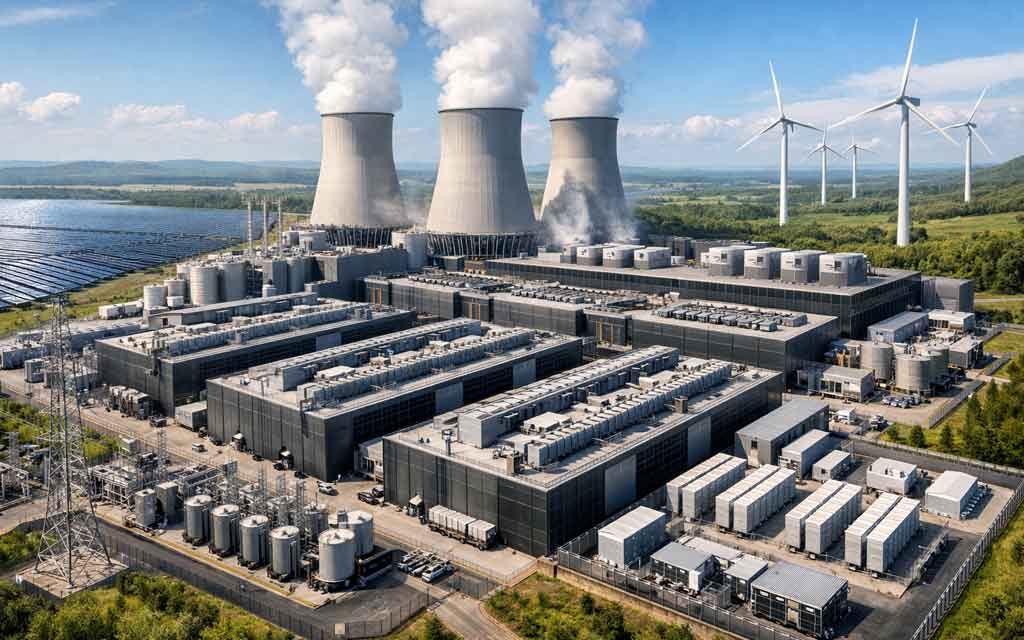
The AI Industry Leaders Pledge to Offset Energy Costs Amid Data Center Boom marks a pivotal moment in balancing explosive AI growth with energy responsibility and consumer protection. As AI adoption accelerates across sectors, the surging power demands of data centers have raised alarms about potential impacts on electricity prices and grid reliability. In early March 2026, a high-profile White House initiative addressed these concerns head-on.
President Donald Trump hosted executives from leading AI and tech firms—including Google (Alphabet), Microsoft, Meta, Oracle, xAI, OpenAI, and Amazon—to sign the Ratepayer Protection Pledge. This voluntary agreement commits these companies to fully fund the energy generation, infrastructure upgrades, and power needs for their expanding data center operations. The goal: ensure that AI-driven electricity consumption does not translate into higher utility bills for American households and small businesses.
This pledge arrives amid projections that data centers could account for a substantial portion of U.S. electricity use in the coming years. Recent analyses indicate data centers consumed around 4.4% of total U.S. electricity in 2023, with estimates suggesting growth to 6.7–12% by 2028, and some forecasts pointing toward nearly 9% by 2030. The rapid scaling of AI infrastructure—fueled by hyperscale cloud providers—is driving much of this surge, prompting utilities, regulators, and policymakers to scrutinize grid capacity and affordability.
The Pledge: Tech Giants Commit to Self-Sufficient Power
Under the Ratepayer Protection Pledge, announced and signed on March 4, 2026, the participating companies agreed to several key commitments:
- Build, bring, or buy dedicated power generation capacity for new data centers.
- Cover 100% of the costs for electricity and related infrastructure upgrades.
- Negotiate rate structures with utilities at the state level.
- Prioritize local hiring and community benefits where facilities are built.
- Explore efficiency measures and grid-strengthening actions to benefit broader energy systems.
President Trump framed the initiative as a win for consumers, stating that these “massive companies” would fund a “colossal expansion of U.S. energy” without passing costs to ratepayers. White House officials emphasized that the pact aims to protect Americans from price hikes while advancing technological leadership in AI.
The agreement responds to growing public and political pressure over rising utility bills, partly attributed to data center buildouts in key regions like Virginia and Texas. By shifting the financial burden to tech firms, the pledge seeks to decouple AI expansion from household energy affordability concerns.
Critics note that details on enforcement, timelines, and exact mechanisms remain limited, with implementation largely depending on state-level negotiations and voluntary compliance. Nonetheless, many companies had already pursued similar strategies—such as Microsoft and Google investing in nuclear restarts or dedicated renewables—making the pledge a formalization of existing trends.
Broadcom’s Bold AI Chip Revenue Forecast
The AI boom’s hardware side is equally explosive. During Broadcom’s recent earnings call, CEO Hock Tan projected that the company’s AI-related chip revenue could exceed $100 billion by 2027—potentially “significantly” higher. This forecast underscores surging demand for custom AI accelerators, networking solutions, and specialized semiconductors.
Broadcom reported strong quarterly results, with AI revenue more than doubling year-over-year, driven by custom chips and optical networking investments. Tan highlighted improved visibility into 2027 demand, with supply chains secured to support massive scaling. This positions Broadcom as a key beneficiary alongside leaders like NVIDIA, as hyperscalers race to build out compute capacity.
The projection reflects broader industry momentum: AI workloads require immense processing power, fueling investments in advanced chips that optimize efficiency and performance.
Shifts in AI Adoption: Claude Gains Ground
User preferences are shifting amid ethical and competitive dynamics. Anthropic’s Claude has seen a remarkable surge, briefly claiming the No. 1 spot on Apple’s U.S. top free apps chart in late February/early March 2026, surpassing OpenAI’s ChatGPT.
This rise followed public backlash over OpenAI’s reported contracts or engagements with defense-related entities, contrasted with Anthropic’s emphasis on safeguards and ethical AI deployment. Reports indicate Claude’s free users grew over 60% since January, with daily sign-ups tripling in recent weeks and paid subscribers more than doubling.
App store data from Sensor Tower and others showed Claude climbing rapidly, fueled by user migrations highlighting preferences for models perceived as more aligned with responsible development. Debates over AI’s military applications continue to influence adoption, illustrating how ethics, performance, and public perception shape the competitive landscape.
Big Tech’s Massive AI Investments
The scale of commitment is staggering. According to Bridgewater Associates, Alphabet, Amazon, Meta, and Microsoft are projected to collectively invest around $650 billion in AI infrastructure in 2026—up sharply from approximately $410 billion in 2025.
This escalation supports data centers, advanced chips, cloud expansion, and model training. Amazon leads with aggressive capex plans for AWS, while Google, Meta, and Microsoft follow suit in hyperscale buildouts. Bridgewater describes this phase as “more dangerous,” noting reliance on external capital, potential inflationary pressures, and risks if returns lag expectations.
Yet, these investments are driving breakthroughs in efficiency, multimodal AI, and enterprise applications, adding momentum to U.S. economic growth through compute demand.
Broader Implications and the Path Forward
The pledge, revenue forecasts, user shifts, and massive investments highlight AI’s dual nature: transformative potential alongside real challenges in energy, ethics, and economics. By committing to self-funded power, tech leaders aim to sustain innovation without compromising affordability or grid stability.
As AI integrates deeper into daily life and industry, responsible scaling—through renewables, nuclear, efficiency gains, and policy alignment—will be essential. This moment underscores that technological leadership and sustainability can coexist.
Join the AI Conversation
Dive deeper into these trends with our exclusive webinar series on vfuturemedia. Register today for expert panels exploring the future of intelligent tech, energy strategies, and investment opportunities in the AI ecosystem!
About the Author: Ethan Brooks Ethan Brooks is a US-based tech journalist with experience analyzing AI trends and societal impacts.
Ethan Brooks covers the tech that’s reshaping how we move, work, and think — for VFuture Media. He was at CES 2026 in Las Vegas when the world got its first real look at humanoid robots, AI-powered vehicles, and Samsung’s tri-fold phone. He writes about AI, EVs, gadgets, and green tech every week. No hype. No filler. X · Facebook



Leave a Comment