
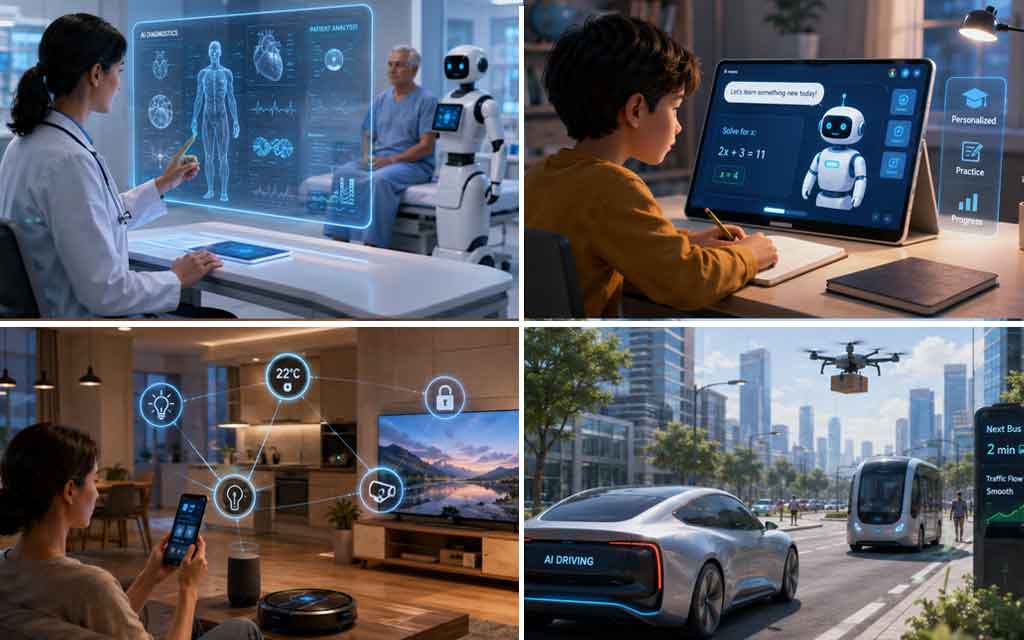
May 7, 2026 — Forget the sci-fi hype. In 2026, AI isn’t coming for your job or your privacy — it’s quietly showing up in the kitchen, the car, the doctor’s office, and the classroom, making ordinary American lives smoother, safer, and smarter. Nearly half of us now use AI weekly, from summarizing emails to catching health issues before symptoms appear.
At VFuture Media, we believe the real story isn’t about robots taking over — it’s about how everyday Americans are using AI wisely to reclaim time, reduce stress, and live better. Here are six true-to-life stories from across the country that show exactly how AI is transforming daily life in America right now.
1. The Suburban Mom in Texas Who Never Misses Dinner (or a Health Warning)
Meet Jessica Ramirez, 38, a working mom of three in Austin. Last year, her family’s chaotic evenings felt impossible. Now? Her AI-powered smart home assistant scans the fridge via camera, checks everyone’s schedules, and suggests personalized recipes based on dietary needs and what’s in season. “It literally told me my daughter’s iron levels looked low from her wearable data and suggested a quick spinach smoothie recipe,” Jessica says.
The wise takeaway for Americans: AI isn’t replacing family dinner — it’s protecting it. By handling the small stuff (grocery lists, meal prep, even kid-friendly variations), it gives parents back the one thing money can’t buy: presence.
2. The LA Commuter Who Finally Beats Traffic (and Stress)
David Chen, a 42-year-old marketing manager in Los Angeles, used to dread his 90-minute nightmare commute. In 2026, he hops into a Waymo robotaxi that knows his calendar, predicts traffic in real time, and reroutes automatically. The AI even suggests a 10-minute power nap or podcast based on how his smartwatch reads his stress levels. “I arrive calmer and more productive than ever,” David shares. Autonomous miles logged nationwide now top hundreds of millions, with crash rates dramatically lower than human drivers.
The wise takeaway: Americans waste years stuck in traffic. AI isn’t just faster — it’s giving us back our sanity and time for what actually matters: family, hobbies, and rest.
3. The Retiree in Florida Whose AI “Doctor” Caught Cancer Early
Retired teacher Margaret Thompson, 67, in Miami, wears a sleek AI health tracker every day. One morning it flagged irregular heart rhythms and suggested she see her doctor — who confirmed early-stage atrial fibrillation. “The AI also summarized my test results in plain English and helped me prepare questions for the cardiologist,” Margaret says. Across America, AI is helping doctors spot diseases faster than ever before.
The wise takeaway for Americans: AI doesn’t replace your doctor — it empowers you to be your own best advocate. In a country where healthcare costs keep rising, early detection through everyday wearables is one of the smartest (and most American) ways to stay independent longer.
4. The Freelancer in Chicago Mastering Work-Life Balance
Freelance graphic designer Alex Rivera, 29, used to drown in client emails and admin work. Now his AI agent handles scheduling, summarizes long contracts, drafts invoices, and even flags when he’s been sitting too long and suggests a walk. “It feels like I gained a super-smart assistant who never sleeps — but I still make the final creative calls,” Alex laughs. Productivity tools like this are now standard for millions of American workers.
The wise takeaway: The American work ethic is legendary. AI isn’t making us lazy — it’s making hard work sustainable so we can focus on what humans do best: create, connect, and innovate.
5. The High-School Student in Denver Building Her Future
Sophomore Maya Patel, 15, in Denver struggled with math until her AI tutor adapted lessons to her exact learning style — visual explanations, instant feedback, and bite-sized practice that matches her attention span. “It feels like having a patient teacher who never gets tired,” Maya says. Teens across the U.S. now use AI daily for schoolwork, summarizing videos, and creating study aids.
The wise takeaway for American families: Education has always been the great equalizer. AI levels the playing field by personalizing learning for every kid — no matter their zip code or learning speed.
6. The Small Business Owner in Rural Nebraska Staying Competitive
Farmer and shop owner Tom Whitaker, 54, in rural Nebraska uses AI to optimize irrigation based on weather data, predict crop yields, and even handle customer service chatbots for his online store. “Last season it saved me thousands on water bills and helped me ship fresher produce faster,” Tom explains. AI isn’t just for tech hubs anymore — it’s powering Main Street America.
The wise takeaway: The American Dream was always about hard work and ingenuity. AI gives small-town entrepreneurs the same superpowers once reserved for Silicon Valley giants.
The Bigger Picture: AI in American Life Is What We Make of It
These stories aren’t exceptions — they’re becoming the new normal for 2026 America. From smart homes that anticipate your needs to AI agents that free up your time, the technology is here to serve us.
But here’s the truly wise part for every American: AI is a tool, not a replacement. Use it to amplify your strengths, protect your health, and create more space for the human things that matter — relationships, creativity, community, and purpose. Guard your privacy, question the output, and keep humans in the loop. That’s how we stay ahead.
What AI story from your own life would you add? Drop it in the comments below.
Stay ahead of the future at VFuture Media — your go-to source for real stories about AI, technology, and the American way of life in 2026 and beyond. Subscribe for weekly updates on how innovation is shaping our daily lives.
Keywords: AI use cases in everyday American life 2026, how AI is changing daily life in America, real AI stories USA, transformative AI applications 2026, AI in healthcare finance transportation education home



Leave a Comment