
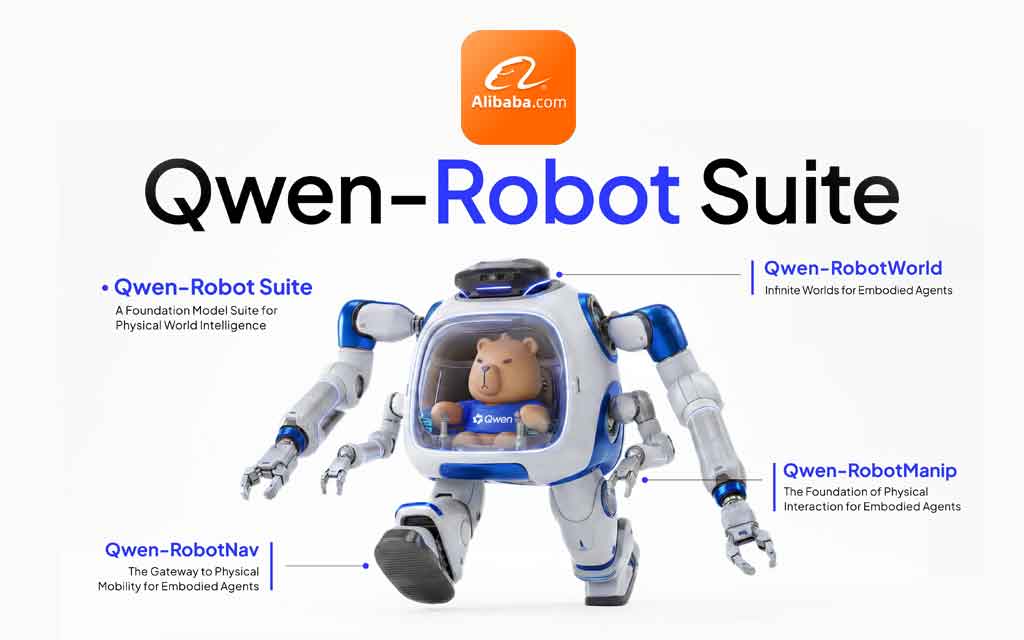
Chinese tech giant Alibaba has unveiled its first dedicated suite of AI models designed specifically to power robots. The Qwen-Robot Suite gives machines specialized “brains” for navigation, object manipulation, and understanding real-world environments.
The announcement, made in mid-June 2026, represents Alibaba’s strongest push yet into embodied AI — the field focused on AI systems that can perceive, reason, and act in the physical world rather than just process text or images.
What Alibaba Announced
The Qwen-Robot Suite includes three core models:
- Qwen-RobotNav: Handles mobility and navigation tasks. Robots can follow natural language instructions, navigate complex environments, and perform tasks like autonomous driving or warehouse movement.
- Qwen-RobotManip: Specializes in physical interaction and object manipulation. Trained on over 38,100 hours of robotic data, it enables precise handling across different robot types and form factors.
- Qwen-RobotWorld: Focuses on scene understanding and future prediction. It can generate realistic video predictions of how environments and objects will behave.
These models are built on Alibaba’s strong Qwen vision-language foundation and leverage massive open datasets. Early benchmarks show strong results, including a 76.5% success rate in navigation tasks and 45% in complex manipulation challenges.
The suite is currently undergoing pilot testing with selected Alibaba Cloud enterprise clients and has already been deployed on robots such as the Unitree Go2.
From Chatbots to Physical Action
The launch comes as China’s tech industry shifts focus from conversational AI (chatbots) toward AI agents that can take real-world actions. Alibaba is positioning its robotics AI as a natural extension of its existing strengths in e-commerce logistics, cloud computing, and large language models.
By developing specialized models for different robotic functions, Alibaba aims to make it easier for companies to build intelligent robots for:
- Warehousing and logistics
- Manufacturing automation
- Last-mile delivery
- Service and inspection robots
This move also aligns with Alibaba’s broader strategy of applying AI across its ecosystem, from supply chain optimization to smart retail.
Context: RynnBrain and Embodied AI Momentum
This is not Alibaba’s first foray into robotics AI. In February 2026, the company’s DAMO Academy research arm released RynnBrain, an open-source embodied AI foundation model family. RynnBrain was designed as a general “brain” for robots and reportedly outperformed Google’s Gemini Robotics ER 1.5 on multiple benchmarks.
The new Qwen-Robot Suite builds on that foundation with more task-specific models, showing Alibaba’s commitment to both foundational research and practical robotic applications.
Why This Matters
Alibaba’s entry intensifies the global race in embodied AI and robotics. Key implications include:
- China’s growing strength: China already leads in industrial robotics deployment. Adding advanced AI “brains” could accelerate its advantage in intelligent automation.
- Enterprise adoption: Integration with Alibaba Cloud makes these models accessible to businesses already using the company’s infrastructure.
- Competition: Alibaba joins other major players pushing embodied AI, including Google, Nvidia, Tesla (with Optimus), Figure, and various Chinese robotics firms.
- Shift toward action: The industry is moving beyond language models that only talk to systems that can see, move, and interact with the physical world.
Experts note that China’s vast real-world data from manufacturing and logistics gives it a potential edge in training effective robotic AI systems.
Challenges Ahead
While the technical progress is significant, challenges remain:
- Bridging the gap between simulation/training data and real-world performance
- Ensuring safety and reliability in unstructured environments
- Cost-effective hardware integration
- Regulatory and ethical considerations around autonomous machines
Alibaba will need to prove that its models can deliver consistent results outside controlled pilot environments.
Outlook
Alibaba’s Qwen-Robot Suite signals that the company sees robotics and embodied AI as a major growth area alongside its core e-commerce and cloud businesses. By open-sourcing elements and integrating with its cloud platform, Alibaba is aiming to become a key enabler in the emerging robotics ecosystem — not just in China, but globally.
As robots move from factories into warehouses, homes, and public spaces, the companies that provide the best “AI brains” stand to play a central role in the next phase of automation.
The race to build truly intelligent, physically capable machines is heating up — and Alibaba has now placed a clear bet on being a major player.
Key Takeaways
- Alibaba launched the Qwen-Robot Suite with specialized models for navigation, manipulation, and world modeling.
- The models are being piloted with Alibaba Cloud clients on real robots like Unitree Go2.
- This marks Alibaba’s push into embodied AI and physical-world agents.
- It builds on the earlier RynnBrain embodied model released in February 2026.
Sources: Reuters, Interesting Engineering, Alibaba announcements, and industry reporting as of June 2026.




Leave a Comment